Train ticket sales for 2026 chunyun begin Monday, with 539m trips expected: railway operator
By Published: Jan 18, 2026 11:05 PM

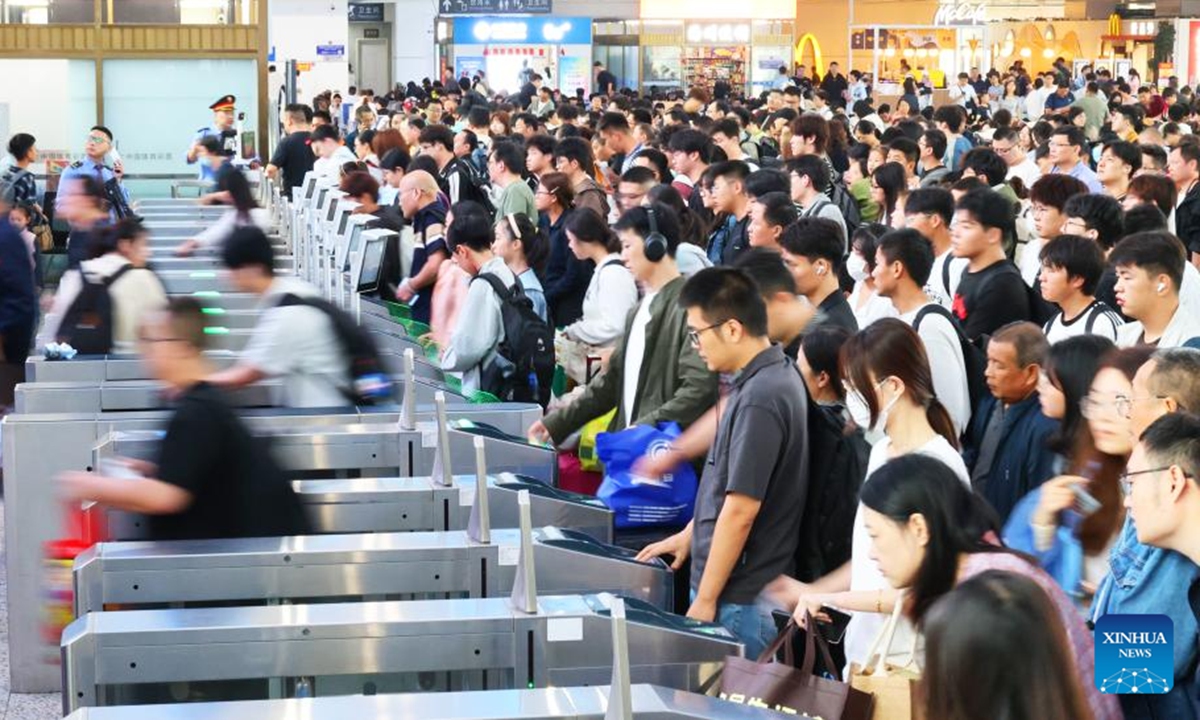
People enter the Lianyungang Railway Station in Lianyungang, east China's Jiangsu Province, Oct. 7, 2025. As the National Day and Mid-Autumn Festival holiday is drawing to a close, return travel flows increase across the country. (Photo by Geng Yuhe/Xinhua)
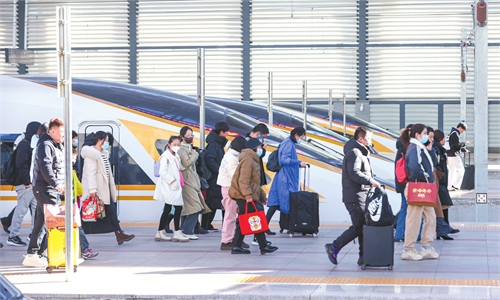
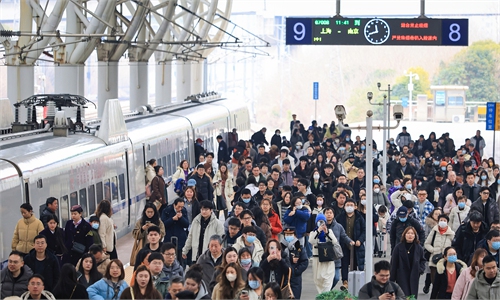
During the 2026 Spring Festival travel rush, or chunyun, the number of passengers transported by the national railway system is expected to exceed 539 million, which would be a 5 percent increase compared with 2025, according to a forecast by China's state railway operator on Sunday.
As the Spring Festival draws near, Chinese travelers are set to pack into cars, trains and planes, kicking off the landmark chunyun, the world's largest annual human migration.
The 40-day travel period is set to begin on February 2 this year and continue through March 13 while train tickets for the first day of the chunyun period will be available for sale starting on Monday, China State Railway Group Co said in a statement sent to the Global Times on Sunday.
The company expects the passenger travel peaks will fall on February 13 before the Spring Festival, while the peak for the reverse journey will likely fall on February 23.
China State Railway Group Co plans to operate more than 14,000 passenger trains daily during peak periods, providing an additional 5.3 percent seats per day.
The company said that it planned to increase transport capacity for key cities such as Beijing, Shanghai, Guangzhou and Shenzhen in South China's Guangdong Province, Chengdu in Southwest China's Sichuan Province and Wuhan in Central China's Hubei Province.
There will also be added transport capacity for tourist hotspot cities such as Harbin in Northeast China's Heilongjiang Province and Qingdao in East China's Shandong Province.
To effectively to boost cross-boundary tourism, special efforts will be made to ensure the smooth operation of the Guangzhou-Shenzhen-Hong Kong high-speed railway and international passenger trains between China and Laos, Mongolia, Russia, and Vietnam.
In addition to visiting family and friends, the chunyun period coincides with the winter vacation for school students and is a peak period for travel.
Online travel giant Qunar said in a statement sent to the Global Times on Sunday that it expects three travel peaks from last week to January 24, when most schools in the country send students on vacation.
The nine-day Spring Festival holidays, which will be the longest holiday period so far this year, will serve as a catalyst for a travel boom in January and February. Data from Qunar showed that as of January 14, hotel bookings in key travel cities including Beijing, Guangzhou, Shanghai, and Fuzhou in East China's Fujian Province had increased by 70 percent year-on-year.
Sun Chuanwang, a professor at Xiamen University, told the Global Times on Sunday that this year's Spring Festival holidays cover nine days, and the extended break is significantly boosting demand for medium- to long-distance travel and deep, immersive tourism experiences, with taking two or more trips emerging as a new trend.
Meanwhile, local governments or platforms are expected to introduce consumption stimulus policies, focusing on optimizing or innovating consumption scenarios, tapping into local resources, and creating differentiated experiences to better meet consumers' demand for high-quality services, Sun said.
Overall, the 2026 Spring Festival consumption market is anticipated to be dynamic, driven by the extended holiday period, policy support, and evolving consumption attitudes, noted Sun.
The 2025 chunyun saw a record high of 9.02 billion passenger trips in the 40-day period, including 510 million trips made by rail, 90.2 million by air, and 7.17 billion by car.
RELATED ARTICLES