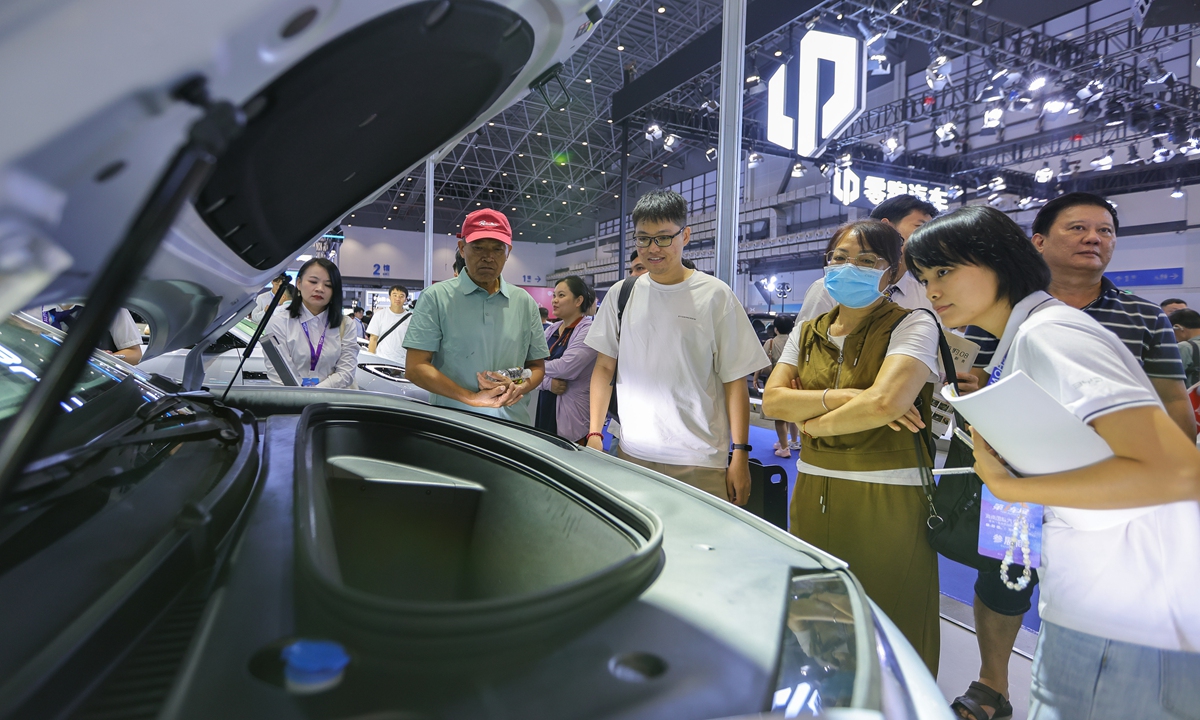
Visitors check out the front trunk of a new energy vehicle at the 2026 Hainan International Auto Expo and the 8th Hainan International New Energy Vehicle Exhibition in Haikou, South China's Hainan Province, on July 9, 2026. Photo: VCG
China proposed stricter oversight of automakers' innovative designs and auto-related testing activities on Saturday, raising specific testing and validation requirements for virtual controls, door handles, new human-machine interactions and large-angle seats.
From January 1, 2027, automakers seeking approval for new models must submit more technical details on innovative designs. Models that are poorly tested or backed by false data will be rejected, according to a draft document released by the Ministry of Industry and Information Technology and three other agencies.
For vehicles that have already been granted approval, manufacturers shall supplement the submission of the relevant technological parameters and validation materials before July 1, 2027.
Technological service institutions shall conduct in-depth assessments of product-related safety hazards, emission risks, and other relevant circumstances, and strictly enforce tech review of innovative automotive designs.
Regarding the tightening of technical requirements for product R&D testing and validation, the draft proposes that automobile manufacturers shall also complete testing and validation in areas such as comprehensive reliability and durability, structural reliability, software functional reliability, environmental adaptability, heating and cooling, and protective performance and sealing, in accordance with the technical specifications for automotive product R&D testing and validation.
During the product R&D and design stage, they shall conduct failure mode analyses of the relevant innovative designs under complex operating conditions and extreme scenarios, fully identify potential safety risks, and assess innovative designs that fail to meet standards, which shall not be installed or applied in vehicles.
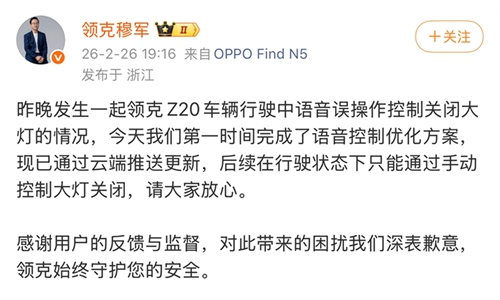
In detail, the draft bans fully hidden door handles and foldable or flexible displays. It also prohibits the use of "zero-gravity" or swivel seats while driving, and requires that key functions such as lights and wipers retain physical controls.
The China Association of Automobile Manufacturers (CAAM) welcomed the draft, saying that it firmly supports the measure and has issued an initiative to the entire industry to comprehensively raise the safety level of China's automotive products.
It said that China's auto industry is accelerating electrification and intelligentization, with rapid product innovation and widespread application of new technologies and functions. Unreasonable designs that pursue innovation gimmicks while ignoring safety, along with inadequate R&D testing and validation, have created hidden risks for product safety, market reputation, and high-quality industrial development, according to the official website of the CAAM on Saturday.
On August 21, the official website of State Administration for Market Regulation showed that several automakers were recalling multiple vehicle models over issues related to in-vehicle emergency mechanical door releases, including Chery, Geely, XPeng, Leapmotor, Tesla and Xiaomi.
These recalls were due to problematic features including in-vehicle emergency mechanical door releases that are similar in color to the interior trim, making them difficult to identify and operate. In extreme situations, such as when a severe collision causes the vehicle's low-voltage system to fail, this may prevent occupants from quickly opening the doors to flee and hinder rescue efforts by people outside the vehicle, posing a safety hazard.
Global Times
RELATED ARTICLES