Fatal expressway crash involving assisted-driving system sparks debate over driver responsibility
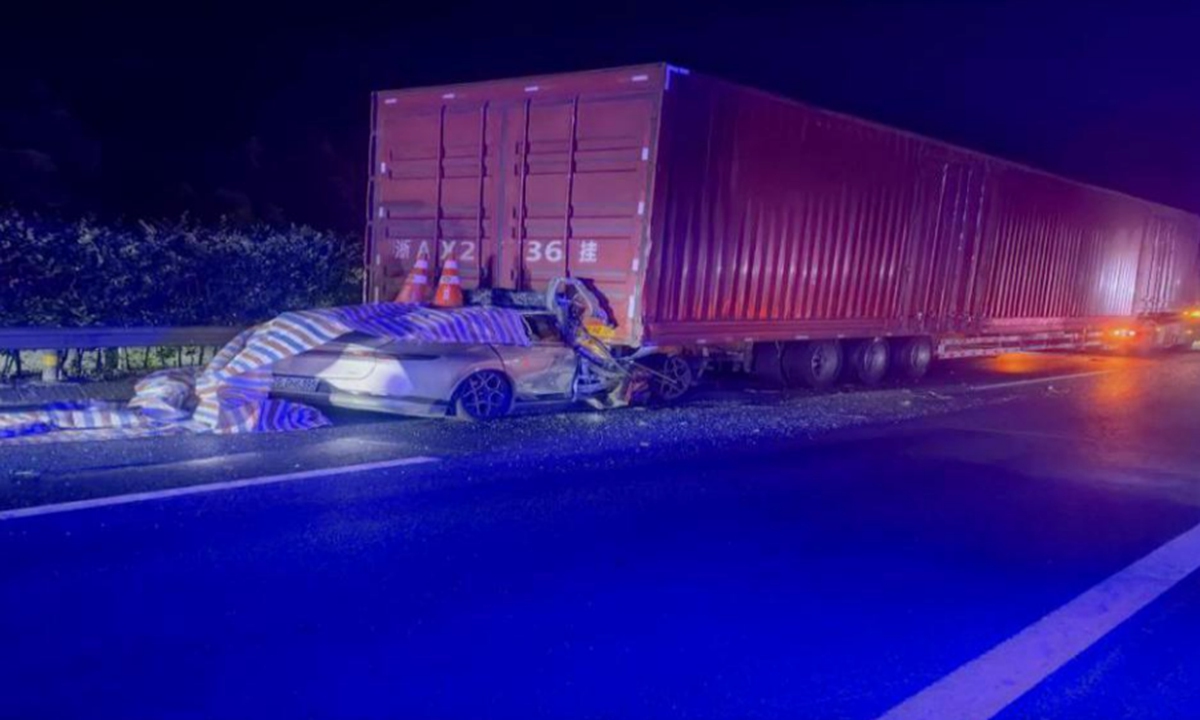
Vehicles involved in the fatal expressway crash in Ruijin, East China's Jiangxi Province, on October 2, 2025 Photo: Screenshot from an investigation report released by the Ganzhou Emergency Management Bureau
A traffic accident investigation in East China's Jiangxi Province found that a driver activated an assisted-driving system and took his hands off the steering wheel just minutes before a fatal expressway crash that claimed three lives. The report cited driver distraction and a disabled truck stopped in a traffic lane as major contributing factors. The case has sparked online debate over the limits of assisted-driving technology and the importance of drivers remaining fully attentive behind the wheel.
The report showed that a sedan collided with a heavy truck on the Jinan-Guangzhou Expressway in Ruijin, Jiangxi Province, on October 2, 2025, killing three people on board.
Investigations showed that the crash was caused by the car driver becoming distracted and colliding with a disabled tractor-trailer that had stopped in a traffic lane. The accident was classified as a production safety liability incident.
The passenger vehicle involved in the accident was a Changan Qiyuan. The truck, meanwhile, was composed of a heavy-duty tractor unit and a heavy-duty container semi-trailer.
At about 3:41 am on October 2, 2025, the truck driver, surnamed Tan, was traveling on the Jinan-Guangzhou Expressway when his vehicle began slowing down while overtaking another truck and eventually stalled in the left lane. After several unsuccessful attempts to restart the vehicle, Tan contacted his fleet operator for assistance and placed four warning cones behind the disabled truck to alert approaching traffic.
At 3:54 am on October 2, Zhang drove a passenger car onto the expressway after leaving the Ningdu East service area. At 3:59:34 am, Zhang activated the vehicle's intelligent driving assistance system and removed his hands from the steering wheel.
At around 4 am, while traveling southbound near the 1,408 km+721 m mark of the expressway, the car collided with a disabled tractor-trailer that had come to a stop in the left lane. The crash killed all three occupants of the passenger car and caused damage to both vehicles.
The investigation found that the truck driver was operating a vehicle that did not meet technical safety standards. After the vehicle broke down, it remained stopped in an expressway traffic lane, while the driver failed to properly set up warning signs and promptly report the incident -a key contributing factor in the crash.
The investigation found that Zhang failed to detect road conditions ahead and take effective evasive action in a timely manner while using the vehicle's intelligent driving assistance system on the expressway at night, making it another major contributing factor in the tragedy.
The accident has sparked widespread discussion online. Some netizens questioned the truck driver's actions, asking why proper warning signs were not set up and why the incident was not promptly reported after the vehicle broke down.
Others used the case to caution against overreliance on assisted-driving systems. "Don't hand your life over to assisted driving," one Weibo user wrote. "Drivers must always take full responsibility for their own safety."
According to the investigation, Zhang was found directly responsible for the accident. As he was killed in the crash, he was exempted from further liability proceedings.
The investigation showed that Tan also bore direct responsibility for the accident, and criminal coercive measures have been taken against him by judicial authorities.
The report also noted that Yunyiyunqing (Yangzhou) Transportation Co operated a vehicle with major safety hazards, transported oversized cargo without approval, and failed to implement safety training and vehicle monitoring requirements. It recommended that the Ganzhou Emergency Management Bureau impose administrative penalties on the company in accordance with the law.
The investigation found that Xiamen Shunyuantai Trading Co had illegally modified a registered container semi-trailer through a repair shop for commercial gain and leased the vehicle, which posed major safety risks, to a transportation company for operation. The report recommended that local transportation authorities impose administrative penalties on the company in accordance with the law.
The report recommended that three public officials involved in matters related to the accident be referred to the relevant authorities for accountability, in accordance with personnel management procedures.
Liu Dingding, a technology industry observer, told the Global Times that while advanced driver-assistance systems have become increasingly capable and can handle complex driving scenarios with minimal intervention, the technology remains far from perfect. He noted that such systems may outperform humans in some situations but can still fail to recognize certain road hazards or misinterpret traffic conditions, which is why drivers are still required to keep their hands on the wheel and remain attentive at all times.
Liu said some automakers have aggressively marketed the strengths of assisted-driving technologies while giving insufficient attention to their limitations, leading some consumers to place excessive trust in the systems. He warned that treating assisted-driving features as fully autonomous driving could create serious safety risks, particularly when drivers reduce their vigilance on highways.
At the same time, Liu noted that China has been steadily improving regulations, testing frameworks and supporting infrastructure for intelligent driving technologies. The adoption of advanced sensors, including lidar and millimeter-wave radars, as well as the development of vehicle-road coordination systems, is helping create a safer environment for the industry's long-term development.
RELATED ARTICLES