Chinese flavors race to win Southeast Asia's 700 million consumers, with strengths in supply chains, localization
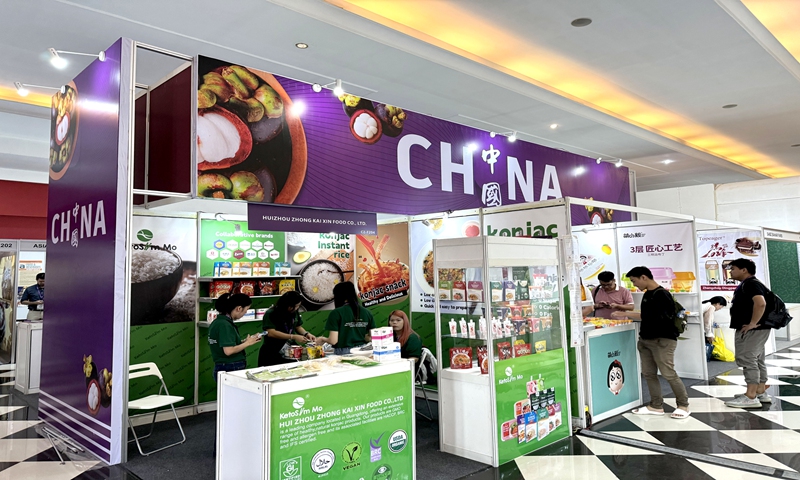
Chinese companies attend an Indonesian food expo. File photo: VCG
From spicy hotpots and malatang to freshly brewed milk tea and packaged snacks, Chinese flavors are finding their way onto dining tables and store shelves in Southeast Asia, as a growing number of Chinese food and beverage brands seek to turn the region's appetite for new tastes into opportunities for expansion.
Home to nearly 700 million consumers and with its economy projected to grow 4.5 percent in 2026, ASEAN market is an important battleground for Chinese, Japanese and South Korean food brands. As competition intensifies, Chinese companies are seeking to stand out, relying on efficient supply chain, competitive pricing and products tailored to local taste.
And, some have noted that, rather than relying solely on exports, more Chinese companies are investing in Southeast Asia, forging distribution networks and local partnerships.
New recipe for competition
Southeast Asia's growing consumer market has attracted food companies from East Asia, with Japanese and South Korean brands already benefiting from years of overseas expansion.
In June, South Korea's Lotte Group announced plans to launch a joint venture in Singapore in November to integrate the Asian operations of its Korean and Japanese food businesses, marking a major step in Chairman Shin Dong-bin's "One Lotte" strategy aimed at building up the group's competitiveness, according to The Korea Times.
Generally speaking, South Korean food brands benefit from the international popularity of Korean pop-culture. A survey released by South Korea's Ministry of Agriculture, Food and Rural Affairs earlier this year showed that South Korean food brands operated 4,644 overseas outlets across 56 countries and regions at the end of 2025.
For Chinese food companies, competing with these established players calls for a different set of strengths.
Wang Hanyi, a research fellow at the China-UK Center for Cultural Exchange at Shanghai International Studies University, told the Global Times that although Chinese food brands own less of a first-mover advantage than their Japanese and South Korean counterparts in the ASEAN market, their competitiveness increasingly stems from China's supply-chain efficiency and structural advantages.
China's well-developed food manufacturing system allows companies to integrate raw material sourcing, product development and large-scale production, Wang said. Combined with regional trade arrangements and cross-border logistics networks, these strengths help lower costs and improve supply flexibility, particularly in categories such as snacks, frozen foods and condiments.
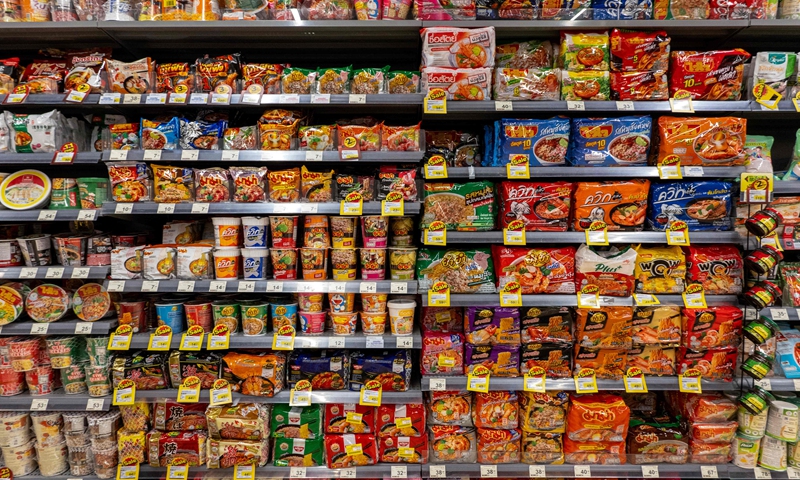
Packages of instant noodles are displayed for sale at a supermarket in Bangkok on December 15, 2025. Photo: VCG
Another advantage lies in the adaptability of Chinese food products.
Wang noted that Chinese companies have strengths in producing flavor-driven, affordable foods, including sweet and spicy products and ready-to-eat snacks that appeal to younger Southeast Asian consumers. Geographical proximity and similarities in food culture also make it easier to adjust ingredients and flavors according to local preferences.
The growing commercial links between China and ASEAN provide a broader foundation for such expansion.
China-ASEAN merchandise trade reached 5.95 trillion yuan ($888.7 billion) in the first eight months, up 20.6 percent year-on-year, with ASEAN remaining China's largest trading partner, accounting for 17 percent of the country's total foreign trade during the period, according to China's General Administration of Customs.
Agricultural trade also highlights the close links between the two markets. According to the China Chamber of Commerce of Import and Export of Foodstuffs, Native Produce and Animal By-Products, China's agricultural trade with ASEAN reached $26.68 billion in the first five months, rising 13.6 percent year-on-year. This accounted for more than 5 percent of total China-ASEAN trade.
From January to May, Chinese agricultural exports to ASEAN totaled $9.26 billion, with exports of meat and meat products jumping 63.7 percent and feed exports increasing 56.1 percent.
For Chinese businesses, Wang said, competitive advantages extend beyond manufacturing costs to their ability to respond quickly to shifting consumer demand and establish local partnerships. Through joint ventures and acquisitions, Chinese companies can gain access to established distribution channels and local resources, accelerating their expansion.
Building up local roots
As competition moves beyond store shelves, Chinese food companies are investing more to ramp up local food production, seeking to strengthen their long-term foothold in Southeast Asia. And, Indonesia, the ASEAN's largest economy, has become a particularly important market.
On September 9, Chinese frozen-food producer Anjoy Food announced plans to establish a joint venture to expand local production and sales networks in Indonesia. According to a company filing, it will invest $37.5 million and its local partner will contribute about $36.8 million.
Anjoy Food said that it intends to combine its strengths in food development technology and standardized operations with its partner's local distribution channels and operating experience.
Chinese beverage maker Eastroc Beverage is pursuing a similar strategy.
In January, Eastroc Beverage announced plans to invest $200 million in an Indonesian energy-drink business in order to increase production capacity overseas.
For other Chinese food brands, localization strategy is moving from investment plans to operational results. On October 1, Dali Foods officially opened its Indonesian subsidiary in Karawang, West Java, marking a major milestone in overseas market expansion. The facility combines manufacturing, sales and research capabilities, with a focus on bakery products, biscuits and snacks.
Dali has entered five major markets overseas, including Indonesia, Thailand and Vietnam, vigorously developing brands including Dalezz, Copico and Hokira, according to the company's announcement.
More than 85 percent of its Indonesian supply chain was localized, while local employees accounted for 95 percent of its workforce there. The company said its supply cycle has been shortened from about 50 days to merely three to five days, illustrating how local sourcing and production can improve responsiveness to local consumer demand.
Such investments suggest that competition among East Asian food brands in Southeast Asia has extended beyond pricing and product appeal to the ability to integrate into local economies.
Wang said that Chinese food brands should move beyond export-oriented business models toward deeper localization, embedding their products, brands and supply chains in local markets.
Building long-term trust through product quality and regulatory compliance will be crucial for Chinese companies seeking to strengthen their brand recognition and move further up the value chain, Wang said.
RELATED ARTICLES