Domestic brands gain ground as China’s smartphone market shows resilient, diversified growth
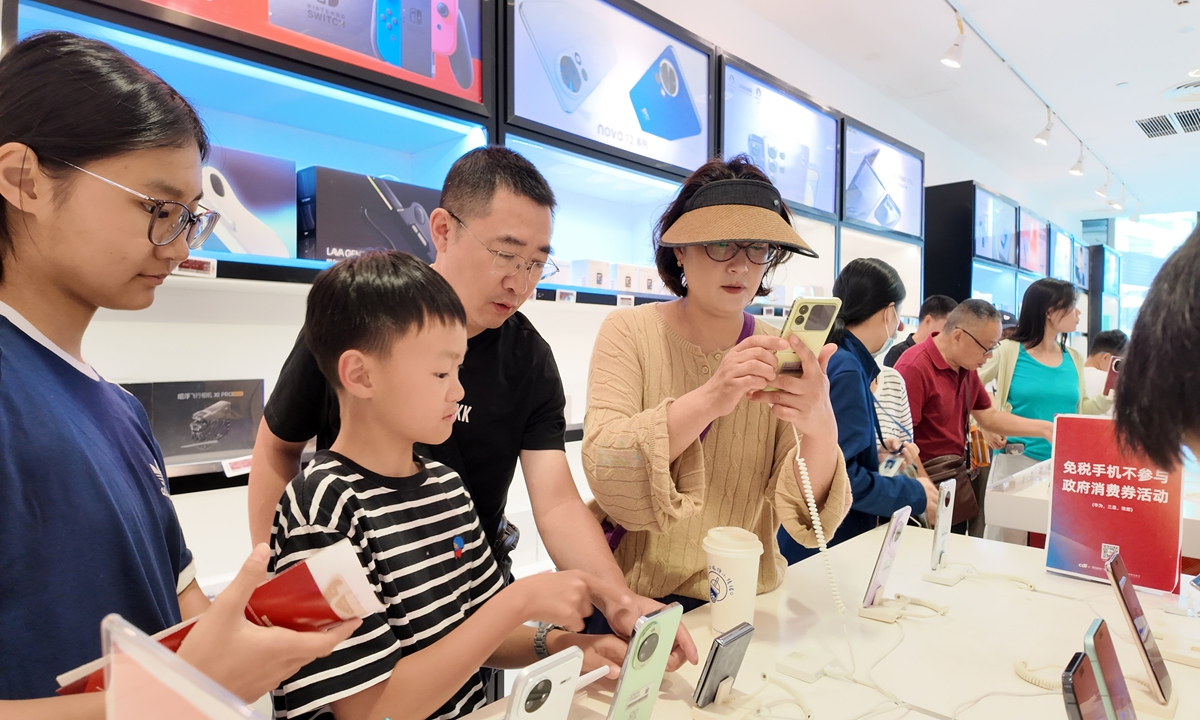
Customers browse smartphones at a duty-free store in Haikou, South China's Hainan Province, on February 21, 2026. Photo: VCG
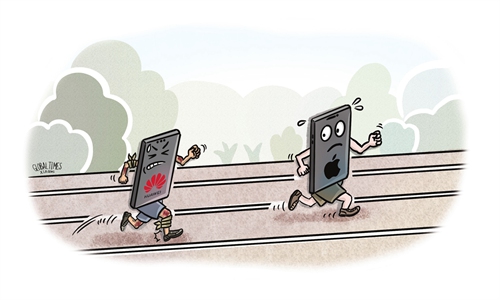
Shipments in the Chinese smartphone market in 2025 underscored resilient demand for multiple domestic brands, while Apple also reported solid growth, according to a report from market research firm Omdia. Analysts said that the trend highlights the sustained strengthening of Chinese brands' competitiveness as well as the diversity and openness of the market.
In terms of vendor rankings for 2025 shipments, Huawei topped the market with a 17 percent share, posting 2 percent year-on-year shipment growth, Omdia data cited by several media reports showed. Xiaomi ranked fourth with a 15 percent share, as its shipments rose 4 percent year-on-year, while OPPO placed fifth with the same share, with shipments broadly unchanged from a year earlier.
Notably, US tech giant Apple ranked third with a 16 percent share, and 7 percent year-on-year shipment growth, reflecting steady momentum in the Chinese market.
Industry data earlier this year showed Huawei's ranking climbing from sixth place in 2023 to second in 2024 and then to first in 2025. With shipments of 46.7 million units and a 16.4 percent market share, the company surpassed Apple to regain the top position in China for the first time in five years.
Liu Dingding, a veteran industry analyst, told the Global Times on Tuesday that the rise in shipments and market shares of domestic brands reflects a systemic strengthening of their competitiveness, particularly through their forward-looking strategic positioning in artificial intelligence (AI)-enabled devices, which are reshaping the high-end segment of the market.
AI is emerging as a decisive variable in the smart device industry chain, an area where Chinese brands have built strong capabilities, Liu said. "As the iteration of AI technologies continues, they are likely to trigger a new round of device replacement cycles, driving product upgrades and further optimizing the consumption structure," he added.
Foreign brands operating in China have also benefited from robust demand. Thanks to the strong sales momentum of the iPhone 17 series since its launch in September, Apple has maintained solid growth in the Chinese market. Data from Counterpoint Research showed that the new model drove overall iPhone sales up 22 percent year-on-year, becoming a key engine of Apple's recovery in China.
According to activation data from the Business Confidence Index, more than 4 million iPhones were sold during the Spring Festival holidays, which ran from February 15 to 23, up 110 percent year-on-year, Shanghai-based Jiemian News reported on Saturday.
"The simultaneous growth of domestic and foreign brands highlights the scale and diversity of demand in the Chinese market," Liu said, noting that China's multi-brand ecosystem, unlike markets dominated by only a few players, creates room for different products to grow and offers foreign companies ample opportunities to expand, reflecting a competitive and open environment.
Analysts also pointed to supportive policy measures and consumption trends underpinning the market's expansion.
Since the implementation of the consumer goods trade-in program, purchases of new mobile phones and other digital products exceeded 91 million units in 2025. Boosted by the policy, the scale of China's mobile phone sector surpassed 1 trillion yuan ($139 billion) in 2025, a record high, according to data from the Ministry of Commerce.
Chinese smartphone brands have also delivered solid performances overseas. According to Omdia's 2025 European smartphone shipment report released on Tuesday, Xiaomi maintained its third-place position with a 16 percent market share. Toward the end of 2025, Xiaomi's overseas expansion under its "new retail strategy" extended further into Europe, marked by the opening of several new stores and the expansion of its broader ecosystem product portfolio, the report said.
Honor entered Europe's top five for the first time, with shipments rising 4 percent year-on-year to 3.8 million units. The brand has stepped up efforts to enhance its presence, influence and relevance among key channel partners, laying the groundwork for further expansion into the premium segment.
Liu noted that as the quality of Chinese brands continues to improve, along with their technological capabilities and brand recognition, their competitiveness in international markets is expected to strengthen further, reinforcing their role in the global smart device industry chain.
RELATED ARTICLES