Cartier owner Richemont posts 11% Q3 sales growth as China recovery continues; analysts see global brands doubling down on China
Cartier Photo:VCG
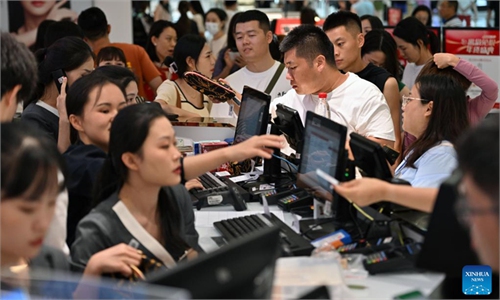
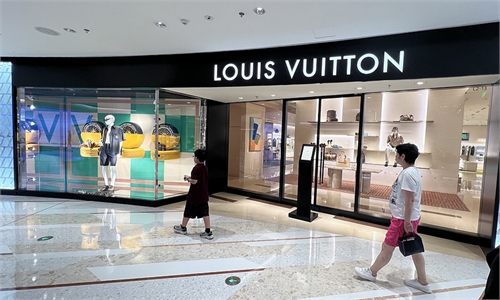
Cartier owner Richemont on Thursday reported an 11 percent increase in sales at constant exchange rates in its third quarter ending December 31, 2025. The company said its sales from September to December 2025 rose to 6.40 billion euros ($7.45 billion). Sales in China (including those in Chinese mainland, China's Hong Kong and Macao) were up by 2 percent, driven by solid activity in Hong Kong, according to Richemont's financial report, highlighting continued improvement in the Chinese market.
China has become global luxury's main growth engine in recent years. Industry experts said global luxury brands are accelerating their expansion into China, driven by the country's vast consumer base, evolving spending patterns, and increasingly favorable policy environment.
Italian luxury group Brunello Cucinelli on Monday reported revenue of about 1.41 billion euros in 2025, up 11.5 percent at constant exchange rates. The company highlighted the performance in China, with sustained double-digit growth, as well as a solid performance in South Korea, Japan and the Middle East.
"Our conviction is constantly strengthening that the Chinese market has reached a new, great equilibrium, grounded in an always more conscious demand oriented toward quality, manual skills, and craftsmanship and capable of contributing significantly to the growth of brands positioned in the highest luxury segment," according to the company's financial report.
Looking ahead to 2026, the company plans to open stores in Geneva, Toronto, Mexico City, Abu Dhabi and several locations in China, including Shanghai and Wuhan. It also plans to open a new Cucinelli House in Shanghai.
Global cosmetics giant Shiseido Group has announced the opening of Serge Lutens first mainland store, Shiseido's avant-garde art fragrance and beauty brand, in Shanghai, according to a statement published on Shiseido's official WeChat account on Tuesday.
This marks a further expansion of Shiseido China's high-end fragrance and beauty market, strengthening its diversified brand portfolio and ushering in a new phase for Serge Lutens' development in China, according to Shiseido's statement.
Jenny Sun, vice president, luxury brands and corporate business development at Shiseido China said that the official opening of Serge Lutens' first mainland store is a significant achievement for Shiseido in continuously improving its high-end luxury brand portfolio in China. "In the future, we will leverage the Group's deep cultivation in the Chinese market to further develop the brand and bring Chinese consumers more high-end niche salon fragrance and beauty experiences that combine artistic value and spiritual connotation," Sun stated.
"China is now the world's second largest consumer market and continues to post some of the strong growth among major economies," Hu Qimu, a deputy secretary-general of Forum 50 for Digital-Real Economies Integration said, adding that a rapidly expanding middle class means investments made in China today are viewed as investments in future demand.
Meanwhile, rising per‑capita incomes are shifting household spending away from low‑margin fast‑moving consumer goods toward higher‑value and premium products, creating fertile ground for luxury and high‑end brands, Hu said. Luxury brands' emphasis on craftsmanship, heritage and design resonates strongly with Gen Z consumers in China, accelerating a generational transition in luxury consumption.
According to Hu, a more import‑friendly policy environment is encouraging foreign brands to deepen their China presence. He pointed to platforms such as the China International Import Expo and broader trade facilitation measures that are creating policy tailwinds and practical incentives for international brands and suppliers.
"Not only international luxury houses, but many domestic premium brands are thriving, which shows China has cultivated consumers willing to pay for quality and experience. The Chinese market is recovering and demonstrating layered demand, supporting growth across value segments from mass platforms to high‑end and luxury categories," Liu Dingding, a veteran industry analyst, told the Global Times on Thursday.
Liu noted that the luxury push is part of a broader, bi-polar consumption map. "China is simultaneously the largest market for e-commerce platform Pinduoduo's value-for-money offerings and the fastest-growing region for luxury brands such as Hermès, LVMH and Richemont," he added.
RELATED ARTICLES