Tim Cook visits Guangzhou as Apple’s executive chairman, underscores China’s key role in firm’s supply chain: expert
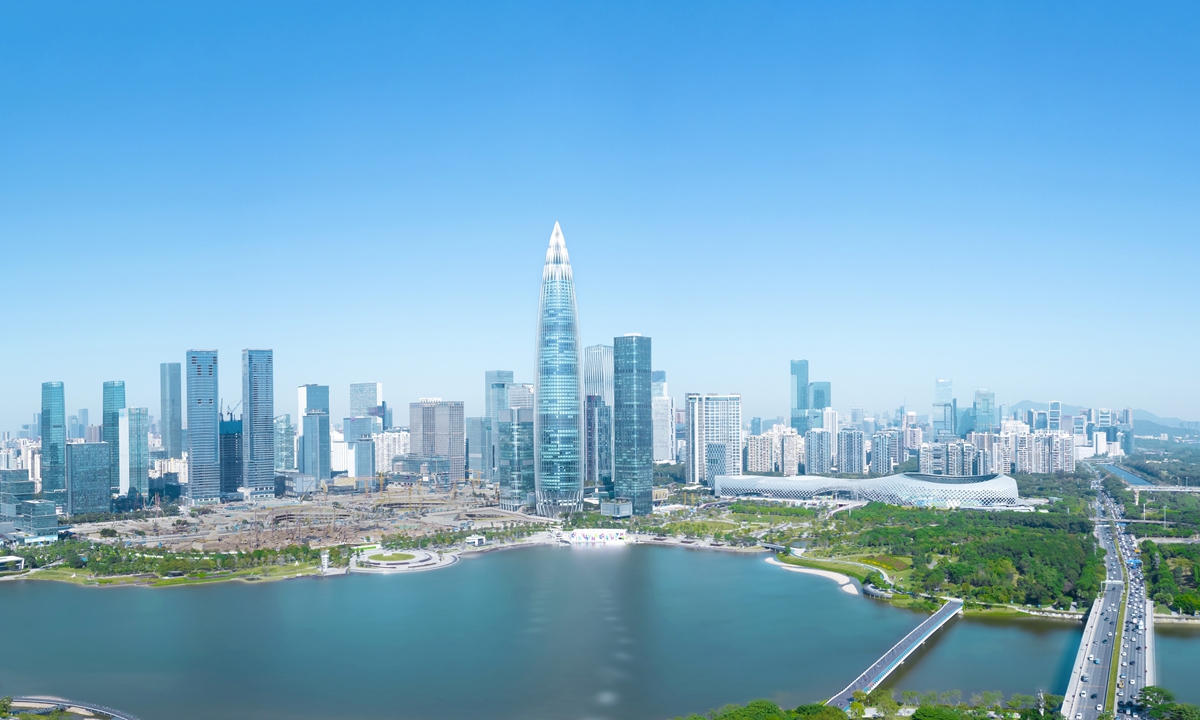
Skyline of Qianhai area in Shenzhen, South China's Guangdong Province Photo: VCG
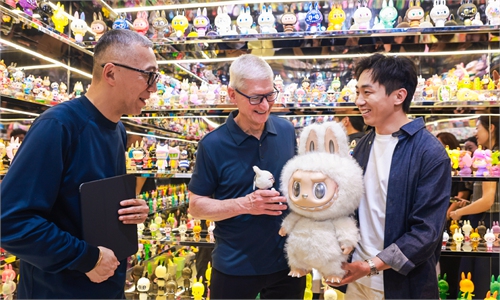
Tim Cook, executive chairperson of Apple Inc, arrived in Guangzhou, South China's Guangdong Province on Saturday for his first trip to China since stepping down as CEO on September 1.
He visited the set of a Wing Chun martial arts short film shot entirely on the company's latest iPhone 18 Pro, then met Guangdong's provincial governor Meng Fanli on Sunday.
"Great to be back in China! Incredible to experience Guangzhou's Wing Chun martial arts for the first time through the lens of iPhone 18 Pro," Cook wrote on his Sina Weibo account.
Cook visited China about 20 times during his 15-year tenure as CEO, more than any other major US technology company chief. In March, he completed a visit to China, during which he exchanged views with domestic game developers. Cook has repeatedly stated publicly that China is crucial to Apple.
On Sunday, Guangdong Governor Meng Fanli met Cook in Guangzhou. Cook described Guangdong as a globally important manufacturing center with a complete industrial and supply chain, strong innovation capacity and a promising consumer market, according to media reports.
Cook noted that the province hosts a large number of Apple's supply-chain partners and ecosystem developers, and said Apple is willing to further expand its presence in Guangdong, exploring deeper cooperation in supply-chain collaboration, smart manufacturing, green manufacturing and sales channels.
Meng welcomed Apple to locate more innovative products, emerging businesses and research and development (R&D) platforms in the province. Meng pledged that Guangdong will continue to expand high-level opening-up and provide a market-oriented, law-based and internationalized business environment for foreign companies, including Apple.
Of Apple's top 100 suppliers, 80 are located in China. More than 80 percent of Apple's 200 major global suppliers have factories in China, according to open data.
Coinciding with Cook's visit, Apple announced on Saturday that its second China Clean Energy Fund has raised its total committed investment to $212 million, roughly doubling the initial $100 million anchor investment made in 2025. New commitments came from Chinese suppliers including Amperex Technology, Avary Holding (Shenzhen) Co and Diodes Inc.
Apple also reported that more than 95 percent of its direct manufacturing in China now runs on renewable energy.
"Cook's decision to make China his first overseas destination after taking a new role in Apple is highly significant. Choosing China first underscores the irreplaceable position of China in Apple's supply chain," Ma Jihua, a veteran industry analyst, told the Global Times.
Ma noted that Guangdong concentrates a large share of Apple's supply-chain partners. "China is not merely a sales market for Apple but a core manufacturing and supply-chain hub."
Cook's trip came amid a rebound in confidence among US firms operating in China.
According to the 2026 China Business Report released by the American Chamber of Commerce in Shanghai, 58 percent of surveyed companies expressed optimism about China's five-year business outlook, up 17 percentage points year-on-year. Nearly 80 percent reported profitability in 2025 - the highest level since 2019.
Among these firms, 28 percent increased investment in China last year, a four-year high. Half of members with China-based R&D facilities plan to raise R&D spending this year, up sharply from one-third in 2025.
A notable strategic shift is also emerging, with the "in China for the world" strategy becoming the top business priority for 29 percent of surveyed companies in 2026, surpassing the "in China for China" model chosen by 24 percent.
The improving confidence among US companies operating in China is closely tied to China's continued efforts to expand high-level opening-up and optimize its business environment, Hu Qimu, a professor at the Maritime Silk Road Institute of Huaqiao University, told the Global Times on Sunday.
"China's rapid rollout of new application scenarios, particularly in artificial intelligence, is generating stronger demand for computing power, integrated circuits and high-end chips," Hu said. "Whether from the manufacturing, application or demand perspective, the Chinese market continues to upgrade."
Hu added that US firms are attaching growing importance to R&D in China. "Many are planning to increase R&D spending at their China-based facilities, viewing local innovation capabilities as essential to staying competitive in both the Chinese and global markets."
A growing number of US companies are expanding their R&D footprints in China. Apple has invested more than 1 billion yuan ($140 million) in application research laboratories in Shenzhen and Shanghai over the past five years.
Auto parts supplier Tenneco launched its global innovation center in Kunshan, East China's Jiangsu Province in September, with plans to invest 470 million yuan in R&D from 2026 to 2030.
RELATED ARTICLES