Apple's suppliers launch 1b yuan new-energy fund in China, as nation's smart & green upgrading creates new opportunities
Rapid development of new quality productive forces creates new opportunities: expert
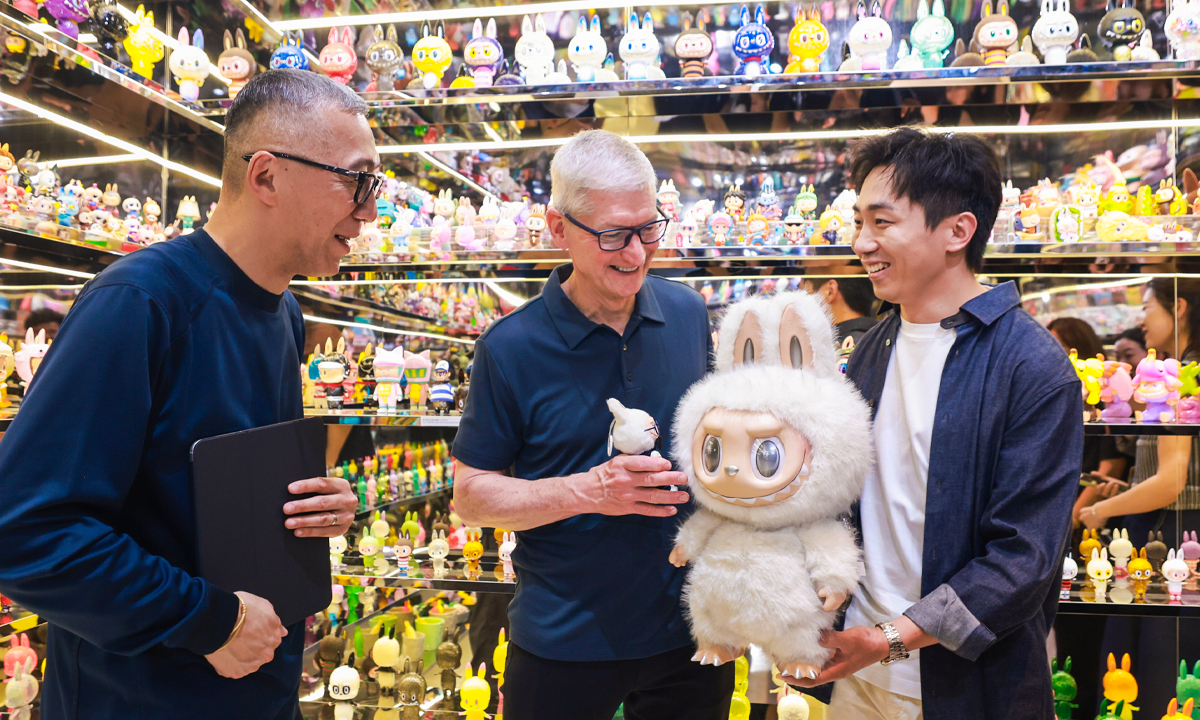
Apple CEO Tim Cook receives a gift — LABUBU, from Wang Ning, the founder and CEO of Pop Mart, during THE MONSTERS exhibition in Shanghai on October 13, 2025. Photo: Courtesy of Pop Mart
US tech giant Apple said on Tuesday that more than 90 percent of its manufacturing in China is powered by renewable energy, which stems from a decade-long close partnership between Apple and more than 100 suppliers in the market. Building on this, the US tech giant's local suppliers have launched a 1 billion yuan ($150 million) investment fund, aimed at supporting the construction of renewable power infrastructure in China.
Our suppliers in China are making rapid and remarkable progress in transitioning to renewable energy, and we're proud to partner with them in this critical work, Apple's Chief Operating Officer Sabih Khan was quoted as saying in a Chinese release on the company's official website on Tuesday.
This new, fully supplier-led investment fund will consolidate existing achievements and help accelerate Apple's goal of achieving carbon neutrality across its entire supply chain by 2030, and deliver positive impacts for people and the planet, Khan said.
On Tuesday, Apple also announced a new donation to Tsinghua University in China. The moves came after Apple CEO Tim Cook made his second trip to China this year, despite intensifying trade frictions between China and the US recently, especially as the White House threatens to impose additional tariffs of 100 percent on China from November 1.
Cook made a surprise appearance on a Douyin Apple Store livestream on Monday night, announcing that preorders for the iPhone Air in China will open on Friday.
In addition, Danone CEO Antoine de Saint-Affrique visited Wuxi, East China's Jiangsu Province to attend a ceremony of capping the roof of the Nutricia Phase III facility on Monday, according to local media outlet Wuxi Daily on Tuesday.
Germany-based global supplier of high-performance engineering materials Envalior launched a joint innovation center in Shanghai on September 23, according to the official WeChat account of Envalior Engineering Materials Jiangsu Co.
In August, German multinational giant Bosch launched an intelligent driving control project in Suzhou, Jiangsu Province, with investment totaling 10 billion yuan, according to the local government.
"Amid the volatile international environment, a number of foreign enterprises' stepped-up presence in China underscores the attractiveness of the ultra-large market, continuously improving business environment as well as opportunities brought about by the economic transformation and upgrading," Yu Xiang, a senior fellow at the Center for International Security and Strategy, Tsinghua University, who focuses on China-US trade relations and US economic and monetary policies, told the Global Times on Tuesday.
According to data released by the Ministry of Commerce on September 19, 42,435 foreign-invested enterprises were established in the Chinese mainland from January to August, increasing 14.8 percent year-on-year.
The actual use of foreign direct investment (FDI) in China's high-tech sectors totaled 148.28 billion yuan, with FDI in e-commerce services surging by 169.2 percent year-on-year, aerospace equipment manufacturing up by 37.5 percent and chemical pharmaceutical manufacturing up by 23.2 percent, the data showed.
"This trend indicates that multinational corporations are accelerating their integration into China's innovation ecosystem, seeking mutual growth with the Chinese market," Yu said.
Thanks to policy support, the development of new quality productive forces made rapid progress in China, which combined with the enormous potential of China's market offers great development dividends for multinationals, including those from the US, Yu said.
Foreign enterprises that are optimistic about China's economic prospects are choosing to expand their footprints in China at an early date, Yu said.
In the first half of this year, China's economy grew by 5.3 percent year-on-year, with exports growing by 4 percent in the first nine months, official data showed. Meanwhile, China has risen to the 10th position in the global innovation ranking for 2025, up one spot from the previous year, marking its first entry into the top 10, the World Intellectual Property Organization announced in September.
The resilience of China's economy and the technological innovation capabilities demonstrated by Chinese tech enterprises are also driving global investors into China's stock markets.
"We retain our preference for A shares, given the more defensive nature against geopolitical tensions and prospect of national team support," James Wang, head of China equity strategy research at UBS, wrote in a note sent to the Global Times on Tuesday.
"The next stage of globalization is being written now - and China is at the center of it. China is not just adapting to the future - it is defining it. The world's next phase of economic transformation will be driven by artificial intelligence, sustainability, and smart infrastructure, and China is leading the charge," Jack Perry Junior, chairman of the 48 Group Club and CEO of London Export Corp, told the Global Times in a recent interview.
China's transition to high-quality development is a defining moment in global economics. Unlike many economies that focus on short-term gains, China has taken a long-term, strategic approach - balancing innovation, stability, and sustainable growth, he said.
RELATED ARTICLES