Why are Chinese tokens gaining popularity overseas in the AI era?
China’s models offer comparable capabilities at more competitive prices
By and Chen Zishuai Published: Oct 12, 2026 08:51 PM


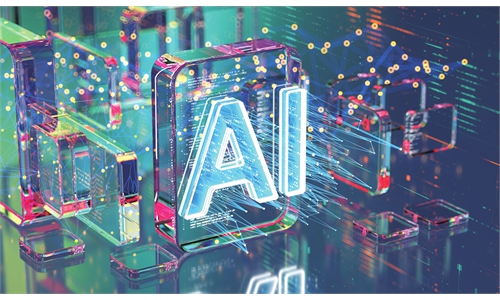
Concept picture of Token Photo: VCG
In the age of artificial intelligence (AI), token — an invisible, intangible yet increasingly vital "new commodity" — is circulating across borders. AI-generated short dramas and comics have taken Southeast Asia by storm. In Africa, livestreamers use AI-produced scripts to sell products live online. These AI tools reshaping production and daily life all rely on vast quantities of tokens.
Recently, the Global Times conducted an in-depth investigation into the token industry and found that a growing number of overseas users are turning to tokens produced in China for one simple reason: high quality at low cost.
Yet behind this choice lies a deeper contest. In the AI era, countries are competing on their combined strengths in models, data, computing power, electricity, infrastructure, and application ecosystems. Industry insiders interviewed said that as AI becomes fully integrated into every aspect of life, China is poised to become an important "token factory" for the world.
Growing popularity
At a cross-border e-commerce livestreaming base in Ethiopia, streamers once struggled to sell goods, as their unfamiliarity with the culture and language of Western consumers made their pitches fall flat. Now, a Chinese large language model (LLM) solved the problem: streamers just input product information, and it generates tailored product descriptions and eye-catching videos for the target market. Sales have risen markedly as a result.
Notably, every piece of generated content relies on tokens "produced" in Xiamen, East China's Fujian Province. The Ethiopian e-commerce company sends requests via API to an LLM deployed in Xiamen. The model performs AI inference, measures usage based on token consumption, and returns results - such as multilingual subtitles and dubbed audio - to the company's terminal. The company then pays fees according to actual token usage, with cross-border payments and settlement handled through banks.
"The first transaction of this international service reached 2.7 billion tokens," Lu Yang, general manager of Xiamen-based Unisound, told the Global Times. He said the very practical reason Ethiopian clients chose Chinese token services was price. They had tried US-developed models such as GPT, but the high cost was unaffordable, whereas Chinese LLM services are far more cost-effective. By Lu's calculation, drafting livestream scripts and marketing copy for a single product costs just a few yuan.
Xiamen completed its first export of token-based AI services to Ethiopia, delivering plug-and-play AI productivity tools through standardized token services, according to the official website of the Xiamen Municipal Bureau of Commerce on September 3.
The bureau said that the first deal involved 2.7 billion tokens and transaction volume exceeded 10 billion tokens within just one week of the service's launch. Xiamen's first token-based AI export is powered by a homegrown LLM developed by Unisound.
In a Vietnamese factory, a manager inputs instructions to adjust the production plan. The instructions travel through a dedicated cross-border connection to a computing facility in the Shantou overseas Chinese economic and cultural cooperation pilot zone, where a Chinese LLM processes them and sends back the results. Within tens of seconds, the manager receives a professionally prepared, AI-generated plan.
In late April, the pilot zone validated the complete commercial process for token exports. In less than five months, average daily token usage surged from 100 million to 100 billion, a 1,000-fold increase.
Shantou Kedom iLink Technology Co was set up in the pilot zone in May. Its general manager, Li Wenyi, told the Global Times that in just over four months, the company's average daily token consumption had topped 1 billion, growing roughly 15 to 20 percent month-on-month.
According to Li's field research, Vietnamese enterprises initially relied on Western LLMs like GPT, which entered the local market earlier. But they gradually realized that Chinese models offer comparable capabilities at more competitive token prices.
"We broke down the pricing structure of Western models like GPT. For the same computing power traffic and performance, our price can be one-third of theirs, meaning enterprises can expect to cut their AI usage costs while completing similar tasks," Li said.
Unique advantages
"Tokens are essentially a standardized intelligent service formed by further encapsulating capabilities such as data, models, and computing power," Zhang Xianghong, a professor at Beijing Jiaotong University's International Center for Information Research, told the Global Times, noting that China is developing some unique advantages in this production chain.
"Behind these invisible tokens lies a huge amount of electricity," Wang Jiye, former deputy chief information officer of State Grid Corporation of China, told the Global Times, adding that token processing essentially involves LLM training and inference, both of which consume vast amounts of electricity.
China's power industry has clear advantages globally: high electricity output, strong stability, and a complete equipment supply chain. As rapid computing power growth abroad has outpaced electricity supply, other countries have already been buying large quantities of related equipment from China, Wang said.
"If enterprises around the world buy Chinese tokens on a large scale in the future, our electricity supply will still keep up," Wang said, adding that token exports are in effect an "indirect export" of electricity. Power infrastructure takes years to build, so for many countries with weaker grids, buying Chinese tokens is simply a more convenient way to share China's electricity advantages.
Token production also depends on computing power.
At the China International Big Data Industry Expo held in August in Guiyang, Southwest China's Guizhou Province, the Global Times observed that many companies in China were accelerating the development of computing infrastructure based on homegrown technology.
For example, Huawei Cloud used its independently developed Lingqu AI computing cluster to build a low-latency, high-throughput token factory. Engineers at the site told the Global Times that a token factory is not simply "stacking chips"; rather, it requires allocating and optimizing computing power resources according to the parameter scale and operating characteristics of different LLMs.
Several industry executives said China's comparatively low electricity prices make computing services cheaper, helping explain the competitiveness of Chinese tokens.
Global hub
As AI deployment accelerates, many places in China have already built token factories.
At the Wuxiang Cloud Valley token factory in Nanning, Southwest China's Guangxi Zhuang Autonomous Region, two AI computing centers stand facing each other. The server room temperature is precisely controlled at 26 C, servers run day and night, and up to 200 billion tokens can be produced per hour.
Wu Yongzhan, deputy general manager of the token business at Runjian, told the Global Times that the goal of the Wuxiang Cloud Valley token factory is to make computing power available on demand and billed by usage - just like water and electricity.
"This model is lowering the threshold for intelligent use," Wu said, adding that when computing power is sufficiently available and affordable, AI will no longer be the preserve of a few countries or a few large enterprises.
"Developers and small and medium-sized enterprises in developing countries can likewise enjoy the convenience brought by Chinese token services, thereby bridging the global intelligence gap to a certain extent," Wu said.
In Malaysia, Thailand, Vietnam, and beyond, AI-generated comics and short dramas are gaining traction - and Chinese tokens are what make them possible.
Yang Yang, general manager of the token business at ChinaDataPay.com, told the Global Times that his company's content creation platform aggregates roughly 90 percent of mainstream Chinese LLMs and focuses on supporting the production of animated and advertising short dramas in Southeast Asia. "Chinese token supply is a 'rigid demand' for them," Yang said.
The token industry is still at a very early, exploratory stage, but Zhang of Beijing Jiaotong University believes tokens may one day become an important strategic resource. In his view, tokens will permeate every aspect of the economy and society, much like oil in the industrial age. In this process, China is bound to become a major global hub for token production and consumption.
RELATED ARTICLES