Apple's iPhone Duo exclusively assembled in C. China's Henan: report; expert says supply chain strengths highlighted

Apple displays its iPhone Duo foldable smartphone during a product launch event at Apple Park in Cupertino, California, the US, on September 9, 2026. Photo: VCG
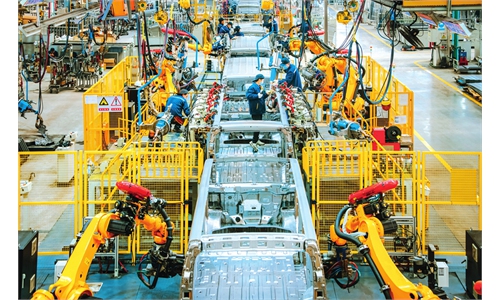
Apple's first foldable smartphone, the iPhone Duo, is being exclusively assembled at Foxconn's factories in China, according to media report on Monday, as the US tech giant prepares to open pre-orders for the new device. The move highlights China's strengths in advanced manufacturing and its continued importance in Apple's global supply chain, Chinese industry observers said.
Apple Chief Operating Officer Sabih Khan visited Foxconn's manufacturing complex in Zhengzhou, Central China's Henan Province, on Sunday, inspecting key production processes for the iPhone Duo, as well as production lines for the iPhone 18 Pro's rear camera modules, anodized frames and system-on-chip components, according to Chinese media outlet thepaper.cn.
Asked about production capacity for the iPhone Duo, Khan was quoted by the report as saying that teams had been working on manufacturing development for the innovative product and were now scaling up production in line with Apple's high quality standards.
The iPhone Duo will open for pre-orders on October 16 and go on sale on October 23. The device features a 7.6-inch inner display and a 5.4-inch outer display, with a starting price of 15,999 yuan ($2,390.71) in China, according to Apple's official website.
Manufacturing the foldable device presents considerable technical challenges. According to Foxconn staff, its hinge contains more than 100 miniature components that must fit precisely together. Apple and Foxconn developed customized automated equipment using laser scanning, machine-learning algorithms and micron-level 3D printing to improve surface flatness and minimize display creases, thepaper.cn reported.
Wang Peng, an associate researcher at the Beijing Academy of Social Sciences, told the Global Times on Monday that unlike conventional smartphones, foldable devices require greater precision and closer coordination among component suppliers, equipment manufacturers and assembly plants. China's mature industrial ecosystem provides important advantages in meeting these requirements.
Wang noted that China's competitive edge goes beyond its manufacturing scale. The country has accumulated extensive experience in precision engineering, automated production and supply chain coordination, allowing manufacturers to turn complex designs into products suitable for mass production while maintaining consistent quality. Such capabilities are particularly important for a first-generation product involving new manufacturing processes.
Despite Apple's efforts to diversify production across different countries, Wang said that China's role in high-end electronics manufacturing remains difficult to replace in the short term. The case of the iPhone Duo shows that global supply chain competition increasingly depends not simply on production costs, but also on technological capabilities, manufacturing efficiency and the strength of supporting industries, he said.
RELATED ARTICLES