China’s ‘Double 11’ shopping festival highlights steady consumer demand, longer shopping season
Event remains important gauge of consumer confidence: experts
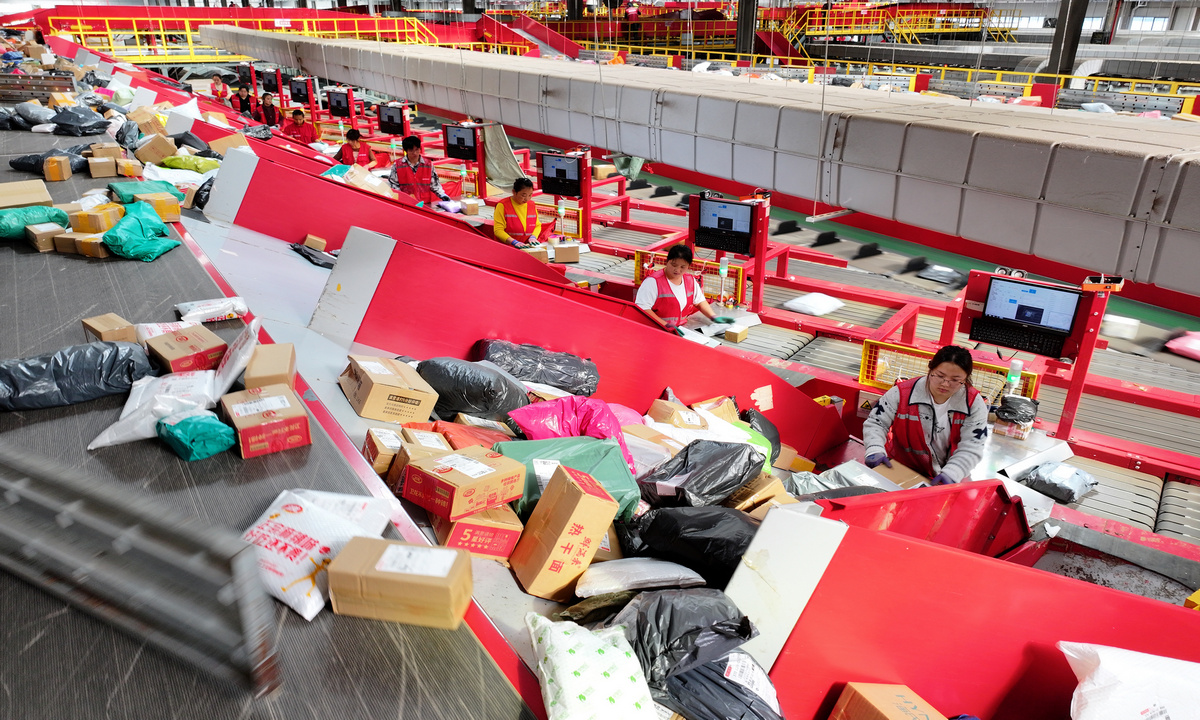
Workers sort parcels at an express delivery company in Yangzhou, East China's Jiangsu Province, on November 11, 2025. China's Double 11 shopping festival is hitting its peak, with major domestic e-commerce platforms and courier firms seeing a surge in cross-border parcel shipments. Photo: VCG
China's "Double 11" shopping festival, which celebrates its 18th edition this year, unfolds with a longer pre-sales window, deeper discount combinations and more aggressive subsidy stacking. According to industry observers on Monday, the annual sales event remains an important gauge of consumer confidence as the country works to sustain domestic demand in the second half of the year.
Chinese e-commerce platforms from Alibaba's Tmall and Taobao to JD.com and short-video platform Douyin have launched preliminary activities featuring cash coupons, limited-time subsidies, pre-orders with locked-in prices and "national subsidy" programs for eligible products. The promotions are designed to stimulate spending ahead of the main sales peak around November 11.
JD.com kicked off its "Double 11" spot sale on Monday, emphasizing immediate discounts and "buy now, ship now" deals, particularly for home appliances and digital devices. Tmall will begin accepting pre-orders on Thursday, allowing consumers to pay deposits to lock in discounts and gifts before making final payments on October 20. Douyin has joined the early push through livestream subsidies and platform-wide coupons.
This year's shopping bonanza is expected to run until November 11 or thereabouts, with promotional intensity peaking between the evening of November 10 and 11.
Industry observers said that the annual shopping bonanza has evolved from a one-day frenzy into a month-long consumption campaign, reflecting both platform competition and increasingly rational, fragmented consumer behavior.
Hu Qimu, a professor at the Maritime Silk Road Institute of Huaqiao University, told the Global Times on Monday that the shift from a one-day shopping frenzy to a longer promotional period has not weakened consumer activity. Instead, it may improve conversion rates, reduce pressure on logistics networks and better support the long-term health of the retail and manufacturing sectors.
"I'm shopping more rationally this year," said a consumer surnamed Liao in Beijing. "I've already joined the pre-sale for items I really need, and I'm comparing prices carefully before placing my final order. I'm not buying just because of the festival — I only purchase what I need."
Analysts said that the changing format of the festival also reflects a broader transformation in Chinese consumption habits, with shoppers increasingly moving away from "stockpiling" toward more need-based purchases.
"The 'festival fever' is not as intense as it was a few years ago," Hu said, citing two reasons. First, the mechanics of the "Double 11" shopping festival have become mature after years of iteration, leaving little room for disruptive innovation; second, consumers are more rational and no longer concentrate purchases so heavily in a short period.
Observers noted that as "Double 11" enters its 18th year, the shopping gala represents not only changing consumer trends, but also the deep integration of technology and the coordinated upgrading of industries.
According to analysts, platforms are experimenting with AI-assisted shopping tools, sometimes described as "AI shopping agents," to help users compare products and complete purchases more efficiently.
As a national consumption event, Double 11 is widely watched as a window into household spending intentions and broader economic expectations.
"The "Double 11" shopping festival preheat campaign is a concentrated test of consumer confidence," Hu said. "Platforms are trying to turn short-term promotions into sustained spending momentum."
China's online retail sales of goods and services reached 13.48 trillion yuan ($2.01 trillion) in the first eight months of 2026, up 4.6 percent year-on-year. Of the total, online goods sales rose 4.3 percent to 8.42 trillion yuan, while online services sales increased 5.1 percent to 5.06 trillion yuan, official data showed, according to the Xinhua News Agency.
Pan Helin, a member of the Expert Committee for the Ministry of Industry and Information Technology, told the Global Times that this growth reflects the resilience and dynamism of the Chinese economy.
Pan said that China's consumer market still has room for growth in the fourth quarter of 2026, adding that preliminary indicators already point to stabilization and a modest rebound in spending.
Experts said that the continued expansion of online consumption suggests Chinese households remain willing to spend on better goods and services, while companies are being encouraged to invest more in research, product upgrades and supply-side improvements.
RELATED ARTICLES