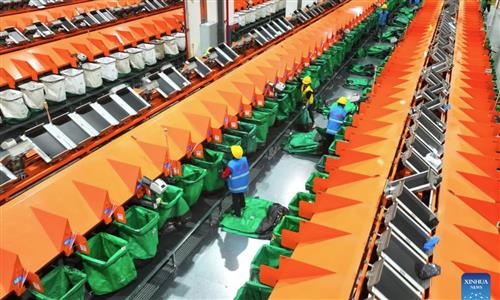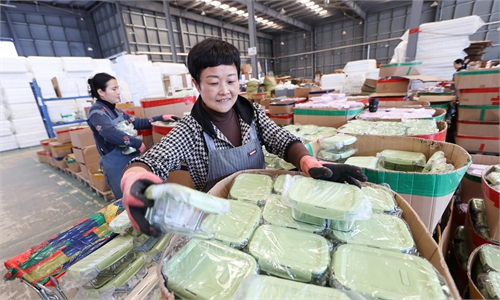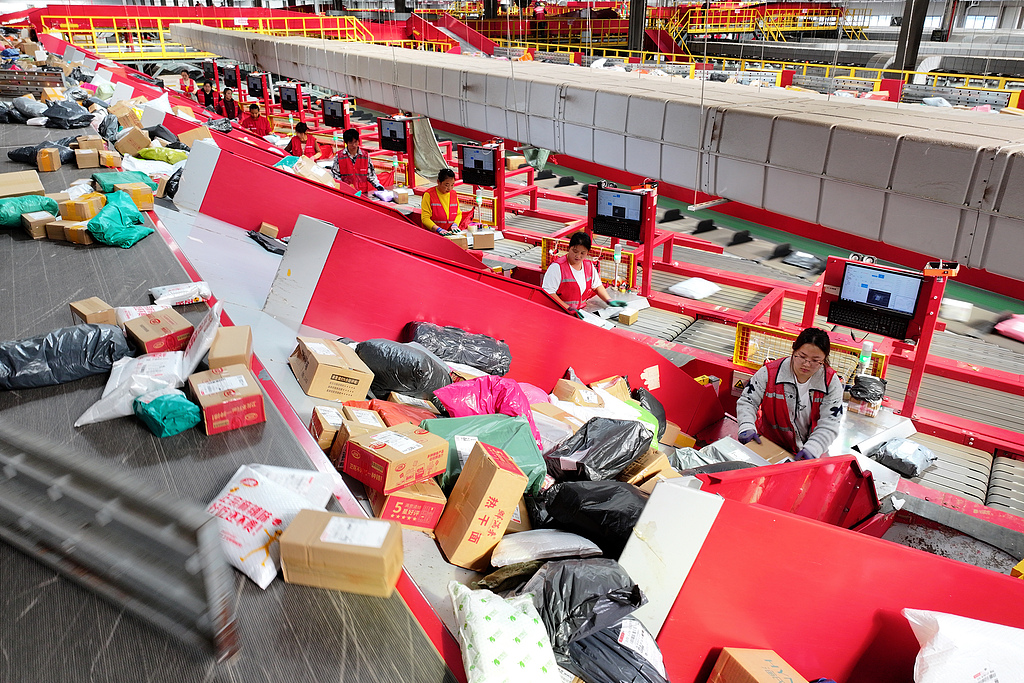
Workers sort parcels at an express delivery company in Yangzhou, East China's Jiangsu Province, on November 11, 2025. China's Double 11 shopping festival is hitting its peak, with major domestic e-commerce platforms and courier firms seeing a surge in cross-border parcel shipments. Photo: VCG
China's annual Double 11 shopping festival once again showcased the resilience and innovation of China's consumer market, with major e-commerce platforms reporting record-breaking sales driven by artificial intelligence (AI) technology integration and evolving consumer preferences for quality, diversity and experience-based purchases.
Latest data from major ecommerce platforms indicated robust sales and showcased remarkable growth across multiple sectors. Taobao and Tmall reported that 80 brands exceeded 100 million yuan ($14.04 million) in sales within the first hour of sales, while JD.com reported a 24.7 percent year-over-year increase in active mobile app users. Shortvideo platform Douyin experienced explosive growth with over 41,000 merchants achieving a five-fold jump in livestreaming sales compared to last year. Online travel platform Fliggy reported more than 1.6 million travel and vacation items were sold, the Securities Times reported on Wednesday.
JD.com said it set a new record for sales during the Double 11 Grand Promotion (Singles' Day). As of 11:59 pm on Tuesday, the number of shoppers during the grand promotion increased by 40 percent year-on-year and order volume increased by nearly 60 percent, according to the information the company shared with the Global Times on Wednesday.
Home-appliance giant Suning said Double 11 sales rose 48 percent from a year earlier, with some categories doubling. In tier-1 and tier-2 cities, nearly 60 percent of shoppers chose AI-enabled next-generation products, the company told the Global Times on Wednesday. Fueled by new-model launches and Double 11 shopping festival discounts, Suning's smartphone, smart-watch and wireless-earphone jumped 63 percent, 222 percent and 374 percent respectively.
A Suning retail store manager told the Global Times that the home-appliance market has entered a new phase of scenario-based, personalized upgrading as demand shifts from basic functionality to quality living. Consumers, he said, are embracing a "new pragmatism," seeking both experience and value and are willing to pay for premium scene-based solutions.
Analysts said that behind the headline sales figures lies the ongoing upgrading of China's consumption structure—a trend showcases the current dynamism of the consumer market and signals further transformation ahead.
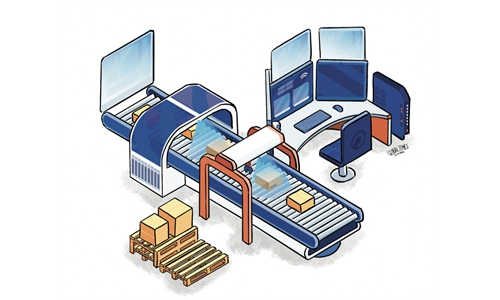
Observers noted that a robust supply chain and the use of AI-driven automation in logistics, have enhanced operational efficiency and delivered innovative service experiences during this year's Double 11 festival.
JD reported surging demand for AIenabled electronics: AI tablets sales rose 200 percent yearonyear growth, while AI glasses, smart speakers and smart home storage devices all posted sales gains above 100 percent, it said.
Personalized and niche consumption also rose, marking a shift toward rational spending and diversified preferences. The Securities Times said Taobao saw large gains in original fashion brands, and Douyin reported strong demand for specialty items including intangible cultural heritage cast‑iron cookware. Tourism spending broadened to cruises and small-group or niche destinations.
A Beijing consumer surnamed Liu told the Global Times that she bought multiple multi‑flight cards on Fliggy during Double 11 livestreams because "they offered lower prices, more route choices and flexible refundable options if plans changed."
Experts noted that the 2025 Double 11 marks a shift away from price wars toward quality, efficiency and experience. Pan Helin, a member of the Expert Committee for the Ministry of Industry and Information Technology said merchants did not rely solely on discounts; they integrated AI into the shopping experience to lift transaction efficiency, while platforms focused on instant delivery and localized after-sales to build a new instant-retail ecosystem.
Pan added that e-commerce platforms are now focusing more on optimizing the "structure" of consumption rather than merely expanding its "scale," eliminating involution-style competition in the sector.
"This year's festival features rational stocking, experience-first offerings and multi-scene consumption," Pan said, adding that as Double 11 evolves beyond a pure discount event, it is increasingly viewed as a window into China's broader consumption upgrade — driven by technology, diversity and quality growth.
The 17th Double 11 has evolved beyond a shopping festival; it now epitomizes rational consumption, deep technology penetration and coordinated industrial upgrading, said Wang Peng, an associate researcher at the Beijing Academy of Social Sciences.
"Double 11 is seen as a barometer of consumer sentiment," Wang said. "This year's festival reflects recovering household spending power and a more optimized demand mix, driven by a vibrant trading atmosphere and diversified supply," Wang said.
"It also lifts the broader economy," Wang added. "As a nationwide shopping event, it stimulates demand and supports stable growth; it drives the prosperity of related industries such as logistics and payments, promoting economic circulation; and it promotes innovation and upgrading of e-commerce and merchants, injecting vitality into long-term economic growth."