IN-DEPTH / IN-DEPTH
Practitioners’ Insights: How does an AI-powered community canteen put people first, one meal at a time?
By in Shanghai Published: Oct 12, 2026 11:57 PM

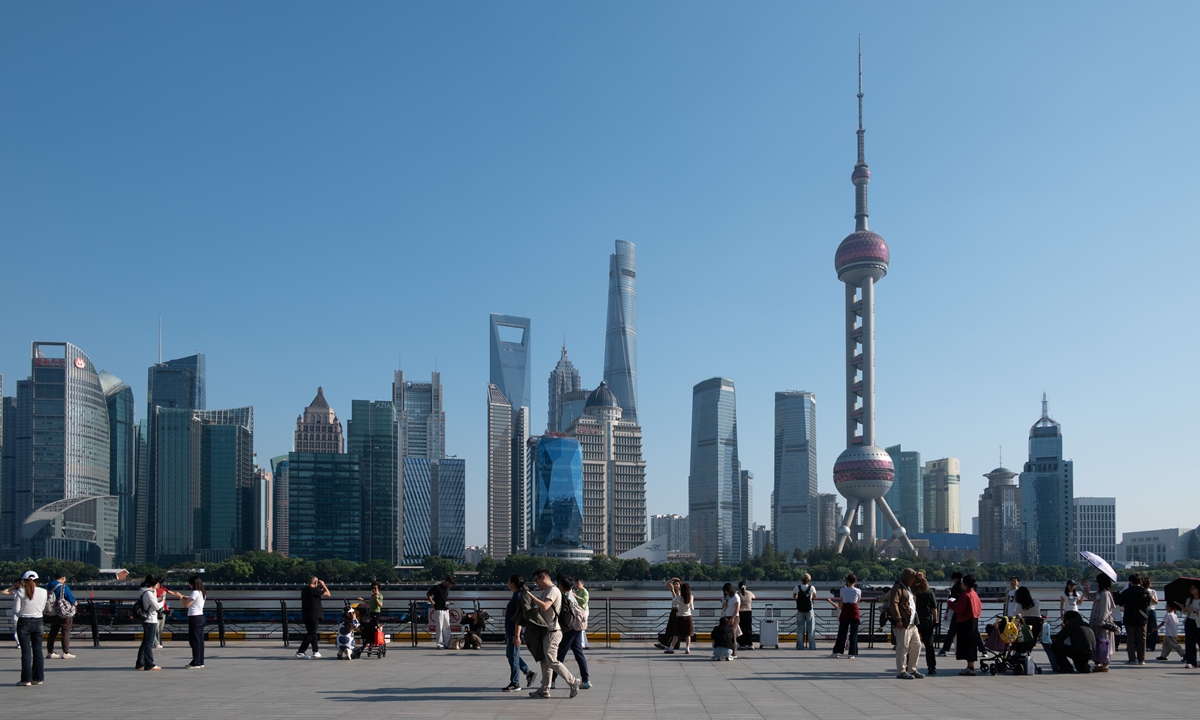
Image of the Shanghai cityscape Photo: VCG
Editor's Note:
In November 2019, during an inspection tour in Shanghai, Chinese President Xi Jinping first put forward the concept that "cities should be built by the people and for the people." This July, also during an inspection tour in this city, Xi stressed the need to fully embrace the people-centered philosophy of urban development and adhere to the principle of understanding the people's needs, soliciting their suggestions, and assessing their evaluation of the effectiveness of urban renewal.
Urban renewal initiatives should be carried out in a thorough, meticulous and effective manner to continuously enhance the people's sense of fulfillment, happiness and security, Xi said.
The concept that "cities should be built by the people and for the people," is a concentrated expression of the development thinking of putting people first in urban governance. Volumes I through V of Xi Jinping: The Governance of China include a series of Xi's important remarks on urban work.
In the article "Bring a sense of gain, happiness and security to the people" in Volume III of Xi Jinping: The Governance of China, Xi gave specific instructions on urban shantytown renovation and waste sorting. He said that "we cannot have cities with skyscrapers on the one side and slums on the other," and that "garbage sorting concerns the public's living environment and resource conservation." In Volume V, Xi said "we will carry out urban renewal projects and improve urban infrastructure to build livable, resilient and smart cities," and emphasized, "guided by the principle that cities should be built by the people and for the people, the new era should witness the development of beautiful cities that are green, low-carbon, habitable, safe, healthy, smart and efficient."
In the 29th installment of the special series "Decoding the Book of Xi Jinping: The Governance of China," the Global Times, along with the People's Daily Overseas Edition, continue to explore this theme - "Cities should be built by the people and for the people" - by inviting Chinese and foreign scholars, translators of the work, practitioners with firsthand experience, and overseas readers to engage in a deeper discussion of the practical value and broader significance of this concept.
Just after 11 am, a wave of warmth and the savory scent of freshly cooked dishes drifted through the "AI community canteen" on Hongqiao subdistrict in Shanghai's Changning district.
Through the glass above the pickup counter, a bright yellow robotic arm in the kitchen could be seen deftly lifting a tray of ingredients, and sliding it into an intelligent cooking pod. No open flame. No greasy fumes. Less than five minutes later, a plate of stir-fried greens emerged from the serving hatch, steaming.
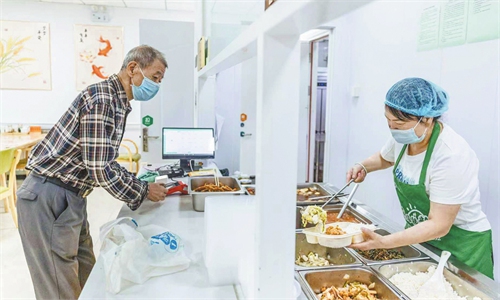
Braised pork, stir-fried zucchini with eggs, curried potatoes - more than a dozen dishes were laid out in succession, each one sending up a plume of heat. At the counter, people stood with their trays in hand, inching forward one by one, gazing at a variety of dishes before choosing what to eat.
Sixty-two-year-old Ao Yongjian sat down at a small table in the canteen with his tray. He picked up a piece of pork, took a bite, chewed for a moment and broke into a smile. "The salt and oil are just right. It feels more comfortable to eat here than at any restaurant," he said.
This canteen is reportedly China's first "AI community canteen." Over the past five years, the yellow robotic arm and intelligent cooking system have prepared more than 3,000 dishes for nearby residents. Its formal name is the "community canteen for the elderly," but it is open to everyone: elderly residents, office workers and students alike can all sit down and enjoy a hot meal.
The fifth volume of Xi Jinping: The Governance of China underscored that, "cities should be built by the people and for the people." This small AI community canteen offers a warm, intimate snapshot of that people-centered vision in action: cutting-edge technology sheds its aloof sheen, taking root in the neighborhood and answering people's everyday needs, one steaming meal at a time.
"This canteen was built for ordinary people," Ao told the Global Times. "It truly puts our needs first."
Dinner tables at your doorstep
Ao lives in a residential compound behind this AI-equipped canteen, less than a five-minute walk away.
When the canteen first opened in 2021, neighbors were eager for one question to be answered: "Will food cooked by robots actually taste good?" Ao decided to give it a try. "After the very first bite, I knew this was a place I'd keep coming back to," he recalled.
Before the canteen opened, Ao usually cooked for himself at home. But as he got older, the whole preparing and cooking process took longer and longer. For Ao and many nearby residents, the community canteen is not only convenient; its food is light, healthy and well suited to local tastes.
Hongqiao subdistrict, where Ao lives, is a deeply aging community, with registered residents aged 60 and above accounting for more than 40 percent of the population. Access to affordable meals for the elderly had long been an urgent need there. Moreover, dense residential areas sit right next to office buildings, where employees also need a nearby place to eat.
Zhao Chen, director of the community services office of Hongqiao subdistrict, recalled that the choice to adopt an AI-equipped community canteen in the area was not about chasing trends. Zhao said the company operating the canteen is a local smart-community services firm in Changning district with extensive experience in using AI technology to assist cooking. "We decided to give it a try and let everyone enjoy the convenience of digital and intelligent dining," she told the Global Times.
During peak meal times, the canteen's manager Dong Yong is always on the move - checking whether the dishes at the serving counter are running low, asking customers for feedback on taste and taking a quick look at the suggestion box by the entrance.
The canteen is open from 7 am to 7:30 pm, serving three meals a day, according to Dong. Its busiest period is between 11 am and 12:30 pm. "When it gets crowded, the line can stretch all the way to the door, with diners struggling to find an empty seat," Dong said.
Why has this canteen become so popular? Many regulars told Dong that the main reason is that "the taste stays consistently good." That consistency is one of the AI system's strongest points: vegetarian dishes are ready in three to four minutes, and meat dishes in seven to eight. Cooking time, temperature and the amount of oil and salt are all precisely controlled by the system, ensuring a healthy, science-based approach.
Affordability is another major reason why residents keep coming back. A price list posted clearly on the wall shows the canteen's appeal at a glance: vegetarian dishes cost 4.5 yuan (67 cents), lightly meat-based dishes 6 yuan, meat dishes 9 yuan and specialty items 12 to 18 yuan. The prices are lower than market rates, and diners aged 60 and above can also receive subsidies and discounts.
The subdistrict has provided the canteen with a venue guarantee and waived the rent, which explains why it can keep the prices so low, Zhao said. "The government provides the space, enterprises forgo the profit and the people enjoy the benefits," she told the Global Times. "The principle that 'cities should be built by the people and for the people' is brought to life in every plate served."
'0.3g salt'
Wu Jiajun witnessed firsthand the painstaking refinement of the canteen's intelligent cooking system.
As head of mechanical design at Shanghai Xixiang AI Kitchen Robotics Co., Ltd, Wu remembers one seemingly minor detail in the R&D process with particular clarity: controlling the precision of salt delivery.
Chinese cuisine prizes timing, heat and the seasoned intuition of master chefs. Turning that craftsmanship into numerical parameters a machine can understand was, in itself, a formidable challenge. Wu recalled that when the system was being developed, "the parameters were clearly set with great precision, but once it actually started dispensing ingredients, there were still a few instances out of a hundred where it added about 0.3 grams too much salt."
Three-tenths of a gram may sound negligible, but it is enough to alter the balance of flavor. The team ran thousands of experiments, only to discover the cause: tiny vibrations generated during operation were causing salt crystals trapped in the gaps of the screw thread to slide down to the discharge outlet. They tried adjusting motor settings and optimizing the screw clearance, but the results were unsatisfactory.
In the end, a simple mechanical solution solved the problem: a baffle was installed in front of the outlet. Salt had to pile up above the height of the baffle before it could reach the discharge opening; any grains dislodged by vibration would simply be blocked from entering. A small piece of metal sealed off a deviation measured in milligrams.
Robust technology, refined through countless rounds of experimentation, gave the AI community canteen its remarkably steady taste. Wu said the original purpose behind developing the system was to bring advanced technology into the warmth of everyday life. "Cutting-edge technology shouldn't be confined to laboratories. Things like rice, oil and salt may be ordinary, but they are closely tied to people's sense of well-being," he told the Global Times.
The third volume of Xi Jinping: The Governance of China includes a number of specific instructions from President Xi on essential livelihood issues, providing guidance for urban governance to focus on the "small things" that matter most to ordinary people and steadily address gaps in public services. The beauty of a city is being written into the newly revitalized buildings of old residential compounds, the clean and orderly streets and lanes, the neighborhood service stations, and the rising steam from community canteens.
These small but steady changes are coming together to form the defining backdrop of a true "people-centered city."
Kept close to heart
What does it mean to build a "city by and for the people"?
From a single meal in a community canteen, to the renewal of an aging street, the participation of ordinary residents has turned "whole-process people's democracy" into a vivid, living reality.
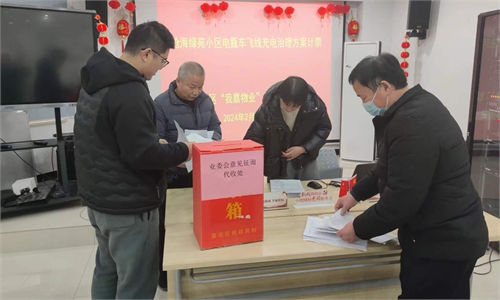
The suggestion box at this AI community canteen is filled with exactly that kind of democracy. Dong shared the two comments he remembers most clearly came from residents. One was from several elderly diners who said that during the lunch rush, seats were hard to find and there was nowhere to sit when they arrived. The other came from many very old residents who were unable to use smartphones. Although they carried their senior citizen card issued by the Shanghai government, they could not enjoy the meal subsidy it was meant to provide.
In response, the canteen adjusted its layout and expanded the dining area. The technical team upgraded the payment system so that the senior citizen card could be swiped directly, with the subsidy automatically deducted. And this was not a one-time adjustment. "Every step was changed based on the feedback we received from the residents," Dong told the Global Times.
Listening and responding extends far beyond this one canteen. Across China, the same pattern can be seen everywhere: from resident consultation meetings on renovating old residential compounds, to public calls for proposals on community spaces; from opinion surveys on rural infrastructure, to the optimization of urban public facilities. Local authorities have found that residents' "good ideas" become a "key" to urban governance and development, and hundreds of millions of people take part in building the homes and communities they themselves inhabit.
By 7:30 pm, the canteen had finished serving its last meal of the day. The last diner stood up to leave, and Dong saw him off at the door with a casual, "See you tomorrow."
After all the customers had left, Dong returned to the kitchen with his colleagues. They checked the smart cooking system's operating status, washed dishes, and then, as usual, opened the suggestion box to see whether any new notes had been left inside. "None today," he said with a smile. "Looks like everyone was pretty satisfied."
The bustle and warmth of the AI community canteen gradually faded into the night. Outside the window, lights came on one after another across the city.
RELATED ARTICLES