Huawei’s Kirin 9050 series has been mass-produced; 2027 Kirin chips show impressive test results: company
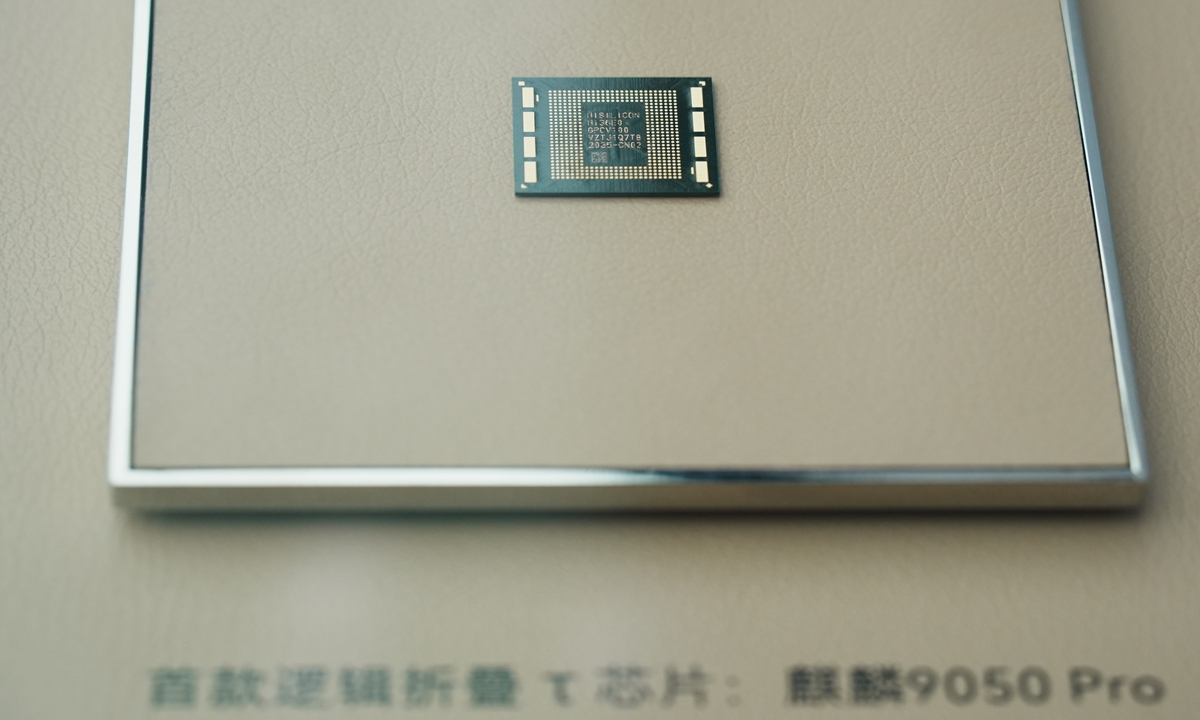
A photo taken at a Huawei store in Hangzhou shows the Kirin 9050 Pro chip, Huawei's first high-performance processor to adopt logic folding technology, on September 7, 2026 Photo: VCG
With the support of China's electronics industry, Huawei's Kirin 9050 series, the first chip to adopt LogicFolding, has been successfully mass-produced, a Huawei executive said on Tuesday, noting that the 2027 Huawei Kirin chips are ready and showed impressive results in some tests.
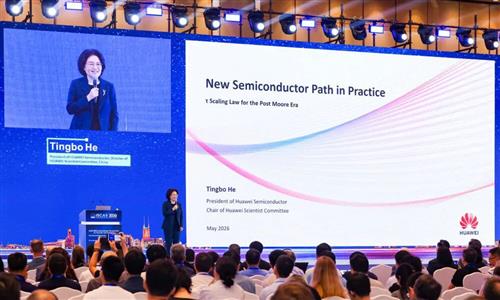
Xu Songyu, head of the Wireless Device Chip Product Management of Huawei Semiconductor Business, made the remarks during an event held in Shanghai, where the executive also revealed Kirin 9050 Pro components based on the Tau Law for the first time.
According to the company, the Tau Scaling Law resulted in considerable gains in Huawei Kirin 9050 Pro's energy efficiency and performance. The chip relies on the LogicFolding architecture, which uses a 16-thread Lingxi CPU and a 9-core configuration.
Data released by the company shows that the Kirin 9050 series has increased transistor density by 53.5 percent, while the Kirin 9050 Pro delivers a 41 percent improvement in CPU big-core energy efficiency and a 140 percent increase in NPU computing power.
After the launch of the Kirin 9000 in 2020, Huawei's chip business encountered supply restrictions. It was not until August 2023 that mobile phones powered by Kirin chips returned to the market. The company disclosed that cumulative shipments of terminal products based on Kirin chips have exceeded 100 million units since 2023.
Huawei's chip development came as China's integrated circuit industry is ushering in a new round of rapid growth with the global AI technological revolution triggering a surge in demand for high-end computing chips and memory chips.
Analysts noted that China has a super-large-scale domestic application market, with demand in fields such as AI, automotive electronics, and industrial control continuing to be released, providing an ample testing ground and fertile soil for growth for the chip industry.
Moreover, a complete industrial chain brings supply advantages. From design and manufacturing to packaging and testing, China's integrated circuit industry possesses a full-chain capability that is rare in the world.
In July, China's integrated circuit output reached 53 billion units, equivalent to a daily average of about 1.7 billion chips, official data showed. The market research firm Omdia has raised its forecast for China's semiconductor market in 2026, projecting the market will reach $812.08 billion.
Global Times
RELATED ARTICLES