Huawei semiconductor chief He Tingbo interviewed by People's Daily: ‘Keep moving forward, a bridge and a way will emerge’
Editor's Note:
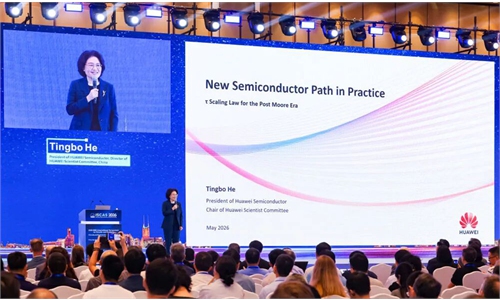
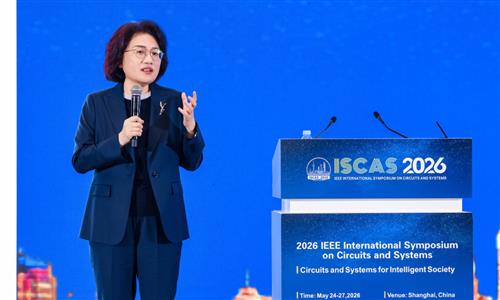
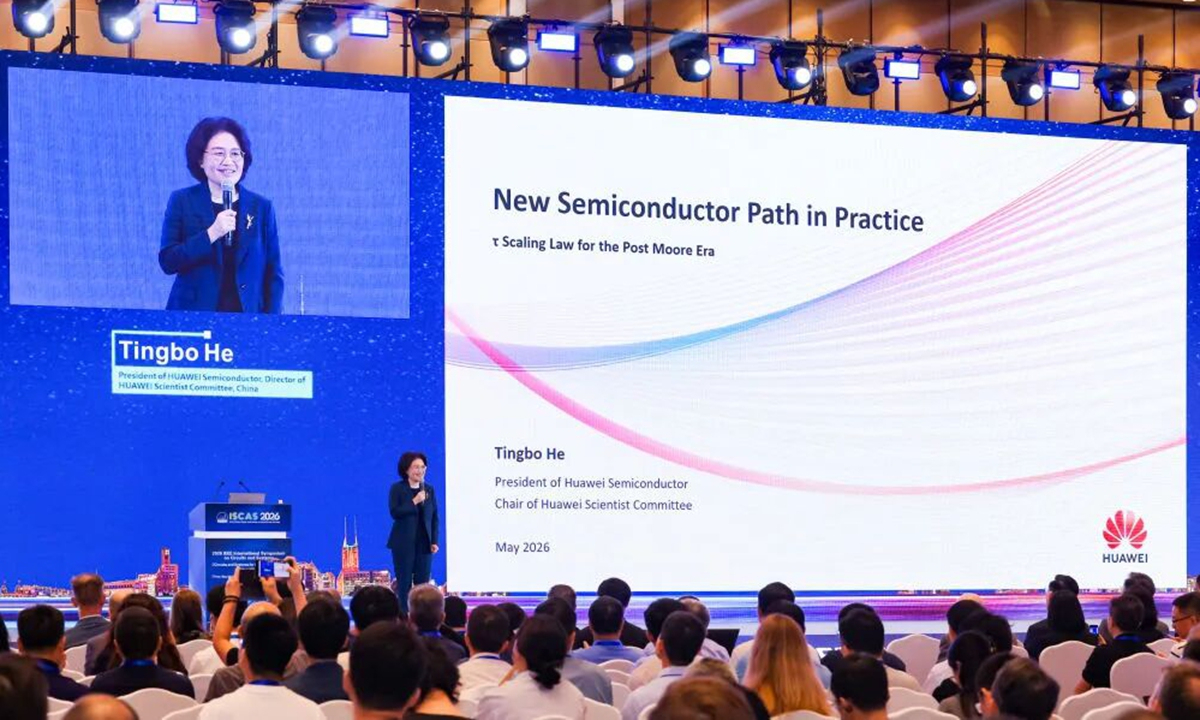
On May 25, He Tingbo, president of Huawei's semiconductor business department, published a signed paper titled "A Time Scaling Theory for Multi-Layer Electronic Systems" on ChinaXiv.org, offering a detailed interpretation of the "Tau (τ) Scaling Law" first proposed at the 2026 IEEE International Symposium on Circuits and Systems and revealing parts of the roadmap for Huawei's Kirin and Ascend chip series.
In May 2019, He drew widespread attention with an open letter announcing that Huawei's chip "backup plan" had officially gone into operation and reaffirming the company's commitment to technological self-reliance. Seven years later, she has once again returned to the public spotlight. Recently, the People's Daily (PD) interviewed He Tingbo (He) to discuss Huawei's chip progress in the past years as well as the newly released semiconductor design approach.
PD: As a new Law, what is 'new' about the "Tau Scaling Law"?
He: When discussing the new design approach, we should first return to Moore's Law. For more than 60 years since it was proposed, Moore's Law has served as a "contract" or industrial convention guiding the electronics industry to focus on the "geometric scaling" of chips in physical space. However, as Moore's Law approaches physical limits and economic costs surge, the trend has slowed. This requires us to return to the fundamentals of science and seek another path.
The "Tau Scaling Law" replaces "geometric scaling" with "time scaling" as the new guiding principle for the evolution of semiconductors and electronic systems. Through innovative technologies such as logic folding, it continuously compresses signal transmission delay and further increases transistor density, enabling the sustained evolution of semiconductors and electronic systems.
PD: What considerations led to the proposal of this law?
He: For Huawei, chips face two key constraints. One is inevitable that Moore's Law will hit a physical "wall" within the next decade. The other is accidental because of the external restrictions that Huawei encountered this "wall" earlier than its peers. This led me to reflect that the essence of Moore's Law is not merely shrinking space, but achieving faster speeds, more functions and affordable prices.
To use an analogy, if a city wants to build more parks, schools and hospitals, it becomes more crowded and commuting times increase. How can this be solved? One key technology behind the "Tau Scaling Law" is logic folding - essentially "stacking" one urban district on top of another and installing millions of elevators between them according to logical relationships. In this way, direct distances are shortened, time is saved and more functions can be provided.
PD: Guided by the "Tau Scaling Law," what innovations and explorations has Huawei undertaken?
He: Over the past six years, guided by this law, we have independently developed 381 chips. Across optical communications, data communications, wireless technologies, 5G, Kirin smartphone chips, autonomous driving, as well as general-purpose and AI computing represented by the Kunpeng and Ascend series, we have redesigned chips from the ground up. This has enabled Huawei's key products to return to consumers and customers.
PD: Could the "Tau Scaling Law" point the global chip industry toward a new direction?
He: This is a breakthrough in Huawei's foundational theoretical research. It is important not only for chips themselves, but also for the entire semiconductor industry. Over the next five to 10 years, the semiconductor industry will inevitably encounter obstacles and seriously consider the path represented by the "Tau Scaling Law."
It took 10 years for Moore's Law to move from proposal to full industry acceptance. As an engineer, I naturally do not want the work I engage in to remain a bottleneck forever. We are releasing the practice and roadmap of the "Tau Scaling Law" because we are relatively confident - more confident than at any other point in the past six years. Some may join us in three days, while others may take three to five years, and all are welcome. More practice is needed to prove the concept, and we hope everyone can work together to improve it.
PD: What nanometer level Huawei's chips have now reached?
He: I believe concern with this question still reflects the influence of Moore's Law. Under the "Tau Scaling Law," chip evolution can develop with "acceleration." This autumn, Huawei will release a new Kirin smartphone chip, which will be the first complete "Tao chip." In terms of performance, integration and transistor density, the improvement compared with last year will be "leapfrog" in nature.
Over the next five to 10 years, we are confident in making steady progress under the "Tau Scaling Law." This "acceleration" can be compared with the other technological path - the gap will not widen, but continue to improve.
PD: Innovation is a marathon, especially in fundamental theoretical research. What has mainly sustained your persistence?
He: Faced with various difficulties, we did not retreat and instead fought with all our strength. What we are proud of are simple beliefs and painstaking efforts. As long as the direction is correct, it does not matter if progress is slower. Keep moving forward, a bridge and way will emerge.
The result is that through persistence and practice in foundational theoretical research, we have not only opened a road, but built a highway.
We are a company dominated by engineers, and the job of engineers is to solve problems. External restrictions imposed extremely harsh constraints on us, but also gave us a purer motivation to work. Most of the time, the team remained firm, quiet and calm in its work. Only under conditions of calmness, concentration and freedom from distractions can people sincerely, openly and deeply discuss problems and ultimately find solutions.
PD: Do you think the most difficult period has already passed?
He: Sometimes the easiest moments are actually the most difficult, because it becomes easier to relax, grow complacent and ignore competition. From a technical and engineering perspective, I can say the hardest period has passed, but other difficulties still need to be overcome.
PD: The last time you appeared prominently in public was in 2019, when you described Huawei's chip "backup plan" as a "solemn Long March" in a letter to employees. Do you still think that way?
He: I did not sleep the night I wrote that letter. What I was thinking about was how we could survive if supply was cut off. After May 2020, the various "cages" customized for Huawei proved far harsher than imagined. I often say that overnight we were thrown back into the "primitive society."
Between us and foreign peers, only Maxwell's equations, Schrödinger's equation, Mendeleev's periodic table remained shared; everything else was separated. I could only return to scientific first principles and rethink our path from the origin of science itself.
PD: Do you believe you have delivered a satisfactory answer after seven years?
He: I would say we do have delivered a fairly good answer, and we are very confident. Seven years ago, we did not know where the road was. "With no way out, the only road is victory" was a major determination and vision, but vision alone is not enough - there also needs to be a technological path. The "Tau Scaling Law" is one answer we have found.
PD: On the path of catching up and surpassing others, what could this new path bring to millions of global users and the industry?
He: I have not thought that far ahead. First, at least for Huawei, it allows us to fulfill our commitments to customers and provide better products and services. Second, in the past we also benefited from the achievements of the global academic and industrial communities. Now, the Chinese technology community is proactively sharing good practices to jointly address global challenges and develop together along this new path. In this way, it can bring greater benefits to the industry, customers and society as a whole.
Openness, cooperation and mutual benefit - we welcome peers to work together with us to improve this path, because no single company can provide all the answers.
On May 25, He Tingbo, president of Huawei's semiconductor business department, published a signed paper titled "A Time Scaling Theory for Multi-Layer Electronic Systems" on ChinaXiv.org, offering a detailed interpretation of the "Tau (τ) Scaling Law" first proposed at the 2026 IEEE International Symposium on Circuits and Systems and revealing parts of the roadmap for Huawei's Kirin and Ascend chip series.
In May 2019, He drew widespread attention with an open letter announcing that Huawei's chip "backup plan" had officially gone into operation and reaffirming the company's commitment to technological self-reliance. Seven years later, she has once again returned to the public spotlight. Recently, the People's Daily (PD) interviewed He Tingbo (He) to discuss Huawei's chip progress in the past years as well as the newly released semiconductor design approach.
He Tingbo, president of Huawei's semiconductor business department Photo: Screenshot of Xinhua News Agency's report
PD: As a new Law, what is 'new' about the "Tau Scaling Law"?
He: When discussing the new design approach, we should first return to Moore's Law. For more than 60 years since it was proposed, Moore's Law has served as a "contract" or industrial convention guiding the electronics industry to focus on the "geometric scaling" of chips in physical space. However, as Moore's Law approaches physical limits and economic costs surge, the trend has slowed. This requires us to return to the fundamentals of science and seek another path.
The "Tau Scaling Law" replaces "geometric scaling" with "time scaling" as the new guiding principle for the evolution of semiconductors and electronic systems. Through innovative technologies such as logic folding, it continuously compresses signal transmission delay and further increases transistor density, enabling the sustained evolution of semiconductors and electronic systems.
PD: What considerations led to the proposal of this law?
He: For Huawei, chips face two key constraints. One is inevitable that Moore's Law will hit a physical "wall" within the next decade. The other is accidental because of the external restrictions that Huawei encountered this "wall" earlier than its peers. This led me to reflect that the essence of Moore's Law is not merely shrinking space, but achieving faster speeds, more functions and affordable prices.
To use an analogy, if a city wants to build more parks, schools and hospitals, it becomes more crowded and commuting times increase. How can this be solved? One key technology behind the "Tau Scaling Law" is logic folding - essentially "stacking" one urban district on top of another and installing millions of elevators between them according to logical relationships. In this way, direct distances are shortened, time is saved and more functions can be provided.
PD: Guided by the "Tau Scaling Law," what innovations and explorations has Huawei undertaken?
He: Over the past six years, guided by this law, we have independently developed 381 chips. Across optical communications, data communications, wireless technologies, 5G, Kirin smartphone chips, autonomous driving, as well as general-purpose and AI computing represented by the Kunpeng and Ascend series, we have redesigned chips from the ground up. This has enabled Huawei's key products to return to consumers and customers.
PD: Could the "Tau Scaling Law" point the global chip industry toward a new direction?
He: This is a breakthrough in Huawei's foundational theoretical research. It is important not only for chips themselves, but also for the entire semiconductor industry. Over the next five to 10 years, the semiconductor industry will inevitably encounter obstacles and seriously consider the path represented by the "Tau Scaling Law."
It took 10 years for Moore's Law to move from proposal to full industry acceptance. As an engineer, I naturally do not want the work I engage in to remain a bottleneck forever. We are releasing the practice and roadmap of the "Tau Scaling Law" because we are relatively confident - more confident than at any other point in the past six years. Some may join us in three days, while others may take three to five years, and all are welcome. More practice is needed to prove the concept, and we hope everyone can work together to improve it.
PD: What nanometer level Huawei's chips have now reached?
He: I believe concern with this question still reflects the influence of Moore's Law. Under the "Tau Scaling Law," chip evolution can develop with "acceleration." This autumn, Huawei will release a new Kirin smartphone chip, which will be the first complete "Tao chip." In terms of performance, integration and transistor density, the improvement compared with last year will be "leapfrog" in nature.
Over the next five to 10 years, we are confident in making steady progress under the "Tau Scaling Law." This "acceleration" can be compared with the other technological path - the gap will not widen, but continue to improve.
PD: Innovation is a marathon, especially in fundamental theoretical research. What has mainly sustained your persistence?
He: Faced with various difficulties, we did not retreat and instead fought with all our strength. What we are proud of are simple beliefs and painstaking efforts. As long as the direction is correct, it does not matter if progress is slower. Keep moving forward, a bridge and way will emerge.
The result is that through persistence and practice in foundational theoretical research, we have not only opened a road, but built a highway.
We are a company dominated by engineers, and the job of engineers is to solve problems. External restrictions imposed extremely harsh constraints on us, but also gave us a purer motivation to work. Most of the time, the team remained firm, quiet and calm in its work. Only under conditions of calmness, concentration and freedom from distractions can people sincerely, openly and deeply discuss problems and ultimately find solutions.
PD: Do you think the most difficult period has already passed?
He: Sometimes the easiest moments are actually the most difficult, because it becomes easier to relax, grow complacent and ignore competition. From a technical and engineering perspective, I can say the hardest period has passed, but other difficulties still need to be overcome.
PD: The last time you appeared prominently in public was in 2019, when you described Huawei's chip "backup plan" as a "solemn Long March" in a letter to employees. Do you still think that way?
He: I did not sleep the night I wrote that letter. What I was thinking about was how we could survive if supply was cut off. After May 2020, the various "cages" customized for Huawei proved far harsher than imagined. I often say that overnight we were thrown back into the "primitive society."
Between us and foreign peers, only Maxwell's equations, Schrödinger's equation, Mendeleev's periodic table remained shared; everything else was separated. I could only return to scientific first principles and rethink our path from the origin of science itself.
PD: Do you believe you have delivered a satisfactory answer after seven years?
He: I would say we do have delivered a fairly good answer, and we are very confident. Seven years ago, we did not know where the road was. "With no way out, the only road is victory" was a major determination and vision, but vision alone is not enough - there also needs to be a technological path. The "Tau Scaling Law" is one answer we have found.
PD: On the path of catching up and surpassing others, what could this new path bring to millions of global users and the industry?
He: I have not thought that far ahead. First, at least for Huawei, it allows us to fulfill our commitments to customers and provide better products and services. Second, in the past we also benefited from the achievements of the global academic and industrial communities. Now, the Chinese technology community is proactively sharing good practices to jointly address global challenges and develop together along this new path. In this way, it can bring greater benefits to the industry, customers and society as a whole.
Openness, cooperation and mutual benefit - we welcome peers to work together with us to improve this path, because no single company can provide all the answers.
RELATED ARTICLES