Chinese automakers accelerate push into Canada, creating new opportunities for win-win cooperation
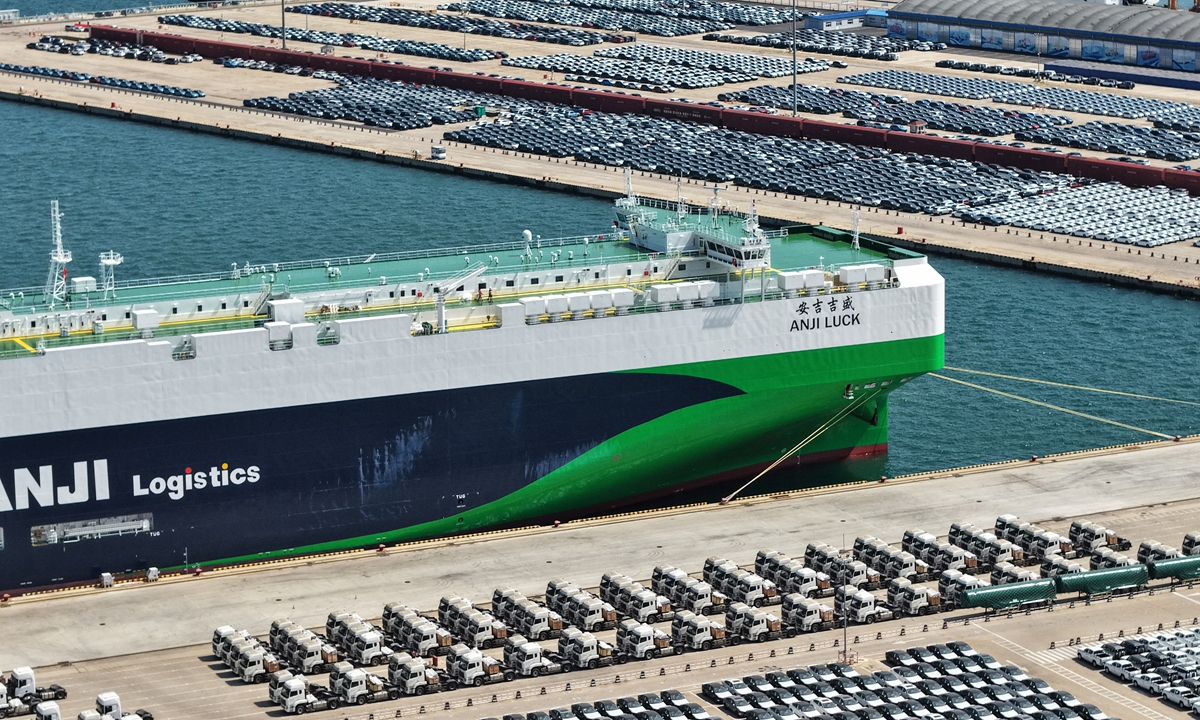
Cars bound for overseas markets wait to be loaded at Yantai Port in East China's Shandong Province on September 15, 2026. Photo: VCG
"Geely E5 spotted in Edmonton [a city in Canada] today!" a netizen posted in a Facebook group dedicated to discussions about Chinese electric vehicles (EVs) in Canada in late September, sharing several close-up photos of the car.
The post quickly sparked discussion among group members, with some suggesting the vehicle could be undergoing long-distance endurance testing or preparing for winter trials in the coming months. The buzz reflects growing anticipation for Chinese EVs on Canadian streets.
On October 9, Geely Auto officially announced its entry into the Canadian market. "With a Canadian team now in place, Geely Auto is establishing local operations and developing a retail and service network ahead of introducing its first vehicles to Canadian consumers in 2027," the company said in a statement sent to the Global Times on Monday.
Geely is far from alone in betting on Canada's evolving automotive landscape. Chinese automakers, including Lotus and Chery, are accelerating their push into Canada, aiming to turn what was until recently one of the most protected auto markets in the world into a fresh frontier for bilateral economic cooperation.
Industry observers said the steady drumbeat of entries reflects not only warming bilateral ties between Beijing and Ottawa but a recalibration of Canada's own industrial strategy. The significance extends beyond vehicle sales to industrial collaboration, which is expected to create new opportunities for China-Canada economic and trade cooperation.
Market entry
Following Canadian Prime Minister Mark Carney's visit to China at the beginning of the year, bilateral cooperation in areas such as EVs has made positive progress. Chinese automaker Lotus' first batch of 18 Eletre EVs arrived in Canada in June. According to a statement the company sent to the Global Times, Lotus was the first Chinese auto brand to complete certification and ship vehicles to Canada after the country reduced tariffs on Chinese-made EVs on March 1, 2026.
Chery's two global premium brands, Omoda and Jaecoo, have launched a Canadian website and confirmed that their premium electric SUVs will officially enter the market in late 2026, industry media outlet Electrek reported on September 28.
Meanwhile, BYD, the world's largest maker of new-energy vehicles, is opening some 20 sales locations with partners in Canada this year, according to a Bloomberg report. Together, these automakers cover segments ranging from premium performance vehicles to family SUVs to mass-market EVs.
Analysts noted that the consequential dimension of this wave is not retail but industrial. "For Canada's auto development strategy, Chinese EVs offer a complete, ready-to-deploy solution rather than a piecemeal one," Zhang Xiang, secretary-general of the International Intelligent Vehicle Engineering Association, told the Global Times on Monday.
China possesses a complete EV industrial chain and a mature supply network spanning batteries, electric drivetrains, and lightweight materials. As complete vehicles are exported, the move is expected to encourage cooperation with auto parts and raw material suppliers, creating opportunities for Canadian companies to find new partners and customers, Zhang said.
Meanwhile, Canada also offers an important market for Chinese EV brands.
"Canada represents an important next step in Geely Auto's international growth," said Bryan Wu, managing director of Geely Auto Canada. "We are entering this market with a long-term commitment, bringing our global technology and engineering capabilities to Canadian drivers while building strong local partnerships and the support customers need to feel confident in choosing Geely. We know that trust is earned over time, and we are committed to earning it here."
Feng Qingfeng, CEO of Lotus Group, said in the statement that "Chinese manufacturing is upgrading from a cost advantage to an advantage in quality and consistency." As export destinations expand from emerging markets to Western markets such as Europe and North America, this sets "higher requirements for automakers while creating greater value," Feng said.
Great momentum
The expansion also reflects a policy shift, as Canada seeks Chinese investment to bolster its automotive industry. In 2024, Canada announced a 100-percent surtax on Chinese-made EVs, effectively cutting Canadian consumers off from high-quality, affordable Chinese EVs.
As China-Canada economic and trade ties improved, the Canadian government announced in January that it would allow up to 49,000 Chinese EVs annually to enter Canada at the most-favored-nation tariff rate of 6.1 percent, exempting them from the 100-percent surtax.
"The sound China-Canada EV cooperation is predicated on stable trade relations and predictable investment policies, and current signs suggest Canada is heading down that path," Li Yong, a senior research fellow at the China Association of International Trade, told the Global Times on Tuesday.
Ottawa's opening to Chinese EVs is fundamentally driven by its trade diversification agenda - years of over-reliance on the US have exposed the vulnerabilities of a single-market strategy, pushing Canada to recalibrate, Li said. "This auto sector collaboration could just be the beginning; lasting, two-way returns will ultimately depend on a consistently sound business climate," he said.
Canadian public opinion also favors win-win cooperation with China. According to a survey, China is becoming an increasingly important market as Canada seeks to diversify its export destinations. An improved bilateral trade structure and closer economic and trade cooperation could support sustained growth in China-Canada trade, according to Xinhua.
After serving as guest country of honor at the China International Consumer Products Expo in April, Canada will return as a guest country of honor at the 9th China International Import Expo (CIIE) in November, its first appearance in that role at the CIIE in eight years.
"It's a great momentum for Canada and China to explore more opportunities," David Perez-Des Rosiers, chief representative of the Canada China Business Council Beijing, told the Global Times in a recent interview.
RELATED ARTICLES