Poll shows most Canadians support arrival of more Chinese EVs; result reflects broad public support for Canada’s China policy shift: expert
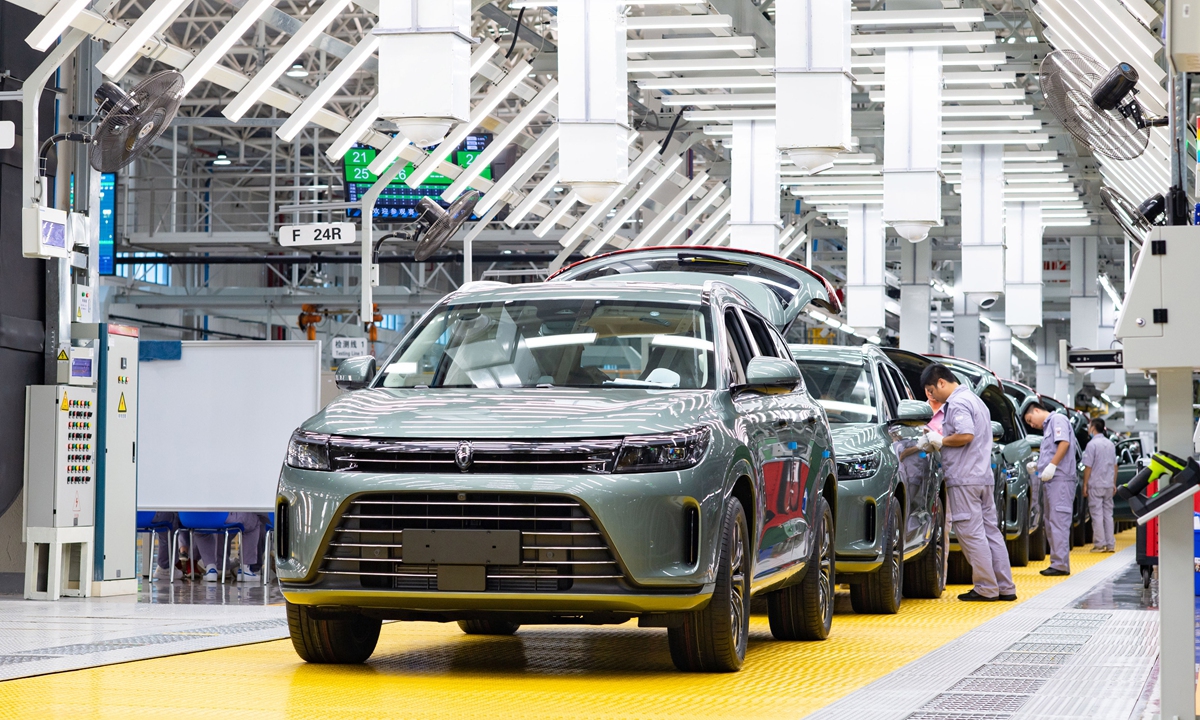
An NEV manufacturing line in Southwest China's Chongqing Municipality Photo: VCG
A new poll conducted by North American market research company Leger showed that most Canadians support allowing more Chinese electric vehicles (EVs) to be sold in Canada, according to the Canadian Press on Wednesday. A Chinese expert said on Thursday that the results reflected broad public support for the Canadian government's recent adjustment in its policy toward China, and Canadian consumers want more cost-effective Chinese EVs.
According to the Canadian Press, the poll, which was conducted online and can't be assigned a margin of error, surveyed 1,570 people from January 30 to February 2. It showed that 61 percent of respondents backed the decision to permit more Chinese EVs to be sold in Canada, with 24 percent saying they "strongly" supported the move and 38 percent saying they "somewhat" supported it, according to the Canadian Press report.
The poll came after the Canadian government announced during Prime Minister Mark Carney's visit to China last month that it would allow an annual quota of 49,000 Chinese EVs into the Canadian market at the most-favored-nation tariff rate of 6.1 percent, exempting them from the 100-percent surtax imposed in 2024.
The Leger poll showed that seven in 10 people surveyed were aware of the agreement between Ottawa and Beijing.
The poll appears to be aimed at surveying Canadian public perception for the Canadian government's policy adjustment and the results reflected broad support in Canada for the shift, Zhou Mi, a senior research fellow at the Chinese Academy of International Trade and Economic Cooperation, told the Global Times on Thursday.
Steve Mossop, Leger executive vice-president for Western Canada, also told the Canadian Press that the results reflect a broader shift in how Canadians view Canada's relationship with China. "Canadians have changed their views radically in the past 12 months on just how we view our relationship with China, and this is just one example of that," he was quoted as saying.
Zhou said that the results also showed that many Canadian consumers are very interested in Chinese EVs, as the 100 percent tariffs previously imposed on imported Chinese EVs significantly limited consumer choices in Canada, making it difficult for high-quality, cost-effective vehicles to enter the Canadian market.
"Many Canadians clearly want more affordable, competitive options to advance affordability and the green transition," Zhou said, adding that rising pressure from the US on trade has also likely pushed Canadians to favor diversifying trade partners.
The poll also claimed that some respondents expressed concerns about quality and durability of Chinese EVs, as well as the effects on the Canadian auto industry.
However, "this is mainly due to a lack of proper understanding of Chinese EVs, due to tensions between the two countries in the past and slanders against Chinese EVs by some media," Zhou noted.
The expert also stressed the need to strengthen communication and transparency. "By creating smooth, reliable information channels and enhancing openness, we can dispel consumer misconceptions about automakers, while helping manufacturers better grasp genuine consumer concerns. This enables targeted improvements to products and services, fostering mutual trust," he said.
Meanwhile, the poll also claimed that nearly two-thirds of Canadians were concerned about possible retaliation from the US if Canada strengthens trade ties with China. However, nearly 60 percent opposed curbing trade with China to avoid US economic retaliation, according to the Canadian Press.
Many Canadians think more affordable EV options are worth it — despite concerns over auto jobs, quality, and potential US retaliation, according to Canadian media reports. Trevor Melanson, director of insights and communications at Clean Energy Canada, said that "more than anything, Canadians want an EV they can afford upfront. High levels of interest in Chinese EVs likely represents just that," Canadian news portal Car Guide reported.
Zhou noted that concerns about US retaliation are quite realistic, given Washington's constant threats. However, the poll indicated that the majority of Canadians have become more positive toward China, proving that most Canadian people hope the government will advance relations with China based on national interests and adopt a pragmatic strategy, Zhou said.
RELATED ARTICLES