ARTS / CULTURE & LEISURE
Chinese platforms remove viral AI videos pairing Monkey King and Lin Daiyu
By Published: Oct 13, 2026 09:38 PM

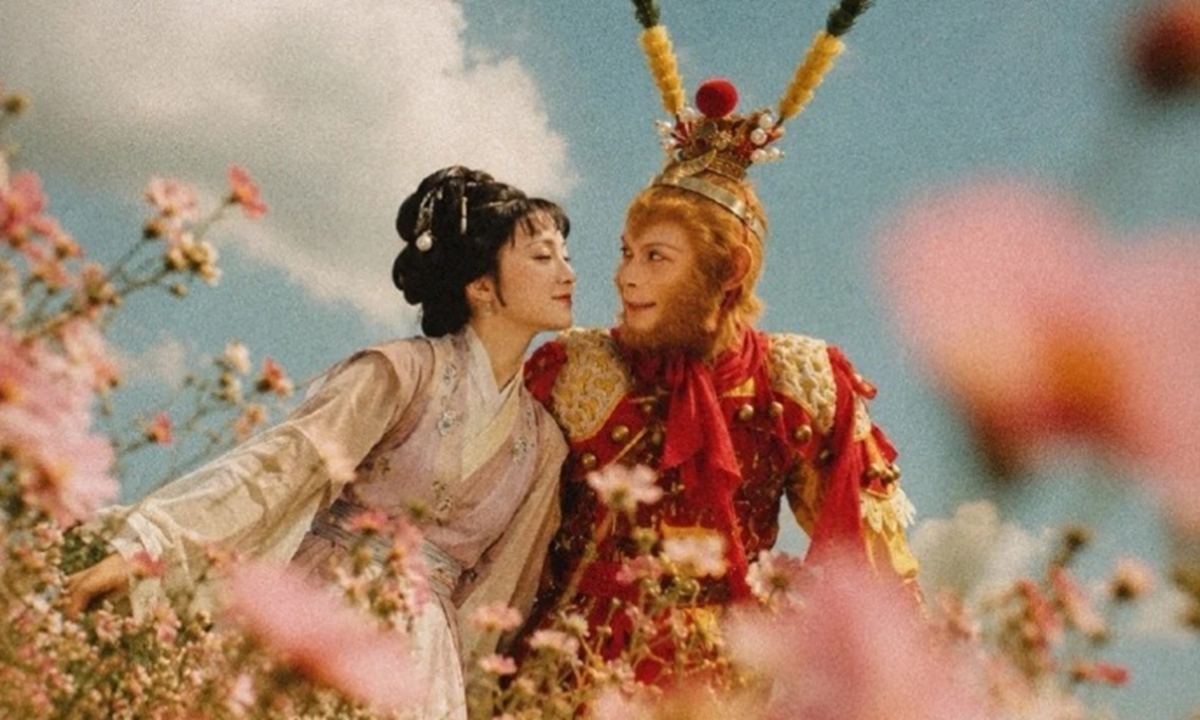
An AI-generated image of the "Sheng-Dai CP" Photo: Sina Weibo
Chinese short-video platforms have removed thousands of AI-generated videos pairing Sun Wukong, the Monkey King from Journey to the West, with Lin Daiyu, the female lead of Dream of the Red Chamber, after a viral crossover trend triggered debate over the boundaries of reworking classical literature.
The two novels are among China's four great classical novels. Journey to the West, written in the 16th century, follows the Tang Dynasty (618-907) monk Tang Sanzang and his disciples, including Sun Wukong, a powerful, rebellious monkey born from a stone who once wreaked havoc in Heaven.
Dream of the Red Chamber, written by Qing Dynasty (1644-1911) writer Cao Xueqin in the 18th century, chronicles the decline of the wealthy Jia family and the tragic love between Jia Baoyu and Lin Daiyu, a sensitive, gifted and frail young woman whose refusal to bow to convention has made her one of
China's most memorable literary heroines.
Using AI tools and footage from the beloved 1986 television adaptation of Journey to the West and the 1987 adaptation of Dream of the Red Chamber, online creators began "matching" the two characters.
In the videos, Sun Wukong takes Lin Daiyu to watch fireworks, or storms the underworld to change the book of life and death so that she can live. While Lin Daiyu, with her sharp tongue, nags Sun Wukong's master Tang Sanzang, who is known for his incessant preaching.
Fans have dubbed them the "Sheng-Dai CP," using internet slang for a romantic pairing.
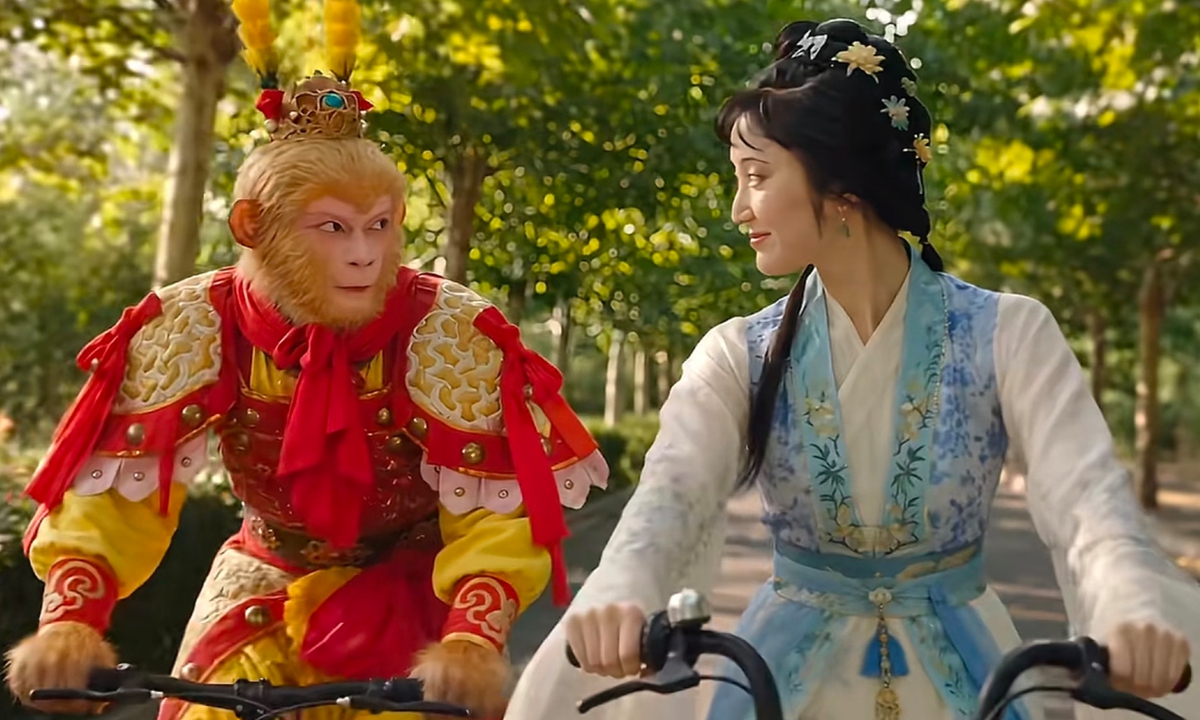
An AI-generated image of the Monkey King and Lin Daiyu
However, Chinese video platform Kuaishou's safety center said in a notice issued on Thursday that in September it handled 2,544 items of content violating "AI magic-modification" rules, including videos that improperly linked characters from classic film and television works in romantic relationships or placed them in time-travel interactions with popular game characters.WeChat and Douyin, the Chinese version TikTok, disclosed similar progress the same day.
The three platforms together cleared more than 7,400 videos that violated these rules in September, according to their notices, a Shanghai-based media outlet reported.
As of press time, a search for related videos did not produce any results on these social media platforms.
The trend has divided public opinion. Some users see these mashups as a playful way for young people to understand classics in their own way. Others worry that excessive adaptations can blur the original characters and relationships, distort the core of the novels, and mislead teenagers who have not read the books. Lawyers also warn of copyright and image-use risks.
Wu Xiaolin, a Beijing-based lawyer, told the Global Times that under Article 24 of China's Copyright Law, fair use for AI secondary creation is limited to small quotations for commentary and introduction purposes; directly using film and television footage as the main body of an AI-modified video and publicly spreading it generally constitutes infringement.
"Although the copyright for the original novels has expired, audiovisual works based on them remain protected, and original characters and their spiritual core are protected under the right of integrity, which prohibits distortion or mutilation," he said.
The removals do not appear to have extinguished broader discussion. Text jokes and debates continue online, as Chinese classics increasingly travel through new media and AI.
Yu Jinlong, a Beijing-based cultural scholar, told the Global Times on Tuesday that the trend's roots lie in the strong recognition of the two national classics, the natural appeal of the characters' contrasting personalities, and AI's lowering of creative barriers.
"Its core emotion is a desire among young people to compensate for Lin Daiyu's tragedy and to seek relationships based on mutual respect, spiritual resonance and low emotional friction," Yu said.
Wang Xianhua, dean of the School of Humanities at the Shanghai University of Finance and Economics, echoed that the pairing was not entirely random.
Sun Wukong was born from a stone, and Dream of the Red Chamber is also known as The Story of the Stone, prompting netizens to joke that Lin Daiyu had mistaken the wrong stone. More importantly, he said, both characters refuse to be disciplined: One dares to rebel against Heaven, the other refuses to flatter the world; one is free and powerful, the other sensitive and lonely.
"AI merely makes this imagination visible," Wang said.
The trend, he added, reflects young people's values: they cherish emotional value, equal companionship and spiritual resonance, and no longer treat classics as objects to be worshiped but as material to be renewed with new tools.
On balancing fun with cultural accuracy, Wang said the key is not to treat accuracy as meaning "not a single word can be changed." Classics have survived through performances, commentaries, opera and film adaptations, and each new audience reinterprets them.
"Fun is often the first step for foreign readers and young people to approach classics," he said.
The two scholars acknowledged a risk that foreign audiences unfamiliar with the novels may reduce grand literature to a sweet romance. But if derivative works are clearly labeled and paired with authoritative explanations, they could become a gateway to Chinese classics.
RELATED ARTICLES