China, EU hybrid auto trade deal secures export growth, fair treatment for Chinese firms: observers
WTO rules key to safeguarding automakers' interests, stable business expectations: analysts
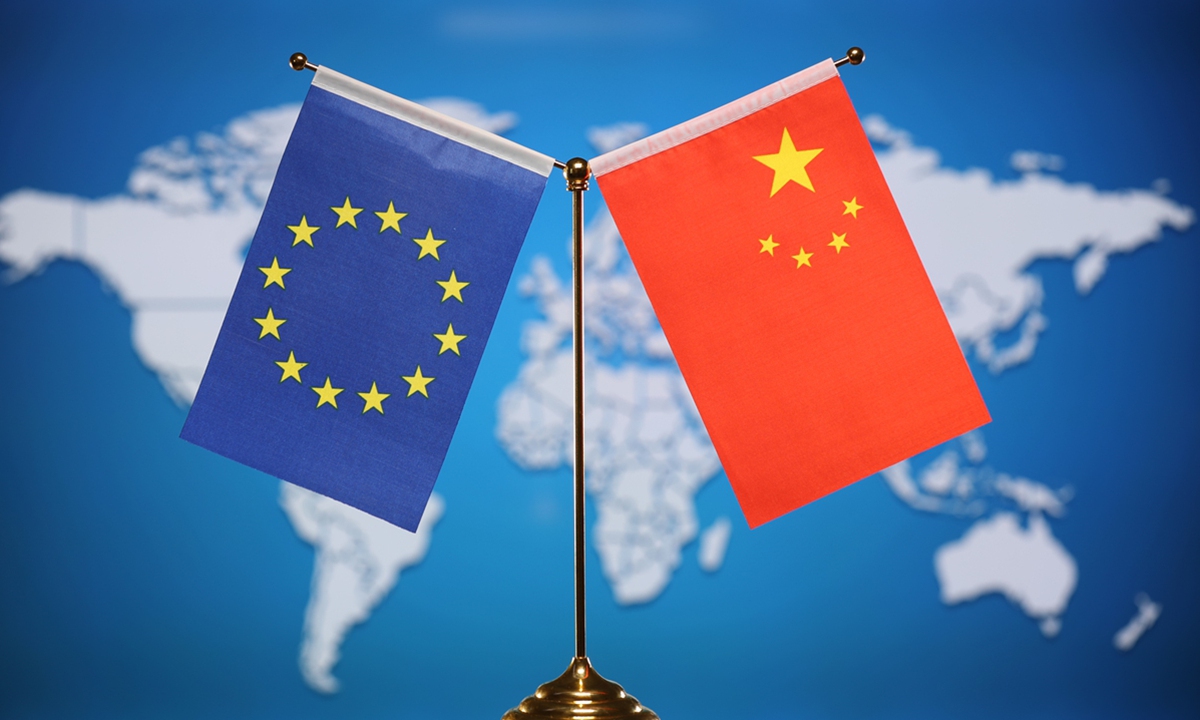
China EU Photo:VCG
China and the EU held more than 30 rounds of intensive consultations on hybrid and electric vehicle (EV) trade, during which the Chinese negotiating team maintained an open attitude and kept up dialogue with the automotive industries on both sides, a source familiar with the talks told the Global Times.
The two sides reached an arrangement for upward adjustment based on the EU's 2025 imports of Chinese hybrid vehicles, with a fixed annual increase thereafter, ensuring room for Chinese automakers to maintain and steadily expand their exports, according to China's Ministry of Commerce (MOFCOM) on Monday.
They also agreed that no measures would specifically target Chinese products or discriminate against Chinese companies, and that China's quota would be no lower than that granted to any other source of EU imports.
The arrangement was among 16 outcomes reached during the second meeting of the China-EU trade and investment consultation (TIC) mechanism in Beijing on October 8 and 9, covering issues including trade and investment, export controls, intellectual property rights and World Trade Organization (WTO) reform.
The hybrid vehicle arrangement has drawn attention following foreign media reports suggesting that it could cut China's hybrid vehicle exports to the EU by more than half over the next four years compared with projected levels.
The Global Times learned that the negotiations were based on the EU's actual imports of Chinese hybrid vehicles in 2025. According to Eurostat data, the EU imported 107,000 hybrid vehicles from China in 2024, rising to 302,000 in 2025.
Under the rules governing safeguard investigations, calculations must be based on the importing economy's official statistics, Chen Jingjing, secretary-general of the automotive branch of the China Chamber of Commerce for Import and Export of Machinery and Electronic Products, told the Global Times.
"By securing an arrangement that allows exports to continue growing from the EU's actual 2025 import level, China has secured the greatest possible export benefits for its automakers," she said.
Analysts noted that the claim of a more than 50 percent reduction was based on projecting the rapid growth of Chinese hybrid vehicle exports in recent years over the next four years and comparing the resulting figures with the negotiated arrangement, rather than the actual import volumes used in the talks. Such projections are inherently uncertain, given the influence of short-term market factors on past export growth.
Notably, the arrangement applies only to hybrid passenger cars, rather than all Chinese vehicle exports to the EU. Chinese customs data showed that China exported about 1.009 million vehicles to the bloc in 2025, up 30.4 percent year-on-year, including 181,000 fuel-powered vehicles, 472,000 electric vehicles and 356,000 hybrids. Hybrids accounted for about 35.3 percent of the total, or roughly one-third, showing that the arrangement covers only a portion of China's automotive exports to the EU.
Zhou Mi, a researcher at the Chinese Academy of International Trade and Economic Cooperation, told the Global Times that the arrangement addresses the concerns of industries on both sides while preserving room for continued export growth and business planning. The EU has substantial demand for imported vehicles, particularly hybrids, and restricting imports from China would make that demand more difficult to meet, he said.
Over the past several decades, Chinese companies have strengthened their capabilities through fair competition, innovation and responding to customer needs, Zhou said. Equal treatment would therefore provide a stronger foundation for companies to pursue cooperation, he added.
The recent consultations helped stabilize broader business expectations. Chinese Commerce Minister Wang Wentao said during a meeting with Danone CEO Antoine de Saint-Affrique on Monday that the second meeting of the China-EU trade and investment consultation mechanism had produced a series of outcomes and understandings that helped stabilize industry expectations.
Wang also said that China remains committed to expanding high-standard opening-up, with its growing consumer market and continued consumption upgrading creating broad opportunities for foreign-invested enterprises. He welcomed Danone to expand its investment and innovation-driven research and development in China.
The broader significance of China-EU trade negotiations ultimately lies in whether they can give businesses on both sides the confidence to invest and operate in stable and predictable market conditions, analysts said.
However, while China approached the negotiations with sincerity, some actions by the EU undermined mutual trust, according to the source. China has demonstrated both sincerity and patience in seeking negotiated solutions, but sincerity cannot be one-sided, nor is China's patience without limits.
Against this backdrop, the two sides' confirmation that trade arrangements must comply with WTO rules is particularly important. Chen said that this means China retains all its rights under the WTO framework, including the right to seek dispute settlement and trade compensation.
If the EU violates relevant WTO rules during its investigation, China can use all lawful means consistent with those rules to effectively safeguard the interests of Chinese enterprises, providing greater reassurance to businesses, Chen said.
RELATED ARTICLES