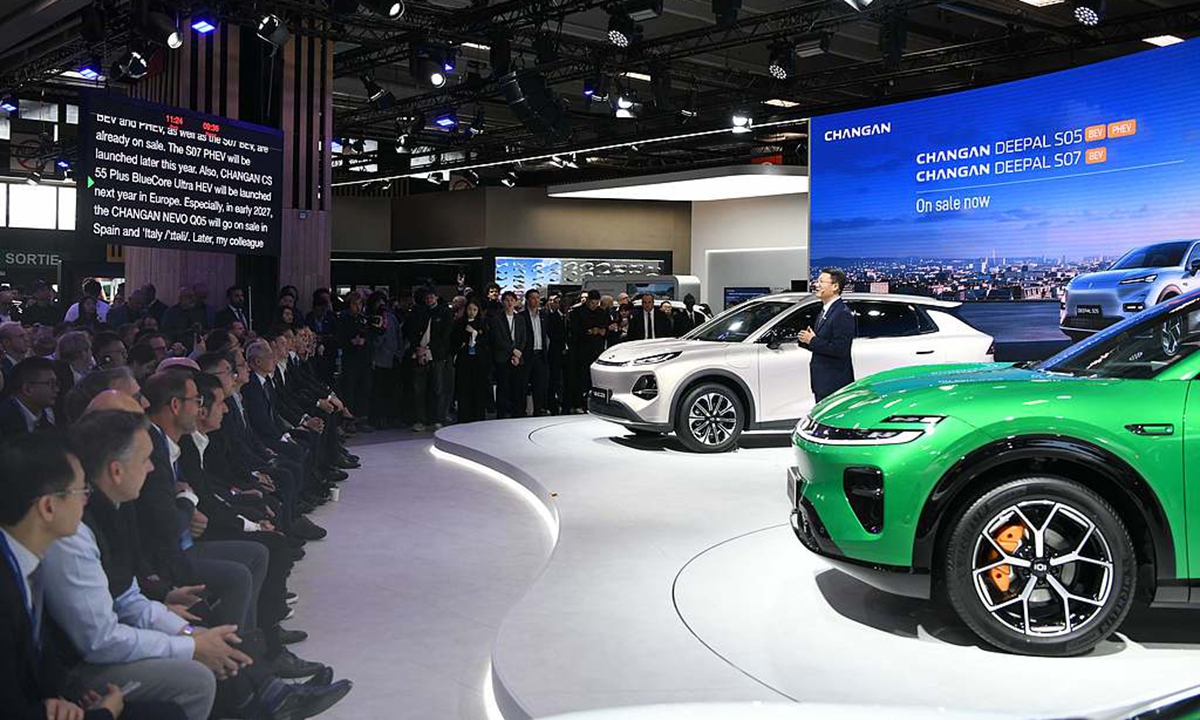
China's Changan Auto introduces models from several of its new-energy vehicle brands at a press conference during the 2026 Paris Motor Show, which opened in Paris, France, on October 12, 2026. Photo: VCG
A spokesperson for the Chinese Ministry of Commerce (MOFCOM) said on Monday that on the basis of mutual respect and equal-footed consultation, China and the EU have held intensive consultations regarding trade in hybrid and electric vehicles (EVs), seeking to address economic and trade differences as well as each other's concerns in a balanced manner. The joint statement of the second meeting of the China-EU trade and investment consultation mechanism noted that, following intensive consultations, the two sides reached an understanding on hybrid vehicle trade in a manner consistent with WTO rules. The statement also referred to the previously agreed guidance document on price undertakings in the EU's countervailing duty case against Chinese EVs, saying that procedures for company-specific price undertakings and reviews under the EV case would continue.
These outcomes were hard won. A source said China and the EU held more than 30 rounds of intensive consultations on hybrid and electric vehicle trade. Throughout the consultations, the Chinese team maintained an open attitude and kept up dialogue with the automotive industries on both sides. According to MOFCOM news releases, Commerce Minister Wang Wentao met with Hildegard Müller, president of the German Association of the Automotive Industry, and held a video call with Ola Källenius, president of the European Automobile Manufacturers' Association and chairman of Mercedes-Benz Group, on September 21. MOFCOM also maintained close communication with the domestic industry.
Notably, the hybrid vehicle trade arrangement applies only to hybrid passenger cars. Chinese customs statistics showed that China exported about 1.009 million vehicles to the EU in 2025, up 30.4 percent year-on-year, including 181,000 fuel-powered vehicles, 472,000 electric vehicles and 356,000 hybrids. Hybrids therefore accounted for about 35.3 percent of the total, or roughly one-third, indicating that the arrangement covers only part of China's automotive exports to the EU.
Chen Jingjing, secretary-general of the automotive branch of the China Chamber of Commerce for Import and Export of Machinery and Electronic Products, told the Global Times on Monday that China consistently upheld three basic principles throughout the negotiations: respect for facts, non-discrimination and compliance with WTO rules. These principles reflect the Chinese government's determination to safeguard the interests of China's industry. For example, the choice of a reference level directly concerns the industry's core interests. Under the rules governing safeguard investigations, calculations must be based on the importing economy's statistics, she noted. According to Eurostat data, the EU imported 107,000 hybrid vehicles from China in 2024 and 302,000 in 2025. Reaching an arrangement for upward adjustment based on the EU's 2025 import volume means that China has secured the greatest possible export benefits for its companies, she said.
Respect for facts also means recognizing the market demand underpinning trade, Zhou Mi, a researcher at the Chinese Academy of International Trade and Economic Cooperation, told the Global Times. He said the arrangement also provides for a fixed annual increase, leaving room for continued export growth and business planning while taking into account the concerns of industries on both sides. The EU has considerable demand for imported vehicles, particularly hybrids, and obstructing imports from China would make that demand harder to meet, he said.
The MOFCOM spokesperson also said that under the principle of non-discrimination for the hybrid vehicle arrangement, no measures will specifically target Chinese products, let alone discriminate against Chinese enterprises. The quota allocated to China will be no lower than that granted by the EU to any other source of imports.
Zhou said this principle means that any subsequent measures taken by the EU will apply equally to all other sources of imports, including its free trade agreement partners. Under this principle, China will effectively retain its position as the EU's largest source of hybrid vehicle imports, he said.
Fair competition has helped Chinese companies improve their capabilities over decades, as they respond to customers' needs and innovate, Zhou said. Equal treatment therefore provides a stronger basis for companies to pursue development and cooperate with their trading partners.
Chen said the two sides also confirmed that the trade arrangement should comply with WTO rules, meaning that China reserves all its rights under the WTO framework, including recourse to dispute settlement and demands for trade compensation. This means that if the EU violates relevant WTO rules during its investigation, China can use all lawful and compliant means to effectively safeguard companies' interests, providing reassurance to businesses, she said.
Zhou said rules provide the foundation for trade policies and responses to them, helping businesses anticipate future conditions and protect their interests, and it is crucial for China and the EU, both major economies promoting free trade, to handle bilateral trade matters in line with WTO rules.
"Compliance matters beyond the current negotiations, as it can also set an example for addressing future differences with the EU and other economies," Zhou said.
Against the backdrop of rising global trade protectionism and the accelerating transformation of the automotive industry, achieving practical results through consultations on an equal footing is of particular significance, Jian Junbo, director of the Center for China-Europe Relations at Fudan University's Institute of International Studies, told the Global Times on Monday. The outcomes demonstrate that both sides have the willingness and capability to properly manage differences and deepen cooperation through dialogue, he said.
In a complex and volatile global trade environment, preventing trade tensions from escalating will help safeguard business interests and stabilize market expectations, while providing a useful example for addressing other trade and economic issues between the two sides, Jian said.
"For China and the EU, properly resolving trade disputes through dialogue and providing businesses with a fair, stable and predictable business environment will not only support the long-term development of their respective automotive industries, but also serve their shared interests in advancing the global automotive industry's green transition," Jian said.
RELATED ARTICLES