China's increasingly position in global value chains makes it ‘indispensable’ to global players: European Chamber
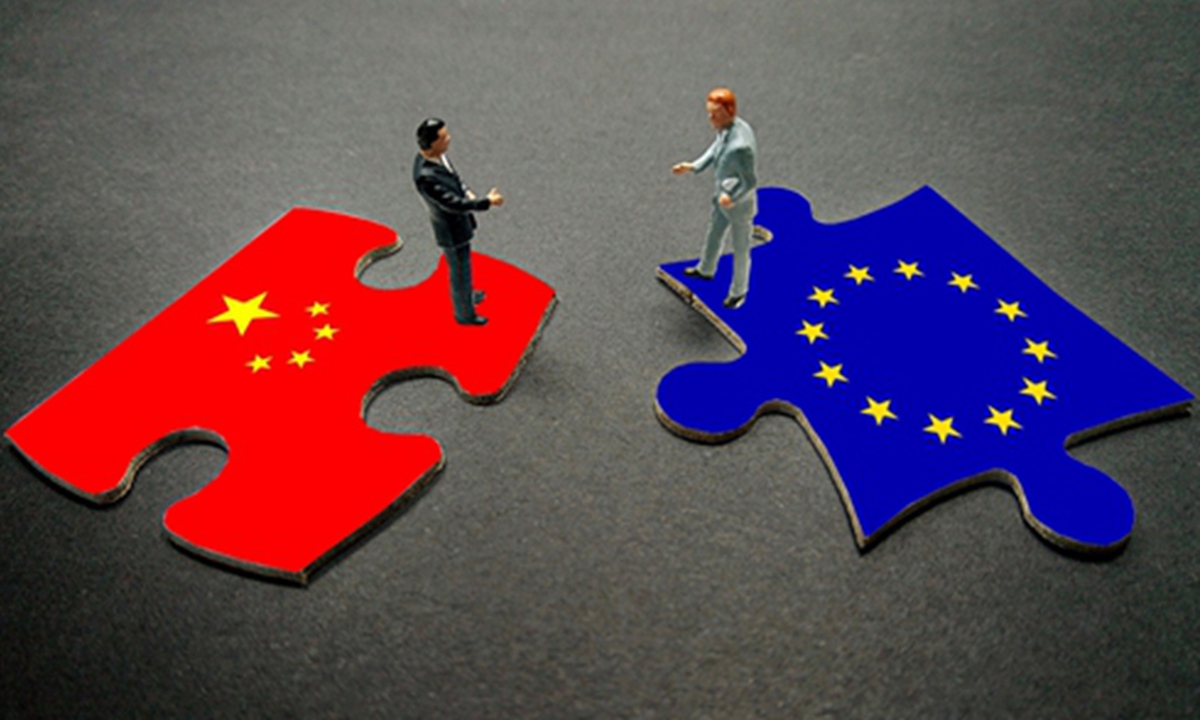
China-EU relationship Photo: VCG
China's increasingly strong position in global value chains is making it indispensable for global players, and that also include European companies, according to the head of the European Union Chamber of Commerce in China (European Chamber) on Tuesday, as the chamber released its European Business in China Position Paper 2026/2027, which addressed some of the latest development trends and perspectives of surveyed European businesses in China.The assessment comes as the EU continues to roll out or consider fresh restrictive measures targeting Chinese products and supply chains. Chinese experts said the latest assessment by the European Chamber highlights the deep interdependence between the Chinese and European economies, calling on Brussels to better reflect the actual market needs of European businesses and tap the two sides' complementary strengths in areas including advanced manufacturing, artificial intelligence and the green transition.
Indispensable supply chains
China's increasingly strong position in global value chains is making it indispensable for global players, and that also include European companies, according to Jens Eskelund, president of the European Union Chamber of Commerce in China (European Chamber), on Tuesday.
"China is very competitive. For many companies, if they want to maintain the growth of marketing, the only way that they can do that is by tapping to that cost-effectiveness of Chinese supply chains," Eskelund said.
The remarks were made during the launch of the European Chamber's European Business in China Position Paper 2026/2027, which addressed some of the latest development trends and perspectives of the surveyed European businesses in China.
Organized across 33 individual industry and horizontal position papers, the Position Paper 2026/2027 puts forward 1,096 recommendations on how Chinese policymakers can enhance business confidence, as well as achieve more sustainable trading relationships with key partners, including the EU, according to the chamber.
The role that China plays is changing for many multinationals, for whom the country's allure now stems less from the size and potential profitability of its market, and more from its world-leading supply chains and industrial clusters, the European Chamber said.
With China operations increasingly being integrated into global production, we are seeing an evolution from 'in China for China' to 'in China for the world,' the chamber said.
This also partially echoes findings from the European Business in China Business Confidence Survey 2026 released in late May, which said that China was the heavyweight champion of highly efficient and cost-effective supply chains, with 75 percent of respondents categorizing their China production as more efficient than their production in the rest of the world, and 94 percent seeing the market as important for sourcing.
"The European Chamber's latest assessment of China's position in global value chains reflects the European companies' actual business needs in China. After decades of development, China and the EU have become deeply integrated through industrial and supply chains. China's comprehensive industrial system, efficient supply chains and growing innovation capabilities not only support its domestic market, but also help many European companies remain competitive globally," Jian Junbo, director of the Center for China-Europe Relations at Fudan University's Institute of International Studies, told the Global Times on Tuesday.
The European Chamber also noted some challenges, including what it described as "involution," driven by the ongoing imbalance between supply and demand growth, which it said has contributed to a situation that can be characterized as "involution on loop."
Despite weak demand and intensifying competition in some sectors, China remains one of the world's most important markets, the expert said.
China is also taking steps to address "involution-style" competition, expand domestic demand and improve market order. For example, during the 15th Five-Year Plan (2026-30) period, Chinese market regulators will use standards, price enforcement and quality supervision to curb "involution-style" competition on the market, while tightening antitrust and anti-unfair competition enforcement, said Shu Wei, spokesperson and deputy administrator of the State Administration for Market Regulation (SAMR), China's top market regulator, on Sunday. "Rather than exhausting themselves in a fierce price-cutting competition, we will steer companies toward raising quality and efficiency," Shu said.
Meanwhile, the competitiveness of Chinese manufacturing stems not only from economies of scale, but also from strong industrial capacity, infrastructure, efficiency and innovation, advantages that European companies themselves have recognized, said Jian, noting that "the competitive pressures facing some European industries are also closely linked to Europe's own structural challenges, including high energy costs, insufficient investment and innovation weaknesses."
Barriers won't fix weaknesses
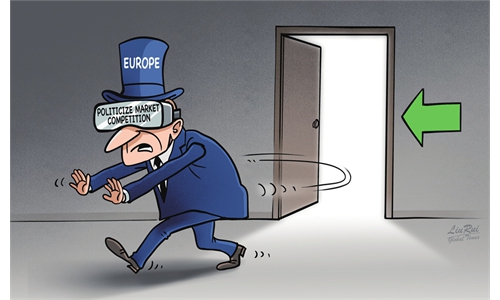
The European Chamber's Position Paper comes as the European Commission has stepped up restrictive measures and is considering further curbs targeting Chinese businesses and supply chains, with some voices also involving unilateral pressure on China under the guise of negotiations.
For example, the EU will impose a set of import quotas and minimum prices for electrical steel and downstream products, it said on Friday, in a bid to shield the EU from imports principally from Asia, Reuters reported.
The Reuters report claimed that "Brussels' move comes as the continent's industry is increasingly calling for better protection against China."
Meanwhile, the EU has asked China to voluntarily restrict exports of hybrid cars, the Financial Times reported.
Reuters also reported on September 10 that European governments including France, Italy and likely Germany, plan to press the EU to deploy a rarely used trade defense tool to protect the chemicals and plastics sectors from surging imports, mainly from China, citing sources familiar with the discussions.
Amid the EU's conflicting impulses between commercial interests and geopolitical protectionism, Chinese experts urged Brussels to confront the real challenges facing its own industries and stop scapegoating China for Europe's declining industrial competitiveness.
Huo Jianguo, a vice chairman of the China Society for World Trade Organization Studies in Beijing, told the Global Times that the EU has increasingly sought to pressure China to voluntarily narrow its trade surplus or make concessions in negotiations whenever Chinese exports rise rapidly, while using the threat of additional restrictive measures as leverage. "They are trying to make China a scapegoat for problems rooted in Europe's own industrial weaknesses," he said.
What China and the EU truly need, Huo said, is an overall framework for resolving economic and trade frictions. China does not pursue a trade surplus, and disputes should be addressed through cooperation and consultation rather than by restricting exports or erecting more trade barriers to force an artificial balance. "Such an approach is neither realistic nor acceptable to China," Huo said.
Chinese authorities have also made their position clear as EU policymakers continue to step up trade pressure on China.
A Chinese foreign ministry spokesperson said on Friday that China hopes "that the EU will honor its commitments to market openness and free trade, observe WTO rules, and provide a fair, just and non-discriminatory environment for companies of all countries.''
China and the EU have agreed to hold the second meeting of the China-EU trade and investment consultation mechanism this autumn, a commerce official said recently.
Jian said the European Commission should listen more closely to businesses when shaping its economic and trade policies toward China, and objectively recognize the deep interdependence and complementary strengths of the two economies.
"Rather than weakening industrial ties built over decades, China and the EU should further tap cooperation potential in areas of shared interest and complementary strengths, including artificial intelligence, advanced manufacturing and the green transition, creating new sources of growth for bilateral economic and trade relations," the Chinese expert said.
RELATED ARTICLES