EU ramps up China trade curbs while seeking talks, raising concerns over sincerity: experts
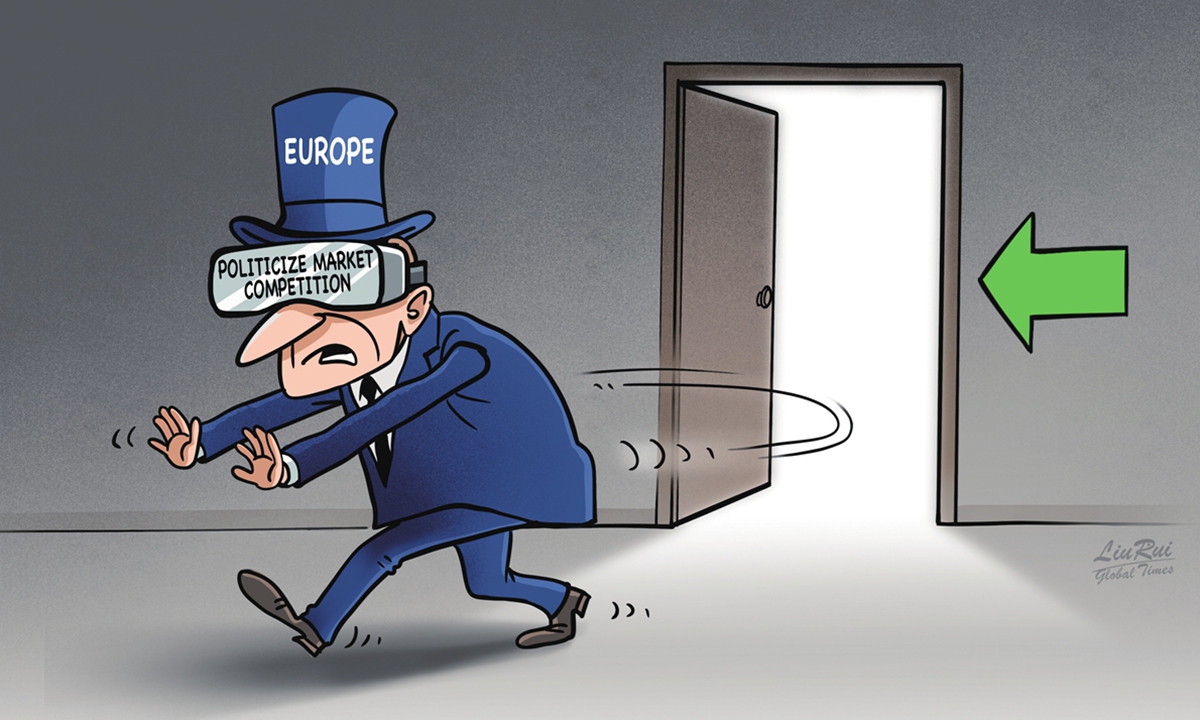
Europe Illustration: Liu Rui/GT
The EU has recently rolled out or considered a series of trade restrictions targeting China, expanding from electric vehicles to hybrid vehicles, steel and downstream products. A Chinese analyst said that the EU's recent moves are no longer limited to traditional trade remedies targeting individual products, but are increasingly extending across broader industrial chains.With European industry already facing mounting competitiveness pressures, the latest attempts to address structural problems through raising trade barriers will do little to strengthen European manufacturing and could instead increase costs for both Chinese and European businesses, disrupt long-established industrial chain cooperation and ultimately backfire on Europe itself, the expert said.
The EU will impose a set of import quotas and minimum prices for electrical steel and downstream products, it said on Friday, in a bid to shield the EU from imports principally from Asia, Reuters reported.
The move will benefit Thyssenkrupp's steel unit TKSE and Poland's Stalprodukt SA, among the last European producers of electrical steel, which is used in wind turbines and power grids.
Reuters said that "Brussels' move comes as the continent's industry is increasingly calling for better protection against China," a country that accounted for more than 50 percent of EU imports of steel and downstream products in 2025.
Meanwhile, the EU has asked China to voluntarily restrict exports of hybrid cars, the Financial Times reported.
A spokesperson for China's Ministry of Commerce (MOFCOM) said on Friday that China has taken note of the relevant reports.
So-called "voluntary export restraints" seriously violate WTO rules and run counter to the principles of the market economy and fair competition, the spokesperson said.
China firmly opposes this. China's position is consistent: Any solution between China and the EU must ensure a balance of interests, comply with WTO rules and the respective domestic laws of both sides, and fully take into account the interests of both industries, according to the MOFCOM.
A Chinese foreign ministry spokesperson said on Friday it is hoped that the EU will honor its commitments to market openness and free trade, observe WTO rules, and provide a fair, just and non-discriminatory environment for companies of all countries.
Notably, these moves by the EU came just as Chinese Commerce Minister Wang Wentao held a video call on Thursday with European Commissioner for Trade and Economic Security Maros Šefčovič at the latter's request to discuss China-EU economic and trade issues.
The ministerial talks took place as China-EU economic and trade ties continue to face challenges, with the EU's recent restrictive measures having fueled concerns about bilateral trade and supply chain cooperation.
While dialogue continues, the EU has kept ramping up trade restrictions, raising questions over its sincerity and doubts about whether such an approach of "talking while imposing restrictions" can genuinely help resolve China-EU economic and trade differences, Chinese experts said.
This is no longer about trade remedies targeting individual products, but an escalation from "de-risking" toward systematic industrial protection, Hu Qimu, a professor at the Maritime Silk Road Institute of Huaqiao University, told the Global Times on Saturday.
"The EU is expanding its restrictions from battery electric vehicles to hybrids, steel and downstream products, extending them across broader industrial chains... tariffs and investigations are increasingly being used as bargaining chips," Hu said.
The EU has shown a clear lack of sincerity in handling trade issues with China, experts said. Hu said that the bloc's approach of "talking while imposing restrictions" essentially "uses negotiations as cover for unilateral pressuring."
For example, China and the EU agreed on June 29 to establish a joint monitoring mechanism to exchange relevant data, monitor trade flows and support technical work with a view on improving transparency, enhancing mutual trust and managing trade frictions, but then on July 9 the European Commission announced the imposition of anti-dumping duties on import of tires for cars and lighter trucks and buses from China.
The EU has recently rolled out or considered trade restrictions extending from electric vehicles to hybrids, steel and downstream products, showing an increasingly clear trend, with China among its major targets, Jian Junbo, director of the Center for China-Europe Relations at Fudan University's Institute of International Studies, told the Global Times on Saturday.
"EU industry faces structural problems including high energy costs, slow industrial transition and weak innovation, which cannot be solved quickly. Trade protectionism is like treating the symptoms while ignoring the disease: It may offer temporary relief, but it cannot address the root causes of Europe's industrial problems and could ultimately make them worse," Jian said.
China is an important part of many EU industrial chains. "If European companies lose access to cost-competitive Chinese raw materials, intermediate goods and components, they may have to seek more expensive alternatives, raising production costs and hurting bilateral trade, consumers and European competitiveness," Jian said.
China and the EU should deepen industrial and supply chain integration to strengthen shared interests and reduce trade frictions, Jian said, and the EU should respect China's legitimate interests and take seriously its determination and capability to counter unjustified restrictions.
RELATED ARTICLES