Mixed signals emerge as China-EU contacts continue amid trade tensions
Dialogue remains practical path as Brussels weighs new trade tools that risk adding uncertainty to bilateral ties: expert
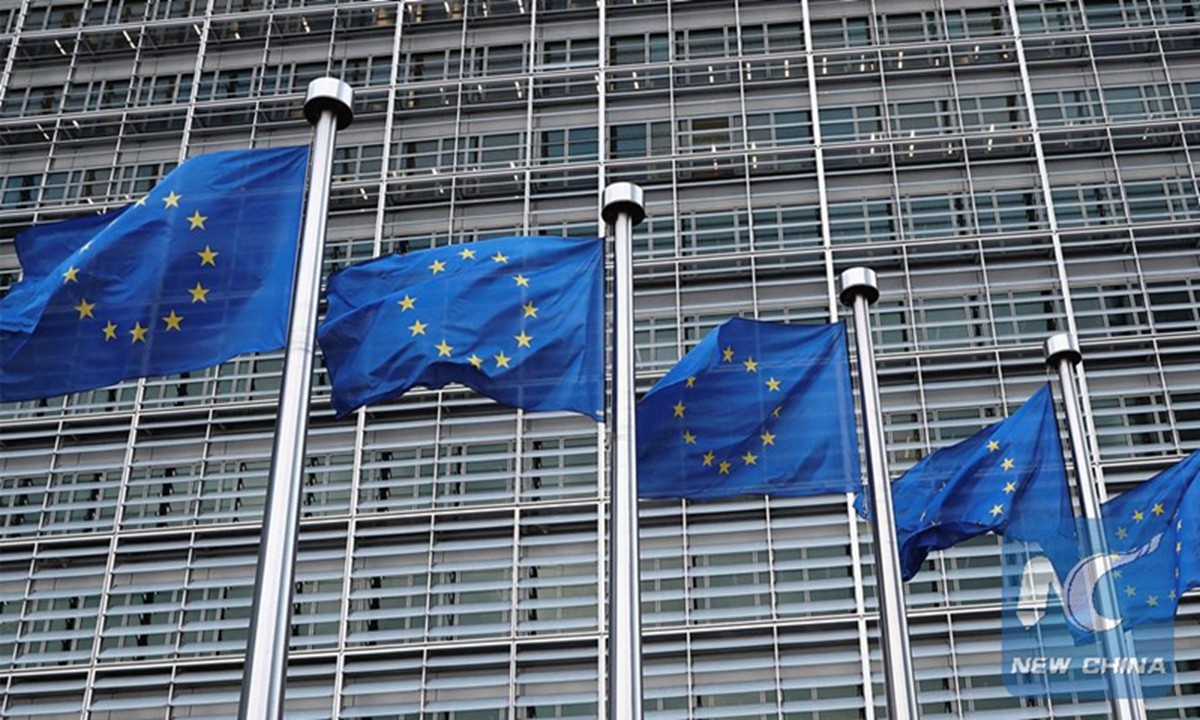
The European Union flags in front of EU headquarters in Brussels, Belgium. Photo: Xinhua
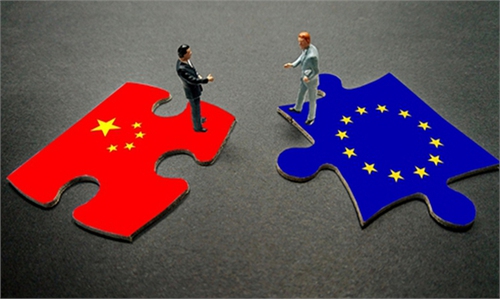
As the G7 summit and a key EU leaders' meeting draw near, a series of communication signals has emerged in China-EU economic relations, even as Brussels weighs tougher trade tools against China and some European politicians sharpen their rhetoric on the bloc's second largest trade partner.
The European Commission said on Thursday that contacts with Beijing "continue at various levels", while making clear that securing results from dialogue with the Chinese government remains its "priority", according to media outlet EFE, citing Olof Gill, deputy chief spokesperson of the commission.
Gill's remarks were made in response to a Financial Times (FT) report claiming that China had recently canceled two planned high-level diplomatic meetings with the EU in Beijing this month in protest against measures being considered by Brussels.
The same week, Chinese and German officials met in Berlin to discuss China-Germany and China-EU economic and trade relations, while Chinese Vice Premier Zhang Guoqing, addressing a France-hosted video summit, called for economic cooperation, inclusive growth and a free and open trade environment.
Analysts said the mixed signals show that dialogue is a practical need for both sides. If the EU wants results from engagement with China, they said, it should not allow new protectionist tools and negative political rhetoric to erode the trust needed for those results to emerge.
Channels remain open
In response to a question regarding the cancellations reported by FT, Chinese Foreign Ministry spokesperson Lin Jian told a press briefing on Thursday that "as we've learned, China and the EU are in communication on relevant dialogue."
China's Vice Minister of Commerce Ling Ji, also the deputy China international trade representative, met with Ditte Juul Jorgensen, director-general of the Directorate-General for Trade and Economic Security of the European Commission on Tuesday. The two sides held in-depth and comprehensive discussions regarding the preparations for the establishment of a China-EU trade and investment consultation mechanism, according to a statement on China's Ministry of Commerce (MOFCOM) website on Wednesday.
The statement came after the Global Times learned from a source who is familiar with the situation, Ling is visiting the EU headquarters from June 9 to 14 to discuss with European officials the relevant arrangements for establishing the China-EU Trade and Investment Consultation Mechanism.
This move demonstrates China's willingness in implementing the consensus of China-EU leaders and properly handling differences and frictions through dialogue and consultation, according to the source, who declined to be named.
Ling also held talks in Berlin on Thursday with senior German officials on economic and trade issues, MOFCOM said on Friday. Ling said China has consistently advocated resolving differences through dialogue and consultation, and urged the German government to play a constructive role within the EU.
The German side said it opposes trade wars and supports China-EU dialogue and consultations to properly address each other's concerns and prevent an escalation of economic and trade frictions, while expressing willingness to strengthen communication with China on economic and trade policies.
Jian Junbo, director of the Center for China-Europe Relations at Fudan University's Institute of International Studies, told the Global Times on Friday that the recent communication signals are important because they show that both China and pragmatic voices in Europe still see dialogue as necessary, even as Brussels hardens its trade and economic-security approach toward China.
"The bloc faces internal divergence, declining industrial competitiveness and weakening growth momentum. Turning such anxieties into restrictive tools will not solve Europe's structural problems but could instead add uncertainty to China-EU cooperation," Jian said.
In an exclusive video interview with the Global Times on Thursday, Esko Aho, former Finnish prime minister and chairman of the board at the China Office of Finnish Industries, said Europe's challenges are linked to its capacity to create competitiveness and to invest in science, technology and innovation, while stressing that Europe also needs to create a better-functioning internal market, where weaknesses still remain.
Against the backdrop of Europe's internal challenges and growing global fragmentation, Aho said the EU and China share an interest in ensuring "a rules-based economic and political system," adding that challenges and risks also present opportunities.
Complexity remains
The recent pragmatic signals are unfolding at a difficult and complex moment for China-EU economic ties, as Europe ramps up pressure to impose trade restrictions, and weighs broader "economic security" tools seen as directly affecting China.
Reuters has reported that Brussels is weighing rules to cut reliance on single suppliers - notably in China - as part of a broader review of trade-defense tools.
German Chancellor Friedrich Merz said on Thursday that the EU must defend itself against unfair trade practices, signaling greater openness to recent European Commission proposals for a tougher approach to China, Politico reported.
Without mentioning China specifically, Merz said EU leaders meeting next week in Brussels will discuss ways to better equip the bloc's trade "toolkit" as it looks to reset its trade relationship with China, according to Bloomberg.
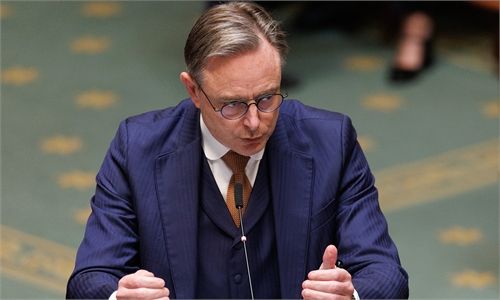
Belgian Prime Minister Bart De Wever, described by news website Euractiv as being "at the forefront of the debate about China's impact on the European economy", has urged European leaders to develop a "serious strategy" against what he claimed was China's drive for economic domination, Euractiv reported on Tuesday.
Industry insiders warned that the EU's "economic security" toolbox targeting China is gradually moving from concept to implementation, with related policy frameworks taking shape at a faster pace, from supply-chain diversification to upgraded trade-defense measures.
Chinese authorities have repeatedly made clear their firm position on the EU's moves. After the European Commission's May 29 discussion on relations with China, MOFCOM said that "if the bloc insists on unilaterally introducing new trade tools and adopting discriminatory restrictions, China will firmly counteract them and take effective measures to safeguard its legitimate interests."
Aho said Europe has realized the need to avoid excessive dependence in critical areas, but the real challenge is where to draw the line between legitimate national interests and limits on global trade. "There are many areas where we can work together without feeling restricted," he added.
RELATED ARTICLES