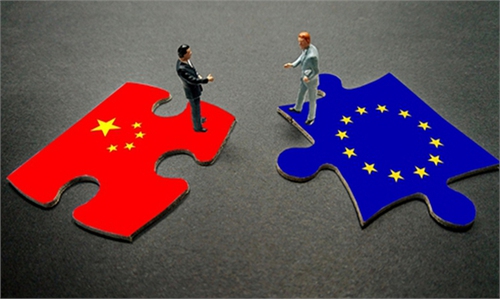
China urges EU to view China-EU trade ties in ‘objective and rational’ way
Gap between EU’s ‘de-risking push’ and European firms’ business reality highlights policy dilemma
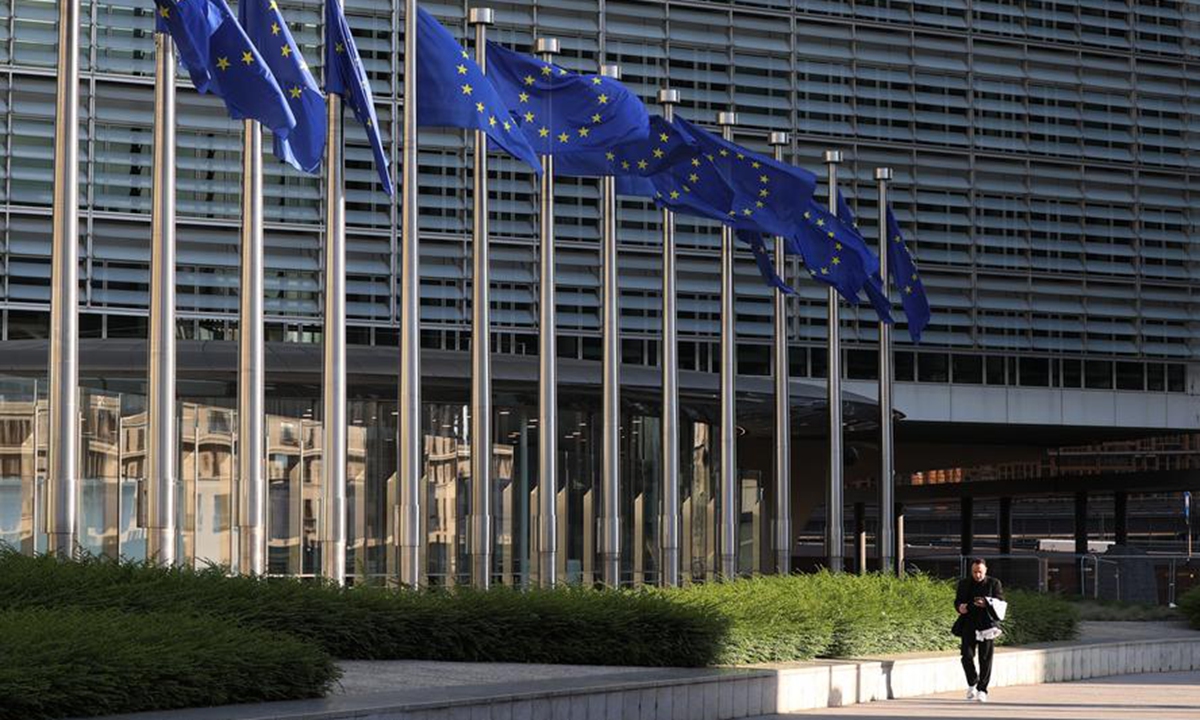
European Union flags fly outside the European Commission headquarters in Brussels, Belgium, on May 23, 2025. Photo: Xinhua
As Brussels pushes further into "de-risking" and weighs tougher measures that could reshape China-EU business ties, many European firms in China are choosing a more pragmatic path: stay, expand and localize. That disconnect between political rhetoric and business reality captures Europe's policy dilemma: whether its expanding toolbox will reduce risk, or merely split markets and erode its own competitiveness.
More and more European companies are deepening their roots and expanding their business in China. Their actions serve as a strong rebuttal to so-called de-risking, Chinese Foreign Ministry spokesperson Mao Ning said on Thursday.
The comments came in response to a media question about reports that the EU is expected to unveil new trade-restrictive tools targeting China in mid-June, while the latest survey by the European Union Chamber of Commerce in China showed that 68 percent of European companies have chosen to stay in or expand their business in China.
The trade cooperation between China and Europe is built on common interests. It is in essence a result of both comparative advantages and participation in market competition. Complementarity is not a risk, and convergence of interests is not a threat, the spokesperson noted.
"Trade protectionism is against the laws of economics and serves no one's interests," Mao said, adding "We hope the European side can view our trade ties in an objective and rational manner, and work with China to shorten the list of problems and make the pie of cooperation bigger for win-win results."
The remarks came against a broader backdrop of Brussels' intensified use of restrictive trade and regulatory tools across sectors, with many seen as directly affecting Chinese firms and eliciting repeated concerns and opposition from the Chinese side.
China will respond resolutely with countermeasures and take effective steps to safeguard its legitimate interests if the EU insists on unilaterally introducing new trade tools and adopting discriminatory restrictions, China's Ministry of Commerce said on Saturday in response to the European Commission's orientation debate on EU-China relations.
New digital barriers
The EU's restrictive approach is moving further into digital and technology sectors. On Wednesday, the European Commission unveiled a so-called "European Technological Sovereignty Package" covering semiconductors, artificial intelligence, cloud computing and open source, a move analysts said could add new market-access and compliance hurdles for non-EU technology suppliers, including Chinese firms.
Brussels framed the package as part of a "major shift" in the EU's technology policy, saying it is designed to reduce "structural dependencies," according to the Commission statement. It has also set a goal of doubling the EU's global semiconductor market share to 20 percent by 2030.
Some media reports have cast the legislative proposals as targeting US and Chinese technology suppliers. Reuters reported on Wednesday that the proposals form part of the bloc's technological sovereignty push and its efforts to close the gap with rivals from the two countries. A Brussels Times report on Thursday also said the acts seek to "cut reliance" on tech giants from the US and China.
The new proposals are, in essence, an industrial policy tool with a protectionist undertone, as they could use subsidies and other policy instruments to crowd out non-EU players, Jian Junbo, director of the Center for China-Europe Relations at Fudan University's Institute of International Studies, told the Global Times on Thursday.
The EU's technological sovereignty package sends a strong signal that Brussels is accelerating the construction of digital technology barriers and reshaping local supply chains, the China Chamber of Commerce to the EU (CCCEU) said in an analysis on its WeChat account on Thursday.
Citing observers, the chamber advised Chinese companies in Europe, particularly those exposed to cloud, AI, chips and other digital technology sectors, to closely monitor policy changes, as the new package could bring tougher data security and market access reviews for non-EU suppliers and create direct challenges for their participation in European digital infrastructure and business-to-government procurement projects.
"If the legislation tightens controls on advanced manufacturing equipment and technology exports, it could raise barriers for Chinese firms in Europe," Jian noted.
European industry groups have also sounded the alarm. The Computer & Communications Industry Association (CCIA Europe) on Wednesday said the Cloud and AI Development Act is "discriminatory" and risks "severe market fragmentation." The group warned that the proposal could shut out trusted global vendors from outside the bloc under standards "the EU itself cannot meet."
CCIA Europe urged the European Parliament and the Council of the EU to abandon the proposal, which still needs to be debated by the two institutions before it can become law.
Asked to comment on the legislative package, Mao Ning on Wednesday urged the EU to abide by basic market economy principles such as free trade, fair competition, openness and cooperation, refrain from resorting to protectionist measures, and stay committed to dialogue and consultation to resolve differences and respective concerns.
The CCCEU said it will closely follow the legislative process and supporting rules of the relevant EU proposals, continue constructive communication with EU decision-making bodies and strive to call for a fair, just and non-discriminatory business environment for companies.
Broader protectionist turn
Brussels has recently been preparing or deploying a series of trade and industrial instruments - from the Foreign Subsidies Regulation to the proposed Industrial Accelerator Act and Cybersecurity Act 2 - that industry insiders said are increasingly discriminatory and exclusionary.
Reuters reported on May 29 that the European Commission was weighing stronger trade and industrial measures toward China after claiming that current EU-China trade and investment relations were "not sustainable," with specific measures not expected to be announced until the third quarter of this year.
The key question is how these instruments are applied, Michael Schumann, Chairman of the Board of the Federal Association for Economic Development and Foreign Trade (BWA), told the Global Times. "Europe has the right to protect sensitive sectors, but such measures should remain proportionate, predictable and open to dialogue."
Overly broad or politicized regulation could create uncertainty for companies, especially in ICT, digital infrastructure, clean energy and cloud-related services, where supply chains are deeply international, Schumann said, warning that fragmentation would only raise costs, slow innovation and benefit no one.
Over the past five decades or so, the annual trade volume between China and Europe has soared by over 300 times, with two-way investment totaling nearly $260 billion. The figures are a strong testament to the robust momentum and promising prospects of China-EU cooperation, Mao Ning said on Thursday.
That depth of integration is precisely why new restrictions carry wider costs, analysts said - and why the warning carries particular weight: "Restrictions are the wrong answer. Cooperation and dialogue are the only viable path."
RELATED ARTICLES