First China-Pakistan army joint training features an all-Chinese equipment lineup, signaling deep interoperability: expert
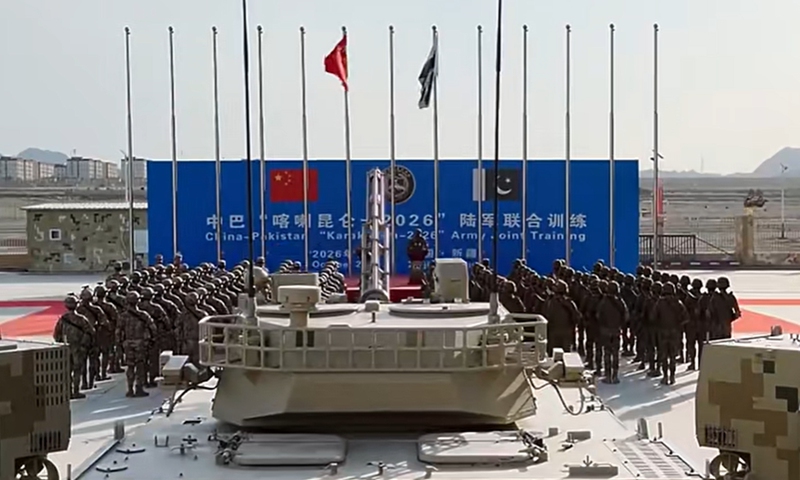
Image of the opening ceremony of the China-Pakistan Karakoram 2026 joint army training held at a training base in Korla, Northwest China's Xinjiang Uygur Autonomous Region Photo: Screenshot from the CCTV's military channel
The first China-Pakistan army joint training Karakoram 2026 kicked off on Wednesday, with all weapons and equipment provided by the Chinese side, China Central Television's (CCTV) military channel reported. A military affairs expert said the choice of medium-weight wheeled vehicles for high-altitude operations, and Pakistan's use of an all-Chinese lineup, signal deepening military trust and potential future procurement.
The opening ceremony for the China-Pakistan Karakoram 2026 joint army training was held at a training base in Korla, Northwest China's Xinjiang Uygur Autonomous Region. It is the first army joint training between the two countries, themed on joint counter-terrorism and clearance operations in high-altitude areas, said the report.
The report said that all weapons and equipment in the training were provided by China, including Type 191 rifles, Type 201 squad machine guns, Type 11 armored assault vehicles, Type 08 infantry fighting vehicles, as well as artillery, unmanned and anti-unmanned systems.
Wang Yunfei, a military affairs expert, told the Global Times on Wednesday that the two types of vehicles are both wheeled platforms. In high-altitude areas, wheeled armored vehicles have their own advantages. Unlike tracked vehicles, they are faster, especially during road maneuvers, and easier to maintain, making them well-suited for movement and combat missions on the plateau.
The all-Chinese equipment lineup covers multiple categories and forms a relatively complete combat system, he said. On one hand, it shows China has provided weapons and equipment technology to Pakistan.
On the other hand, these weapons could be procured by Pakistan in future military trade, further expanding the presence of Chinese equipment in the Pakistan Army. This joint training thus serves as a rehearsal and a process of familiarization.
From a broader perspective, it also reflects strategic mutual trust, showing that military cooperation between the two countries has reached a high level. Building this kind of deep interoperability will lay a solid foundation for future joint operations between the two armies in counter-terrorism, border control and other areas, the expert said.
Zhang Jueshe, another military affairs expert, told the Global Times that China and Pakistan complement each other well in the field of counter-terrorism, while cooperation can be advanced via intelligence sharing, joint operations, technology transfers, experience exchanges and economic cooperation.
"China could provide Pakistan with technical and equipment support, including drones and smart combat platforms, to boost its surveillance and early warning capacity against terrorist groups, and also conduct experience training," he noted.
Pakistan's experience in addressing complex border security situations, handling local separatist forces and coordinating counter-terrorism efforts can also provide references for China to tackle similar non-traditional security challenges, Zhang added.
On Saturday, Senior Colonel Chen Xi, a spokesperson for the Chinese Ministry of National Defense, announced that in mid- and late October, Chinese and Pakistani armies will hold Karakoram 2026 joint army training in Korla, Xinjiang. Focusing on joint counter-terrorism operations in high-altitude areas, the activity will include skills training in UAV operation, on-the-move target search and firing, and long-range sniping, and cover joint command and live-force exercises.
The exercise will expand the scope of China-Pakistan military cooperation, reflect growing mutual trust, and strengthen counter-terrorism collaboration through the sharing of experience and expertise, Zhang said.
RELATED ARTICLES