China’s environment authority adds nuclear power safety divisions amid industry expansion
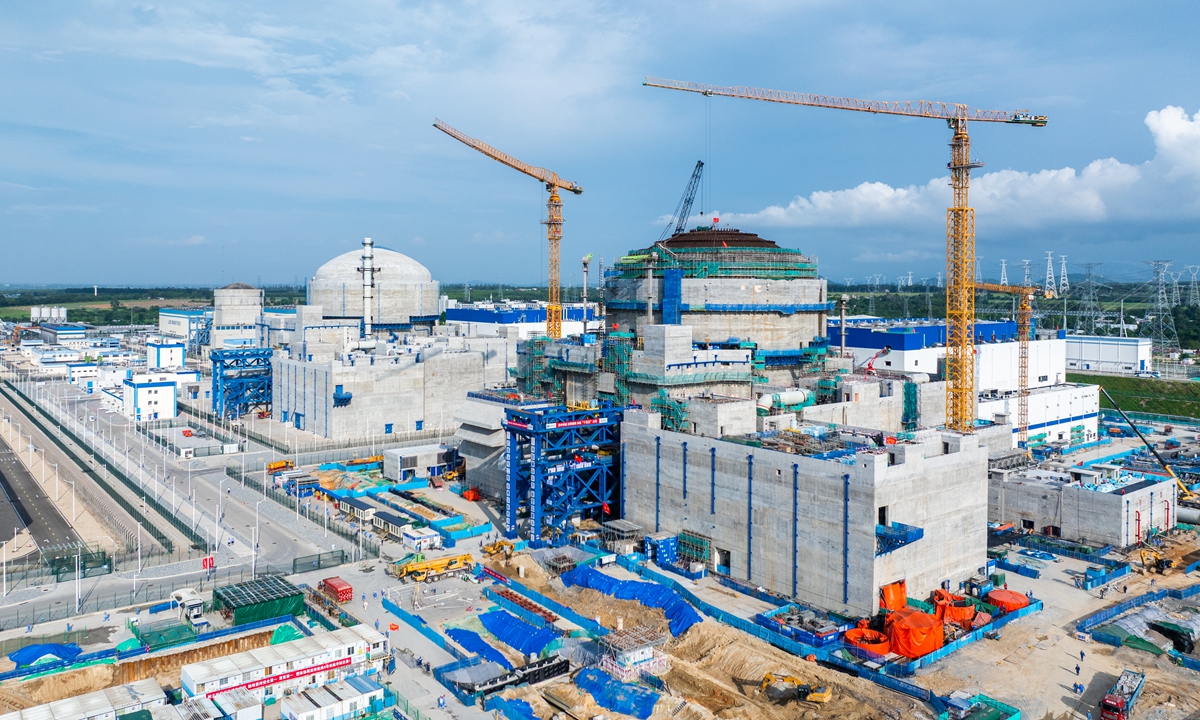
Unit 3 and Unit 4 of the Huaneng Changjiang Nuclear Power Plant in South China's Hainan Free Trade Port Photo: Courtesy of China Huaneng Group Co., Ltd
The Ministry of Ecology and Environment (MEE) has established the Department of Nuclear Power Construction Safety Supervision and the Department of Nuclear Power Operation Safety Supervision, according to recruitment information released by the ministry for the 2027 civil service exam, the Paper.cn reported.
The MEE's official website now lists the Department of Nuclear Power Operation Safety Supervision, with experts noting a further refinement of the country's nuclear safety supervision framework.
The move comes as China's nuclear power industry enters a phase of accelerated development, with a growing number of nuclear power projects moving forward and the country placing greater emphasis on strengthening safety oversight throughout the entire industrial chain.
Safety supervision of the industry needs to become more specialized and refined. Although only a few projects are approved each year, the growing number of operating units and those under construction will bring more complex regulatory challenges, Lin Boqiang, director of the China Center for Energy Economics Research at Xiamen University, told the Global Times on Wednesday.
"Nuclear safety supervision should cover the entire life cycle of nuclear facilities, from construction and operation to maintenance, lifetime extension, decommissioning and radioactive waste management," Lin said.
China ranks first globally in nuclear power units under construction and second in operating units. A total of 65 nuclear power units have obtained operating licenses, according to Dong Baotong, head of the National Nuclear Safety Administration.
During a State Council Information Office press conference in August, Dong said that during the 15th Five-Year Plan (2026-30) period, China's number of operating nuclear power units is expected to rank first globally. By 2030, the number of units with operating licenses is expected to approach 100, making ensuring high-level nuclear safety an increasingly important task.
Dong said that China will build a comprehensive nuclear safety responsibility system, promoting high-standard design, high-quality construction and high-level operation of nuclear power plants. He added that safety oversight would cover nuclear fusion devices, radioactive sources, nuclear fuel cycle facilities and nuclear facility decommissioning to ensure safety throughout the entire life cycle.
Lin noted that as the nuclear fleet expands, higher requirements will be placed on risk monitoring, early warning, construction oversight and decommissioning planning. The establishment of specialized nuclear power construction and operation safety supervision divisions reflects the need for the regulatory system to adapt to the industry's development. Strengthening regulatory capacity and professional talent reserves will be crucial to ensuring the safe and high-quality development of China's nuclear power sector, Lin added.
RELATED ARTICLES