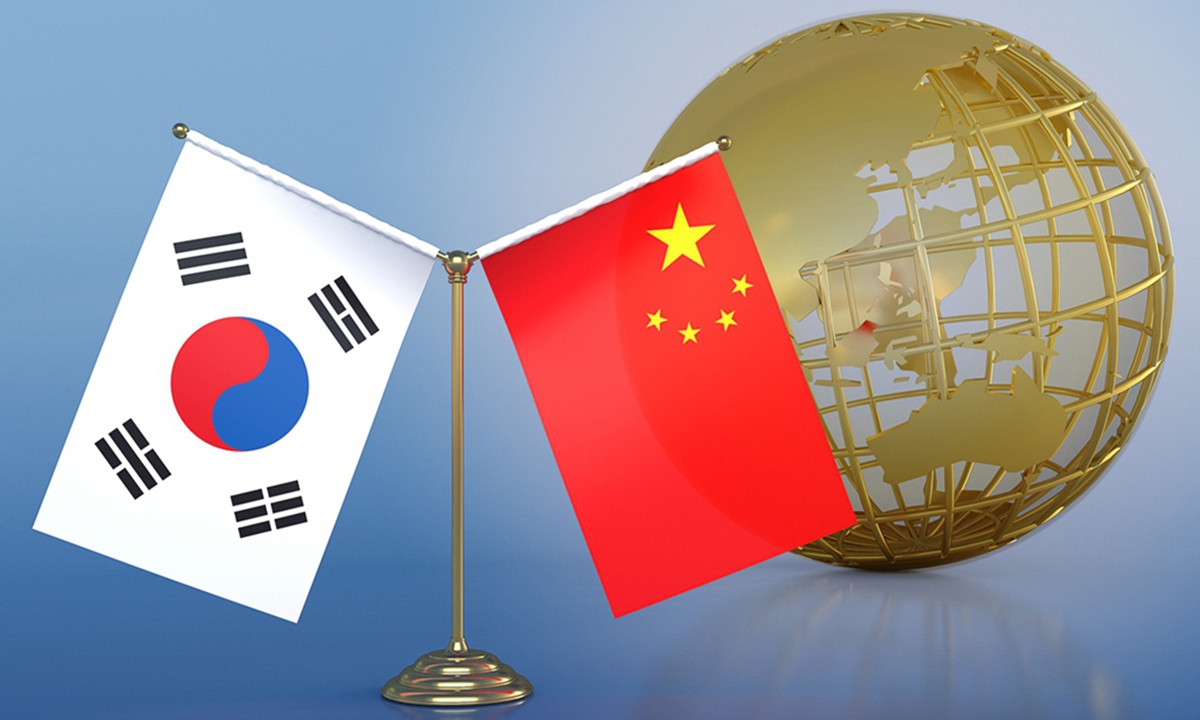
China South Korea Photo:VCG
The 17th round of follow-up negotiations on services and investment under the China-South Korea free trade agreement (FTA) is being held in Seoul from Monday to Friday, according to a press release published by South Korea's Ministry of Trade, Industry and Resources.
Since the China-South Korea FTA officially took effect in 2015, tariffs on bilateral goods trade have been reduced to a relatively low level. The two countries have shifted the focus of their consultations to trade in services and investment, a move that carries particular significance at a time when global trade protectionism is on the rise and some countries are busy erecting barriers. It demonstrates, at the very least, that these two neighboring countries still recognize the value of openness and mutual benefit.
One set of figures is particularly worth noting. In September, South Korea's exports to China surged 122.7 percent year-on-year to $26.01 billion, exceeding $20.0 billion for a fourth consecutive month. Against the backdrop of South Korea's long-standing trade surplus with China, this growth reflects not only China's absorptive capacity as a market, but also the fit that South Korean suppliers have gradually developed with Chinese demand.
With tariff barriers substantially lowered, China-South Korea trade has not simply remained at the stage of volume expansion. Instead, the latter's export structure has been quietly upgrading, from consumer goods and intermediate inputs to a fast-rising share of high-end chips, precision instruments, and high-quality specialty chemicals. This structural shift has moved in lockstep with the continuous upgrading of demand in the Chinese market.
As one of the world's largest and continuously expanding markets, China's demand for advanced products and high-quality services keeps escalating. Any economy that accelerates its opening-up to the Chinese market and delivers what the Chinese market truly needs will be able to share the huge growth dividends generated by China's development. Economic and trade practices between China and South Korea over the past decade have fully validated this logic. By actively opening its own market to Chinese enterprises and continuously integrating into China's broader opening-up process, South Korea has reaped substantial and tangible returns. The Chinese market has also gained access to high-quality goods and services that effectively support China's goals of industrial upgrading and consumption upgrading.
Some Western media outlets have fixated on the so-called "trade imbalance" problem, even using it to hype groundless claims of unfair competition from China.
Yet the Chinese market is large enough in capacity and open enough in access. The gains and losses of trade should never be judged solely by the narrow metric of surplus or deficit. The core of mutually beneficial trade lies in whether an economy can identify its own position in the global industrial chain and accurately match the real demand of the Chinese market.
South Korea's sustained trade surplus with China over the years is rooted in its strong competitiveness in semiconductors, precision manufacturing, and fine chemicals - sectors that align precisely with China's needs. This fully proves that as long as products and services are well-targeted, the Chinese market offers real opportunities for foreign partners.
More fundamentally, the continued push for deeper openness under the China-South Korea FTA shows that despite the repeated restructuring of global supply chains, the internal momentum for regional economic cooperation remains strong. Trade in services and investment liberalization represent deeper and more sensitive areas of openness than trade in goods.
The fact that both sides are willing to keep pushing in this direction shows that their willingness to cooperate is genuine and firm.
This kind of institutional opening will not only unlock bilateral trade potential but also provide more stable expectations for businesses in both countries and inject certainty into Asian and global economic cooperation.
This steadily advancing FTA also offers a clear reference for other economies around the world. In the face of intensifying industrial competition, choosing sustained openness over building walls does not lead to a loss of interest, but to greater market space and stronger industrial resilience. The door of the Chinese market has long been open; who profits is the one with the ability to offer what China needs.
RELATED ARTICLES