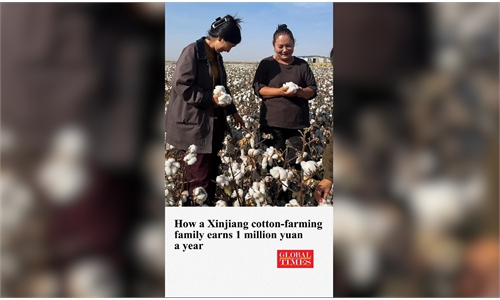
‘Forced labor’ in Xinjiang’s salmon industry, too? The New York Times has lost it: Global Times editorial
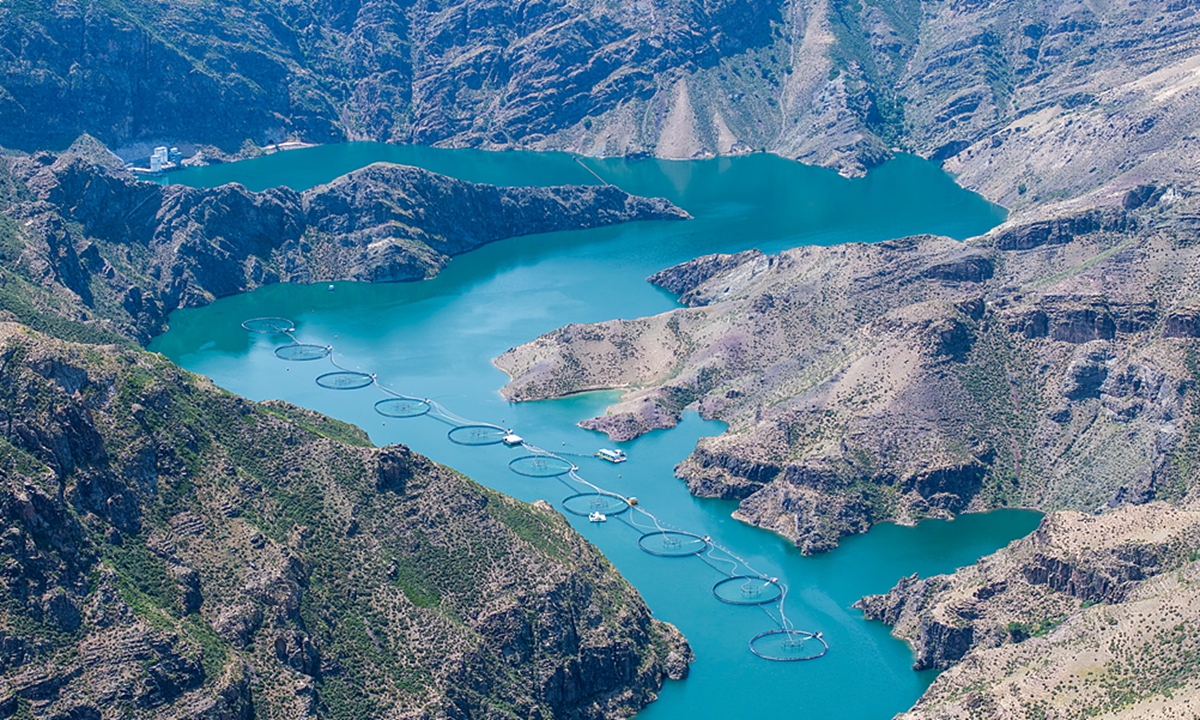
A salmon farm in Nilka County, Ili Kazak Autonomous Prefecture, Xinjiang Uygur Autonomous Region. Photo: VCG
In their attacks on Xinjiang-related issues, some Western media outlets are still deliberately presenting themselves as "objective and fair," but the signs of preconceived bias and a narrative assembled to fit a predetermined agenda are all too clear. Ultimately, no amount of smearing by US media can erase Xinjiang's economic and social development, nor can it stop people of all ethnic groups at the foot of the Tianshan Mountains from striving for a better life.Recently, The New York Times published a purported in-depth investigative report about the fish farming industry. The article adopts the posture of a "neutral" investigation, citing global research and evidence from multiple sources. It ranges from Peruvian fishing vessels and fishmeal processing plants to offshore aquaculture pens in Norway. Yet in the second half of the article, the focus takes a sharp turn toward the salmon industry in Northwest China's Xinjiang, devoting extensive coverage to recycling familiar allegations such as "forced labor." Read closely, the report reveals a familiar pattern: In their attacks on Xinjiang-related issues, some Western media outlets are still deliberately presenting themselves as "objective and fair," but the signs of preconceived bias and a narrative assembled to fit a predetermined agenda are all too clear.
The report offers no evidence from firsthand interviews to support its claims about Xinjiang. Instead, it pieced together much of its narrative from vague attributions with phrases such as "claim," "accuse," and "most likely." By using documented problems in the seafood industry in other parts of the world to shape readers' perceptions in the first half, the article encourages them to assume that the claims made in the second half are equally well substantiated. However, the report provides no solid evidence that similar problems exist in Xinjiang, while packaging subjective speculation as so-called "investigative findings." Such journalistic practices run directly counter to the most basic standards of media credibility.
Why are US media outlets willing to lose their credibility just to push out similar fake reports? The real aim, it would appear, is to lend support to Washington's unilateral sanctions targeting Xinjiang. From cotton and tomatoes to sunflower seeds and dumplings, and from solar photovoltaics to polysilicon, the pattern remains the same, with the focus now shifting to Xinjiang's cold-water fish industry: Any competitive industry that benefits Xinjiang's local communities is targeted with the "human rights" cudgel, as negative media coverage is paired with unilateral sanctions to suppress Chinese competitive industries and contain development in China's western regions. It's important to point out that what these sanctions are really aimed at is the employment and development rights of people of all ethnic groups in Xinjiang.
In fact, Xinjiang's salmon industry is a prime example of how local resources can be harnessed to turn geographical disadvantages into drivers of development. It is also a tangible achievement of China's campaign to develop its western regions in the new era. Nilka County in the Ili Kazakh Autonomous Prefecture benefits from glacial meltwater flowing down from the Tianshan Mountains. The water remains cold and rich in dissolved oxygen throughout the year, and its excellent quality provides exceptional natural conditions for cold-water fish farming.
Technologies such as automated feeding, underwater cleaning robots, and semi-closed recirculating aquaculture systems help minimize pollution, while uneaten feed and fish waste can be processed into organic fertilizer. The farming process emphasizes raising fish without medication and at low stocking densities. Companies in the industry have also obtained multiple international food safety certifications. Their products serve the domestic market and are exported to countries across Southeast Asia, the Middle East, and Europe. They have even gained access to Singapore, a market known for its stringent food standards. Turning desert landscapes into productive fisheries and snow-capped mountains into a source of premium seafood is an industrial success achieved through Chinese ingenuity and hard work.
The benefits to people's livelihoods, brought about by industrial development, are being tangibly enjoyed by the people of all ethnic groups. Under a model that combines leading enterprises, employment in industrial parks and social security, some farming and herding families whose livelihoods have revolved around pastoralism for generations have moved into companies and become industrial workers, earning stable wages. Some herders also receive dividends through equity investments. Many young people have chosen to return to their hometowns for work closer to home.
The salmon industry has also spurred the growth of fish-themed agritourism, specialty restaurants, rural tourism, and related businesses, opening up additional sources of income and giving fresh impetus to rural vitalization. These concrete, visible improvements in people's lives stand in stark contrast to the falsehoods propagated by some Western media outlets.
Ultimately, no amount of smearing by US media can erase Xinjiang's economic and social development, nor can it stop people of all ethnic groups at the foot of the Tianshan Mountains from striving for a better life. It is hoped that some Western media outlets that pride themselves on being "fair and objective" will drop their self-deceptive tactics and go to Xinjiang to see the real production scenes for themselves, listen to workers on the ground describe their own experiences, and gain a firsthand understanding of what human rights really mean to the people of all ethnic groups in Xinjiang - and what rights they genuinely enjoy and deserve to have respected.
RELATED ARTICLES