Canton Fair helps companies expand in BRI markets through partnerships, tailored solutions
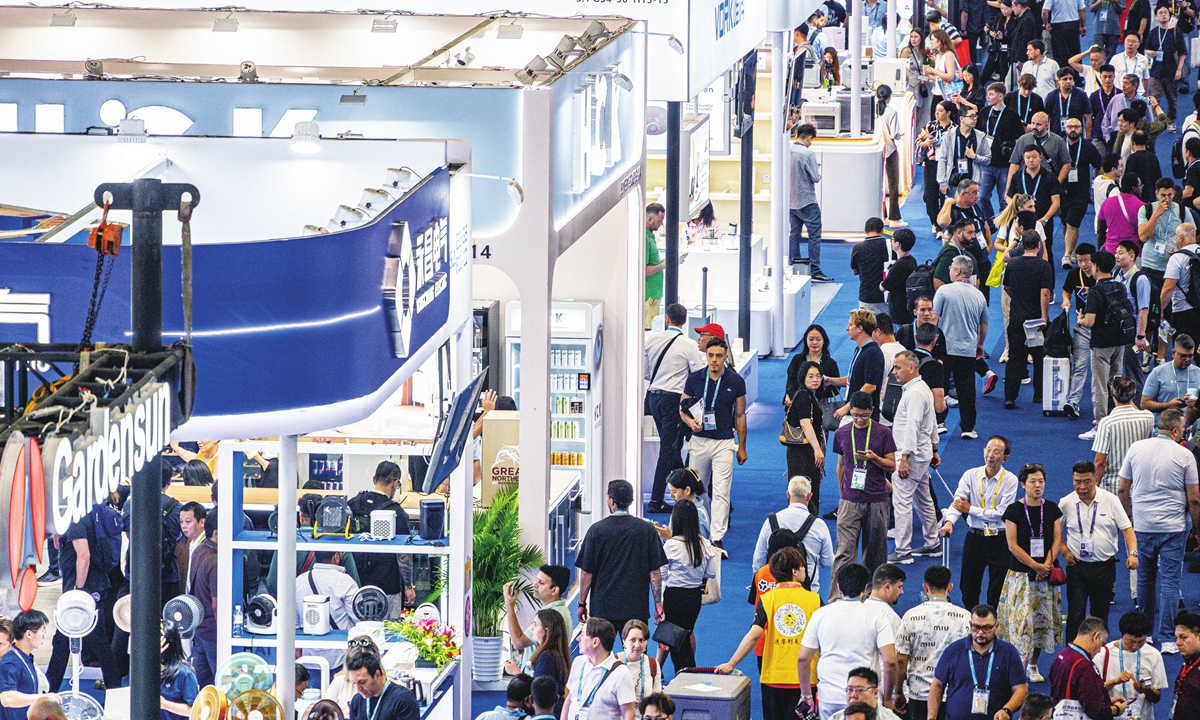
Buyers and exhibitors gather at the 140th Canton Fair in Guangzhou, South China's Guangdong Province, on October 16, 2026. Photo: VCG
At Wandisplay Technology's booth, an Indonesian buyer spent several minutes testing the company's app and checking the accuracy of a new smart wristband before placing an order for 2,000 units on the spot.
Such scenes are unfolding across the exhibition halls of the 140th China Import and Export Fair, commonly known as the Canton Fair, where buyers from around the world began exploring products and negotiating orders on Thursday.
BRI markets move to the fore
Liu Yupei, sales director at Wandisplay Technology, told the Global Times on Thursday that this was the company's second time participating in the Canton Fair, but its business in previously smaller markets across the Middle East, Africa and South America had grown noticeably, particularly in countries and regions covered by Belt and Road Initiative (BRI) cooperation.
"More than 400,000 units in new orders came through the last edition of the fair in April," Liu said.
Guangzhou Chengzhi Intelligent Machinery Technology Co (CZI), a drone-payload maker, received more than 200 orders worth nearly 10 million yuan ($1.5 million) at its first Canton Fair in April, mostly from Southeast Asia and Eastern Europe.
Zhang Kai, deputy president of CZI, told the Global Times that BRI partner countries and regions had seen rapid growth over the past six months and would be the company's priority markets in the near future.
Chongqing Huifan Technology is showcasing a palm-vein authentication terminal that works without physical contact, designed for retail stores and smart campuses. Sales manager Zhou Nana told the Global Times that overseas revenue rose about 25 percent in the first half of 2026, with BRI markets such as Uzbekistan and Kazakhstan now a priority.
"We hope that through the Canton Fair, we can introduce more new products to markets in countries [and regions] participating in the BRI. On the first day, purchasing agents from countries such as Cameroon came to discuss potential orders," Zhou said.
At CVTE's booth, a Brazilian buyer watched a staff member turn a hand-drawn cube into a rotatable 3D model on an interactive display and immediately began discussing a potential purchase. "This is exactly what we need," said Max Goldberg, who had come specifically to find AI-powered education products suited to Brazilian classrooms.
Guangzhou-based CVTE, a leading global provider of consumer and commercial LCD display technology, has established local operations and service networks in 33 countries and regions and services more than 140 markets, according to Duan Yu, the company's chief strategic resources officer.
These small encounters reflect a broader shift during the first phase of the 140th Canton Fair, which runs through Monday. Buyers from BRI partner countries and regions are arriving not with generic orders but with specific demands. The companies closing deals are those willing to redesign products, rework service models and maintain a presence in the market long after their shipments arrive.
Localization and after-sales power
Customized products are only half of the story. Local operations and after-sales service help companies build lasting relationships with customers.
Must Energy (Guangdong) Tech Co., Ltd. has established offices, delivery hubs and service teams across BRI markets, from Central Asia to Africa and Latin America. It operates more than 20 service centers worldwide and provides household energy solutions tailored to these markets.
"Buyers visit our booth at the Canton Fair by day and come to visit our factory in Foshan [in South China's Guangdong Province] by night," Wu Changhua, chairman and president of MUST Energy, told the Global Times on Friday.
Wu said the company plans to establish business and sales service centers, open warehouses and expand local services in more BRI markets.
Foshan is about an hour's drive from Guangzhou, the host city of the Canton Fair.
At the factory of Namkoo New Energy Technology Co. in Foshan, the Global Times met Eric Ong Lim, president of Mindanao Rock and a Canton Fair buyer from the Philippines. Lim visited the factory on Friday to inspect the production line and discuss closer cooperation.
"Namkoo is very famous in the Philippines. We have already been talking there. They have an office, so they have many customers," Lim told the Global Times. After the visit his assessment was clear: "I'm very satisfied with the product quality and much more confident to invest than before."
A two-way trade bridge
While Chinese companies are finding BRI customers and partners at the Canton Fair, businesses from BRI markets are also using the platform to reach buyers worldwide.
The Canton Fair's import section serves as a bridge for two-way trade. At this edition, it will run during the second phase, from October 23 to 27, and the third phase, from October 31 to November 4. In recent editions, the proportion of exhibitors from BRI countries in the import section has continued to rise, the Global Times learned from the organizer.
The Canton Fair's global partnership network now spans 112 countries and regions and includes 238 overseas institutions, industry associations and major purchasing companies.
Since the import section was created in 2007, more than 15,000 overseas companies from over 100 countries and regions have taken part. For many of those exhibitors, the fair is not only a door into China but a bridge to buyers from other countries.
The broader trade figures provide context for these business exchanges. In the first three quarters of 2026, China's trade with BRI partner countries reached 20.37 trillion yuan, up 17.1 percent year-on-year, with imports rising 17.9 percent, slightly faster than exports at 16.6 percent, according to statistics from the General Administration of Customs.
What is changing at the Canton Fair is not simply who is buying, but what a deal includes. A wristband order comes after a buyer tests the data. A conversation at a booth turns into a service network that remains in place long after the shipment arrives.
For BRI partner countries, these partnerships offer access to products, technical support and local services. For Chinese companies, they create opportunities to build lasting customer relationships and expand their market presence.
RELATED ARTICLES