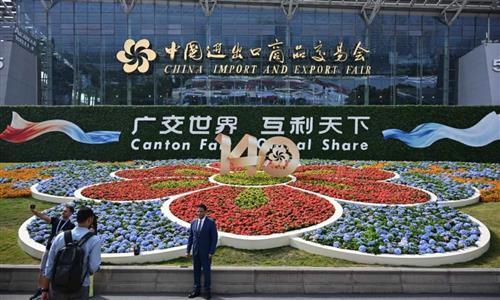
Canton Fair stories spanning generations show China's leap from selling products to offering innovative solutions
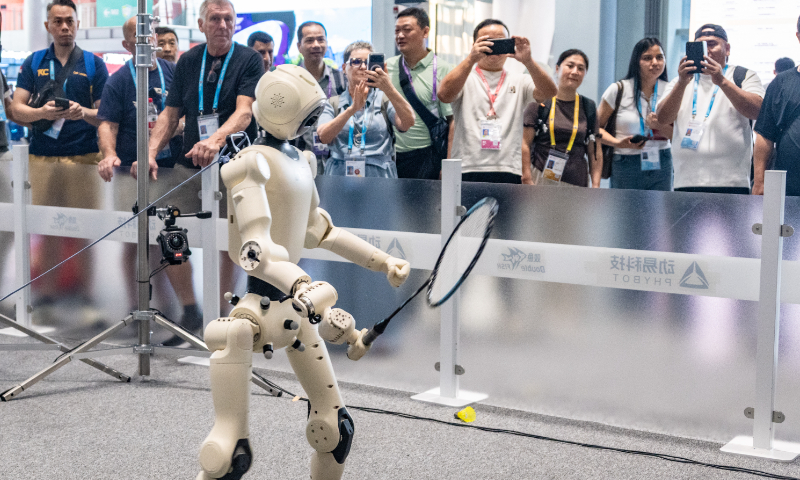
Global buyers watch and film a China-made robot playing badminton at the 140th Canton Fair in Guangzhou, South China's Guangdong Province, on October 15, 2026. Photo: VCG
At the first phase of the 140th China Import and Export Fair, commonly known as the Canton Fair, a crowd gathered around a booth. Inside, a humanoid robot plays badminton - it swings, returns, and smashes while layers of buyers press in with phones held high.
Outside the crowd, Michael Lee Chi-fung, deputy general manager of the Hong Kong trading firm Yuen Tai, paused. His mind turned to his grandfather Lee Fuen.
In the spring of 1957, Lee Fuen boarded a coal-fired train from Hong Kong to Guangzhou for the very first Canton Fair - China's flagship trade exhibition, still held twice a year to connect Chinese manufacturers with global buyers. The star attractions at that edition were 100,000 lovebirds and 10,000 golden-coin turtles, sold alongside silk and Foshan paper umbrellas from Guangdong.
At that edition, total turnover reached $17.54 million; agricultural products and handicrafts made up more than 60 percent. A total of 1,223 buyers from 19 countries and regions walked into the exhibition hall of just 9,600 square meters.
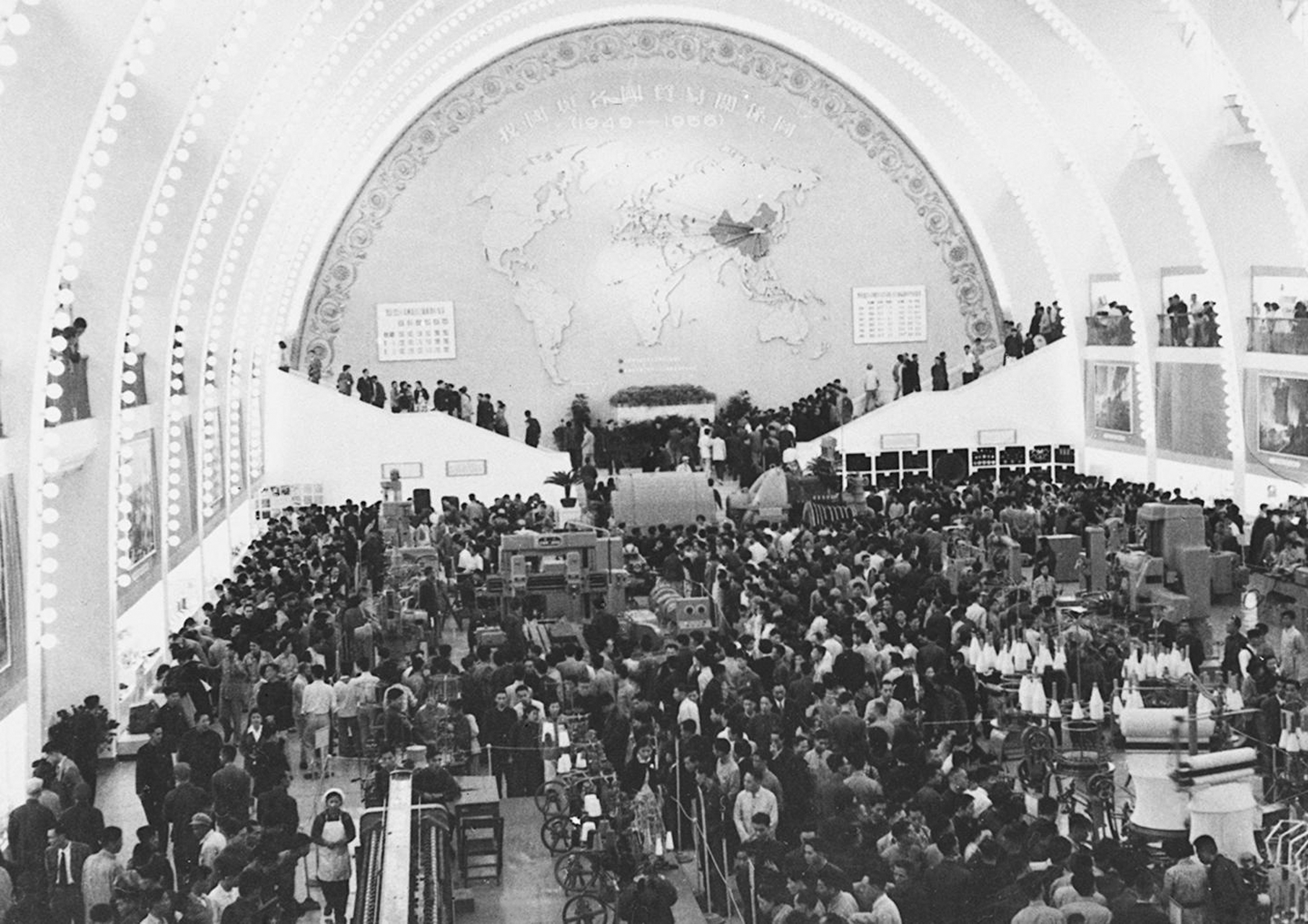
Global buyers at the exhibition hall for industrial products at the first edition of Canton Fair in Guangzhou, South China's Guangdong Province, on April 25, 1957. Photo: Courtesy of Canton Fair
Lee Fuen went on to attend 126 consecutive sessions without missing one. He visited factories, improved packaging, and helped introduce brands such as Tsingtao Beer to Hong Kong's market and beyond. His grandson Michael Lee has now attended nearly 50 sessions himself.
"My grandfather's generation did the zero-to-one," Michael Lee told the Global Times. "They made sure China had something to sell."
That was the era of "having something to sell." The Canton Fair was a window the country pushed open; outsiders looked in to see what China could offer.
In the decades that followed came the "one-to-ten" phase. Canned goods and silk gave way to home appliances, machinery and equipment. By the 86th session in 1999, mechanical and electrical products had become China's largest export category for the first time.
Talip Murat Kolbaşi, chairman of Arzum, Turkey's leading home-appliance brand, has attended more than 60 sessions. He remembered the questions of buyers changing from "Can the price be lower?" to "Can you make it to our standard?"
"Most of our company's most innovative and best-selling products have their origins at the Canton Fair. We hope to use the platform to explore international markets further," Kolbaşi said. "Similar projects elsewhere can take a long time. In China, the speed from concept to reality far exceeds expectations."
Kenneth Ng, managing director of Sanyu Industrial (Holdings) Co, first came to the Canton Fair as a child in 1968 with his father. He became a buyer in his own right in 1985, at the age of 20.
"Many products are now automated and intelligent," he told the Global Times. "In textiles, you put in the raw material and the machine does the rest. Machines run 24 hours; if a thread breaks, they find and fix the problem themselves. Before, a broken thread stopped everything. AI helps a great deal. When my father brought me into this hall, I could never have imagined today's level of sophistication - or that an entire exhibition hall would struggle to hold all the robot companies."
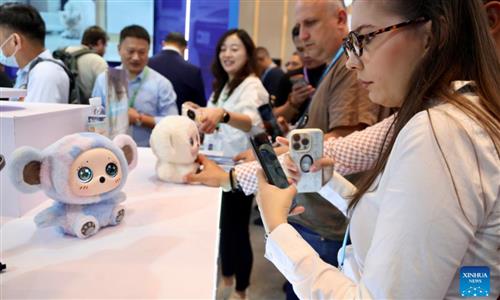
Phase One of the 140th session is a vivid example of the third chapter of China's trade. Under the theme "Advanced Manufacturing," more than 12,000 companies are attending, with 17 dedicated zones for emerging and future industries forming a complete chain from core components and intermediate goods to finished machines. The number of first-time releases of service robots, smart medical devices and drones rose by about 20 percent.
A manager at Shandong Tools Manufacturing Co put the change simply: "Customers used to ask about price first. Now they ask about quality, technology and complete solutions."
Gao Jianhua, vice general manager of Tsann Kuen (Zhangzhou) Enterprise Co, described another kind of upgrade. The long-standing small-appliance exhibitor has moved from pure OEM (making products to other companies' designs) to ODM (designing and manufacturing under its own intellectual property).
"In the past, most of our work was OEM - the customer's design, the customer's appearance. Now, for automatic coffee machines, steak grills, food-preparation equipment and smart garment care, many of the designs and patents are ours. We cooperate with foreign clients in ODM form. That is a big adjustment," Gao said, adding that 126 foreign buyers had confirmed they would visit its booth before the session even opened.
The shift came in stages. In recent years, the company has invested more heavily in its own design capability. "We used to chase volume. Our grill series once held more than half the global market. Now we go deeper into quality, convenience and intelligence," said Gao.
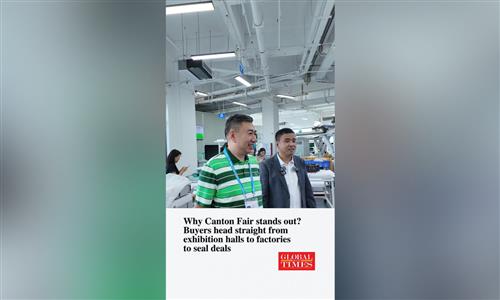
Eric Ong Lim, president of Mindanao Rock in the Philippines, did not linger in the exhibition hall on October 16, the second day of the session. He went straight to the Foshan factory of exhibitor Foshan Namkoo New Energy Technology Co to inspect the production line and discuss deeper cooperation.
What buyers now want is no longer a single machine but a package of capabilities, Yuan Feng, sales director at Namkoo, told the Global Times.
After the factory visit, Lim's assessment was clear: "The product quality is very good. I'm very satisfied and much more confident to invest than before."
Wu Changhua, chairman and president of Must Energy (Guangdong) Tech Co., Ltd, told the Global Times that "during the day, buyers look at products at our booth at the Canton Fair; at night they come to our factory in Foshan to talk about deeper cooperation."
Guangzhou-based industrial IoT platform provider iROOTECH offers another illustration of the shift toward "selling capability." The company serves more than 120 countries and over 1,100 large clients worldwide. "Our direction is helping our customers build AI-powered factories of the future, using agents to guide production robots," Xu Zinan, sales director at iROOTECH, told the Global Times.
As many exhibitors at the Canton Fair put it: The question the world asks is no longer only what China sells, but whom it is helping to build - and how well.
RELATED ARTICLES