World’s longest cross-sea high-speed rail bridge sees closure of first navigation channel span

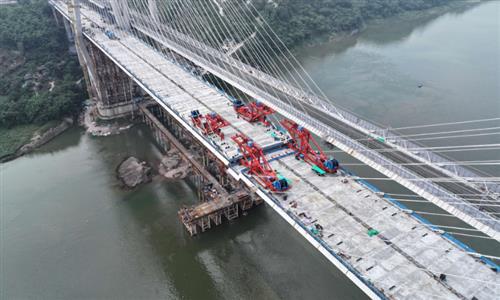
The southern navigation channel bridge of the Hangzhou Bay Cross-Sea Railway Bridge achieves closure on October 17, 2026. Photo: Screenshot from People's Daily
As the steel truss girder of the southern navigation channel bridge of the Hangzhou Bay Cross-Sea Railway Bridge saw closure on Saturday evening, it became the first of the three navigation channel bridges to reach this milestone, marking a landmark breakthrough in the construction of the world's longest cross-sea high-speed railway bridge. This achievement has laid a solid foundation for subsequent stay-cable tensioning, bridge deck construction, and the full structural system conversion of the entire bridge.
The bridge forms a crucial section of the Nantong-Ningbo High Speed Railway. At 29.2 kilometers, it is currently the world's longest and highest-standard clustered cross-sea railway bridge under construction, according to the People's Daily.
The project consists of northern, central, and southern navigation channel bridges, as well as mid-sea approach bridges and shoal-area approach bridges. The southern navigation channel bridge that has just been closed is situated in the central waters of Hangzhou Bay. It measures 814.5 meters in total length, with a main span of 364 meters capable of accommodating vessels of up to 3,000 deadweight tons, said the report.
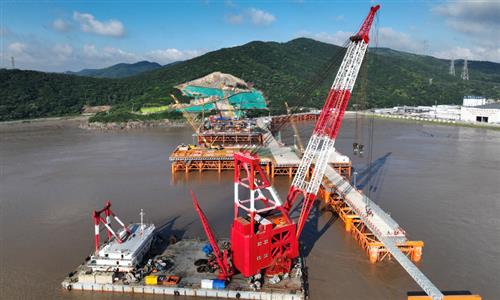
Hangzhou Bay is one of the world's three strongest tidal bays, with a maximum tidal range of nearly nine meters, swift currents, and frequent strong winds. The annual effective offshore construction window is extremely limited. The highly saline and humid environment, together with constantly shifting seabed scouring and deposition, poses extreme challenges to construction precision, structural safety and offshore operations.
To overcome the world-class construction difficulties, the project team has adopted an innovative double-sided incremental launching closure technique suited to the complex conditions of a bay with strong tides.
During construction, BeiDou Navigation Satellite System positioning and digital monitoring systems were employed, with comprehensive monitoring points installed on the towers, steel girders, and temporary supports. Stress, cable force, and displacement data were collected at millisecond intervals.
Besides, longitudinal wind-resistant devices and transverse restrainers were used to dynamically adjust the alignment of the closure gap. Operations were deliberately scheduled during nighttime periods of stable temperature to minimize thermal deformation.
In addition, the project team has established a meteorological and hydrological early-warning mechanism and dynamically optimized the construction schedule to ensure offshore safety.
Following the closure of the southern navigation channel bridge, the project will proceed with graded release of stay cables, casting of wet joints, installation and tensioning of the remaining cables, and placement of permanent bearings, steadily advancing the full structural system conversion.
All offshore pile foundations and pier shafts of the bridge have been completed. Construction of the main structures of the three navigation channel bridges is progressing steadily, and overall works across the line are accelerating.
The Nantong- Ningbo High Speed Railway, with a total length of 301 kilometers, forms an important part of the coastal corridor in China's high-speed rail network. Once completed, it will significantly densify the rapid rail network in the Yangtze River Delta, shorten the travel times between coastal cities in Jiangsu and Zhejiang provinces, improve the regional comprehensive transportation system and further inject strong momentum into the region's high-quality integrated development.
Global Times
RELATED ARTICLES