ARTS / CULTURE & LEISURE
New research sheds light on Liangzhu’s role in the origins of Chinese civilization
4th forum being held on 90th anniv of discovery
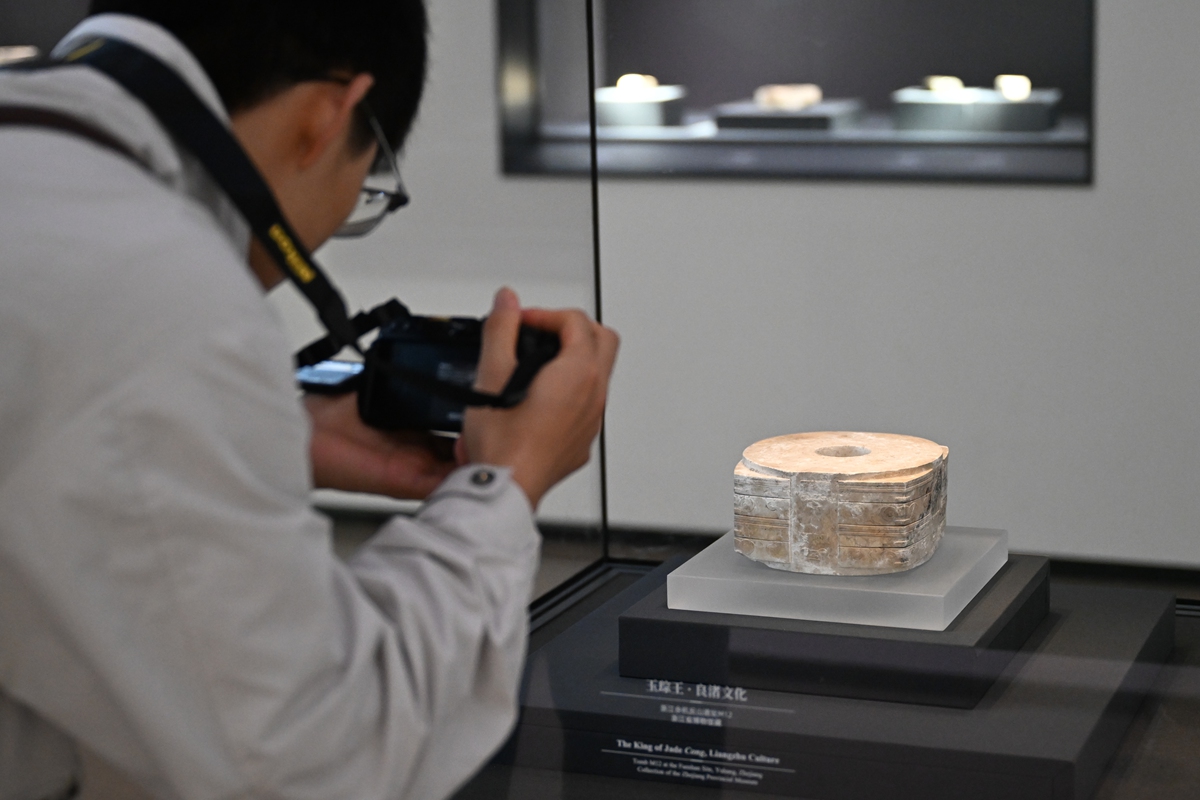
A visitor takes photos of one of the largest jade congs (a ritual object featuring a square outer form and a circular inner tube) at a special exhibition marking the 90th anniversary of the discovery of the Liangzhu archaeological site in Hangzhou, East China's Zhejiang Province, on October 19, 2026. Photo: VCG
The Liangzhu civilization in the lower Yangtze River basin offers important evidence of the emergence of early states in China. Archaeological findings reveal a society marked by social hierarchy, specialized production and large-scale water management more than 5,000 years ago, as highlighted at the ongoing 4th Liangzhu Forum.The Liangzhu civilization was a Neolithic culture that existed in China's Yangtze River Delta region. Inscribed on the UNESCO World Heritage List in 2019, the Archaeological Ruins of Liangzhu City offer important evidence of an early regional state that flourished more than 5,000 years ago.
At the main session of this year's forum, Chen Xingcan, a member of the Chinese Academy of Social Sciences and president of the Chinese Society of Archaeology, outlined the new development in the study of early Chinese civilization.
Chen said that archaeological evidence shows that from around 5,800 years ago, relatively pronounced social stratification emerged at roughly the same time in several regions, including the Yangtze River, Yellow River and West Liao River basins, marking the beginning of an accelerated phase in the emergence of civilization across these regions. He said the "ancient states era" can be divided into three stages.
From around 5,800 to 5,300 years ago, early societies in several regions began to show distinct social stratification. In the lower Yangtze River region and the West Liao River basin, jade objects increasingly served as symbols of social status.
From around 5,300 to 4,300 years ago, the middle and lower reaches of the Yangtze River were at the forefront of the emergence of civilization in China. Typical features of this stage included walled cities, a clear distinction between urban and rural settlements, large buildings and public facilities, high-status burials, specialized craft production for the elite and established ritual systems. Liangzhu society also had a highly unified system of religious beliefs, making the Liangzhu culture the foremost representative of this stage.
During the third stage, from around 4,300 to 3,800 years ago, development in the middle and lower Yangtze River region slowed, while societies in the Central Plains and northern China gained prominence.
"A series of archaeological discoveries has confirmed that the Yangtze River Basin is an important region of origin for Chinese civilization, profoundly highlighting the irreplaceable historical position of the Yangtze River civilization within the diverse yet integrated pattern of Chinese civilization," noted Chen.
Recent research has provided a more complete picture of Liangzhu's extensive water management system.
Wang Ningyuan, director of the Scientific Archaeology Department at the Zhejiang Provincial Institute of Cultural Relics and Archaeology, said researchers have identified more than 20 additional dam remains buried underground, building on the 11 dams previously identified in the peripheral water management system at the Liangzhu site.
Dating back approximately 5,000 years, the extensive hydraulic project would have required substantial manpower and resources for planning, construction and maintenance. Its scale provides tangible evidence of Liangzhu's capacity to organize labor and mobilize resources, which are key indicators of early state formation, Wang said.
Another significant discovery is a large complex near the Fanshan royal cemetery. Enclosed on all four sides and covering approximately 25,000 square meters, the complex is believed to have served as a ceremonial space for Liangzhu's ruling elite. Archaeologists have suggested that it may also be linked to the origins of China's early tomb and burial traditions.
After identifying traces of buildings on a raised area east of the Fanshan cemetery in 2025, the team completed a reconstruction of the structures this year. Three buildings stood at the center of the mound, including an oval-shaped main structure.
"Writing has not yet been found from the Liangzhu period, so we have to piece together the social structure of the time through archaeological evidence, including artifacts and buildings," Wang said.
The chronology of Liangzhu culture has also been refined through recent research. A 2026 report revised the culture's dates to approximately 5,350 to 4,500 years ago, based on systematic scientific dating, Wang said.
The updated chronology provides a more precise framework for studying Liangzhu's development and strengthens the archaeological evidence supporting China's 5,000-year history of civilization, noted Wang.
The year 2026 marks the 90th anniversary of the discovery of the Liangzhu ruins. The inaugural forum was held in Hangzhou in 2023. The fourth edition, which kicked off on Sunday and is scheduled to conclude on Tuesday, is being co-hosted by China's Ministry of Culture and Tourism, the National Cultural Heritage Administration and the Zhejiang provincial government.
The forum brings together four international organizations: UNESCO, based in Paris; the International Centre for the Study of the Preservation and Restoration of Cultural Property, headquartered in Rome; the Alliance for Cultural Heritage in Asia, based in Beijing; and the International Alliance for the Protection of Heritage, headquartered in Geneva, according to the organization.
RELATED ARTICLES