ARTS / CULTURE & LEISURE
China-hosted theater forum brings global voices together to discuss national theater
By Published: Oct 19, 2026 10:36 PM

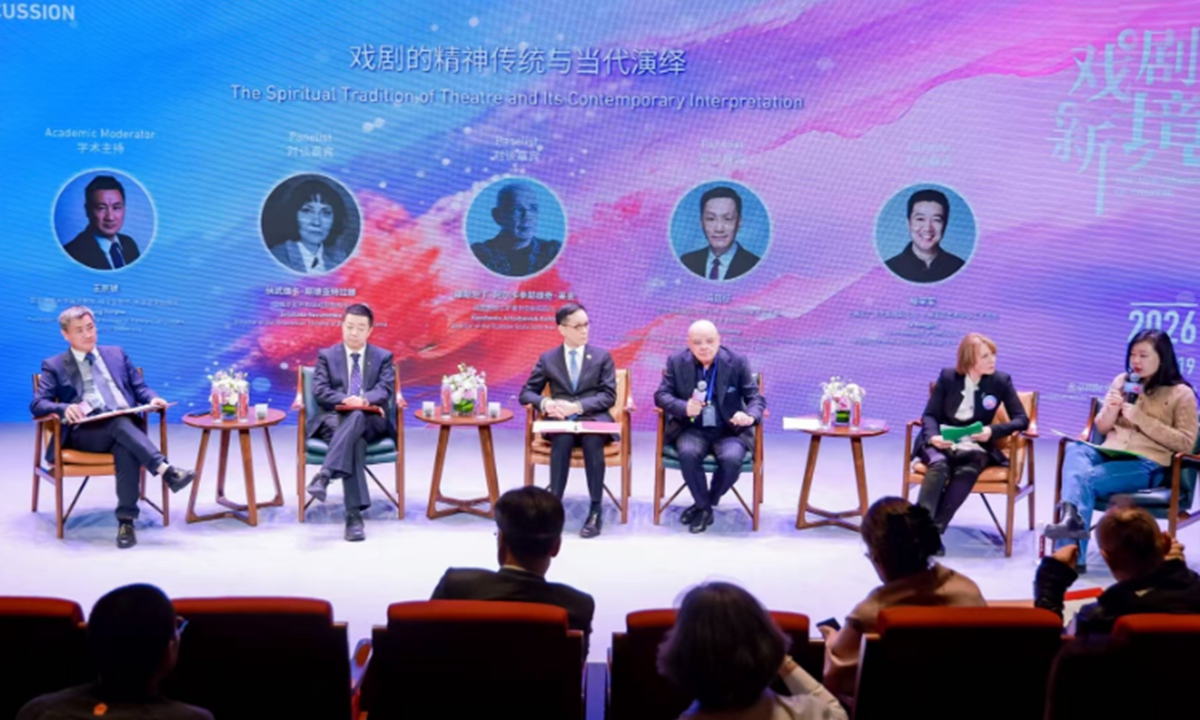
Photo: Xu Liuliu/Global Times
In 1765, with Prussia and Russia tightening their grip on Poland, King Stanisław August Poniatowski made an improbable bet on culture. He founded a national theater, a school and a newspaper modeled on London's The Spectator.More than two and a half centuries later, the theater still stands.
"This is the heritage we have," Jan Klata, director of the National Theatre in Warsaw, Poland, told the audience at the 2nd World Theatre Forum in Beijing on Sunday. "It is an enormous obligation."
That sense of obligation - to history, to memory, and to the public today - hung over the forum, which was held from Saturday to Sunday and hosted by the China Theatre Association. Directors from China, Poland, France, Belarus, Slovenia and Romania gathered for two days. No one asked the question directly, yet every speech circled it: What is a national theater for, and how can the world communicate through theater?
For Klata, the answer begins in personal memory as much as in national myth. His mother once queued for tickets at the National Theatre for dozens of hours at a stretch, with his father later taking her place in line.
"In a sense, I stood in that queue too," he said, "because my mother was pregnant with me."
His newest production reaches back to that founding era: It opens in 1813 on the battlefield at Leipzig, inside the mind of a drowning prince, then travels further into the 18th century to "the moment a new European paradigm was being formed."
Across the room, Chinese artists offered a different perspective on continuity. Feng Li, who leads the China National Opera and Dance Drama Theater, spoke of The White-Haired Girl, which premiered in Yan'an in 1945 and has been staged continuously for 80 years. Continuity, she suggested, is itself a form of meaning. When her company took the opera The Wilderness to Madrid and Paris in September, the applause lasted seven or eight minutes. "The play was novel," she said, "but not exotic."
Vicențiu Rahău, creative director of Romania's Sibiu International Theatre Festival, described an institution that refuses to remain seasonal. Over 10 days, the festival hosts more than 850 events featuring 5,000 artists from 80 countries, drawing a million spectators and 500 volunteers - four out of five of them teenagers. He argued that a festival should be "a structure that works the whole year," not a 10-day event that then goes quiet.
Feng Yuanzheng, president of the Beijing People's Art Theatre, framed theater as deliberate exchange.
In 1980, his company took Teahouse to Europe, where it was greeted as a miracle of the Eastern stage. Today, exchanges move both ways: The British production Frankenstein was screened in Beijing in 2014, the company's own filmed productions travel abroad, and in 2025 the Georgian director David Doiashvili brought to the stage The Cherry Orchard with a Chinese cast.
"Exchanges cannot stop at importing or exporting works," Feng said in an interview with the Global Times.
"It needs creators from China and abroad to break down barriers, think side by side and work together."
For the hosts, the gathering was itself a partial answer. The Beijing People's Art Theatre has spent years building the infrastructure that makes such encounters routine rather than exceptional and the results speak for themselves: a theater festival now in its 11th year, 32 productions from 17 countries, and more than 200 performances held abroad in the past decade.
RELATED ARTICLES


