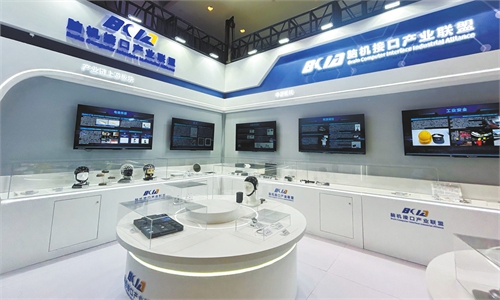
China achieves breakthrough in international standards for brain-computer interfaces
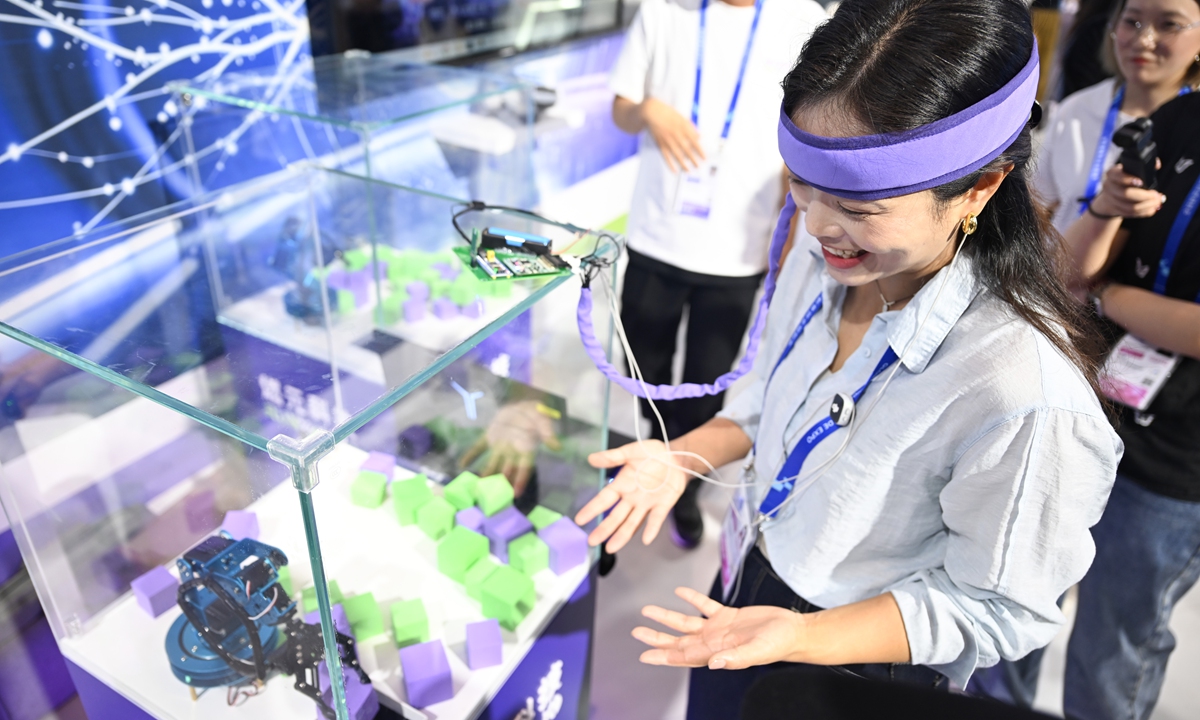
A visitor uses a non-invasive brain-computer interface device to control a robotic arm to grasp objects at a media preview event for the 5th Global Digital Trade Expo in Hangzhou, East China's Zhejiang Province, on September 20, 2026. The expo, an event dedicated to promoting digital trade and industrial cooperation, will be held from September 23 to 27 in Hangzhou, with artificial intelligence as its main theme. Photo: VCG
The International Organization for Standardization has published an international standard on the reference architecture for brain-computer interfaces (BCIs), which was led by China. The standard establishes a complete technical framework covering concepts, applications, functions, and implementation, marking another important achievement by China in the field of international standardization for BCIs.
As BCIs gradually move from scientific research into applications in fields such as healthcare, health-related consumer products, industrial production, and traffic safety, a unified foundational architecture is increasingly important for promoting technological coordination and the regulated development of the industry. The international standard was led by Chinese experts serving as project leaders and was jointly developed with experts from Italy, South Korea, the UK, India, the US, and other countries, according to the People's Daily.
Centered on four core questions — "What is BCI, how is it used, what functions does it have, and how is it implemented?"— the standard systematically reviews typical implementation models and addresses differences among BCI technical routes and application scenarios in terms of system composition, functional division, and implementation methods.
The publication of the standard will help unify understanding among industry stakeholders worldwide regarding the system composition, functional boundaries, and typical implementation methods of BCI systems. It will provide a unified technical reference for BCI product development, system design, and the subsequent development of related standards on data, interfaces, testing, and applications, further consolidating the standards foundation for the large-scale and standardized development of BCIs, said the report.
"The essence of leading a standard is to combine application scale, engineering capability, and the ability to articulate rules, thereby laying the groundwork for future global standards on data, interfaces, testing, and applications," Chen Jing, vice president and research fellow at the Society for the Study of Technological and Strategic Trends, told the Global Times on Monday.
Chen said that although China still needs to make breakthroughs in high-performance electrodes and implantable devices, low-power chips, and original theories, the country has built deep expertise in non-invasive BCIs, neural engineering, and rehabilitation assistive devices across universities, hospitals, and enterprises, with abundant cases, data, and engineering iteration scenarios.
Moreover, strong application demand in medical rehabilitation and health-related consumer products makes it possible to rapidly turn prototypes into systems and stands out for its speed in clinical implementation and industrialization, the expert noted.
For instance, the world's first invasive BCI medical device was recently approved to enter the market, and China's National Healthcare Security Administration assigned a medical insurance code to the product, bridging the critical gap from regulatory approval to clinical application.
The development of semi-invasive BCI devices is also accelerating to catch up with the tide. The clinical trial of the semi-invasive Beinao-1 system was launched in March, according to the Xinhua News Agency.
The rapid development of China's BCI sector would not have been possible without intensive support from policies and the industrial ecosystem, Chen noted.
For the first time, BCI was included in this year's Government Work Report delivered to the National People's Congress in March. The outline of the 15th Five-Year Plan (2026-30) for national economic and social development lists BCI as one of the six key industries of the future.
Medical institutions in Beijing, Tianjin, Guangzhou, Wuhan, Nanjing, and other cities across China have set up dedicated BCI clinics or clinical research wards. BCI products developed in China have been applied in a wide range of scenarios, including assisting disease diagnosis, safety monitoring for high-risk operations, motor rehabilitation, and neuromodulation treatment for brain diseases such as Parkinson's disease and epilepsy, Xinhua said.
China's BCI market is projected to reach 6.14 billion yuan ($917.6 million) by 2028, with a compound annual growth rate of 17.7 percent from 2024 to 2028, according to CCID consulting under China's Ministry of Industry and Information Technology.
RELATED ARTICLES