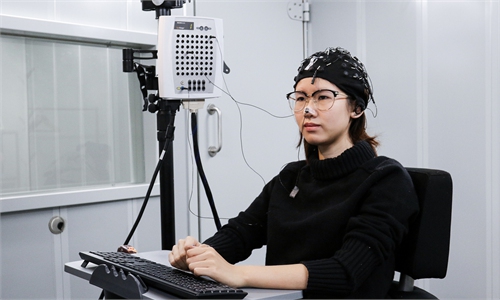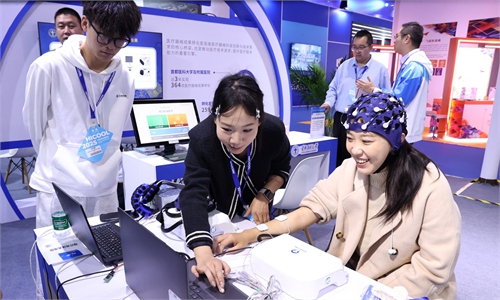
Brain-computer interface Photo: VCG
The world's first invasive brain-computer interface (BCI) medical device was recently approved to enter the market, and China's National Healthcare Security Administration (NHSA) assigned a medical insurance code to the product, bridging the critical gap from regulatory approval to clinical application, the People's Daily reported on Wednesday.
The BCI device is made by Neuracle, a Chinese neural technology company based in Shanghai.
The company told the Global Times on Wednesday that the NHSA's rapid assignment of a medical insurance code indicates "strong" support for innovative healthcare technology, and it is also an "authoritative" recognition of the company's technological strength, as well as the device's clinical value.
The company said that its implantable BCI product contains movement function compensation system, which is useful in curing patients with high-level paraplegia caused by spinal cord injuries.
China has more than 3.7 million patients with spinal cord injuries, with the number increasing by about 90,000 new cases each year. This innovative device works by implanting a coin-sized, minimally invasive device inside the patient's cranium.
The system could collect and decode brain signals in real time, enabling patients to control an external pneumatic glove through sheer "thought" alone, allowing them to independently perform daily actions such as grasping, picking up objects, and drinking water, the company said.
"The assignment of a medical insurance code makes it possible for BCI implantation procedures to be covered by China's medical insurance system. By front-loading the reimbursement process, it will accelerate the clinical application of BCI technology and provide medical insurance payment protection for patients undergoing BCI implantation.
"It will foster a favorable ecosystem for the widespread application of BCI technology," Pan Helin," a member of the expert committee of the Ministry of Industry and Information Technology, told the Global Times on Wednesday.
Despite having the medical insurance code, the product must go through the hospital procurement process. Large medical equipment requires configuration approval from the National Health Commission, Pan said.
BCI-related clinical trials have already in progress in China. For instance, the Xinhua News Agency reported on Tuesday that the first BCI research ward in Southwest China, situated at the Second Affiliated Hospital of Chongqing Medical University, has recently received its 100th patient, achieving ground-breaking progress in clinical use of BCI technology.
The government's policy support has prompted the development of the industry, Pan said.
For the first time, BCI was included in this year's Government Work Report delivered to the National People's Congress in March. The outline of the 15th Five-Year Plan (2026-2030) for national economic and social development lists BCI as one of the six key future industries.
Meanwhile, various regions in China are accelerating their layout of the sector. East China's Jiangsu, Beijing, Shanghai and Southwest China's Sichuan have released action plans for cultivating BCI industry.
"BCI technology is still at the early development stage. Currently, it focuses on improving the quality of life for people with disabilities and helping them regain some movement functions. It has promising prospects," Pan said.
According to data from Qianzhan Industry Research Institute, China's BCI market size reached 2.3 billion yuan ($333.6 million) in 2024. It is expected to exceed 10 billion yuan by 2029, with a compound annual growth rate of 35 percent, stcn.com reported.
Pan said that the greater long-term potential lies in the fact that BCI can provide a valuable platform for research involving neuroscience, surgical robotics, and biological signal processing, which will help elevate the country's scientific research capabilities.
RELATED ARTICLES