China rolls out 20 measures to boost sci-tech insurance in support of self-reliance
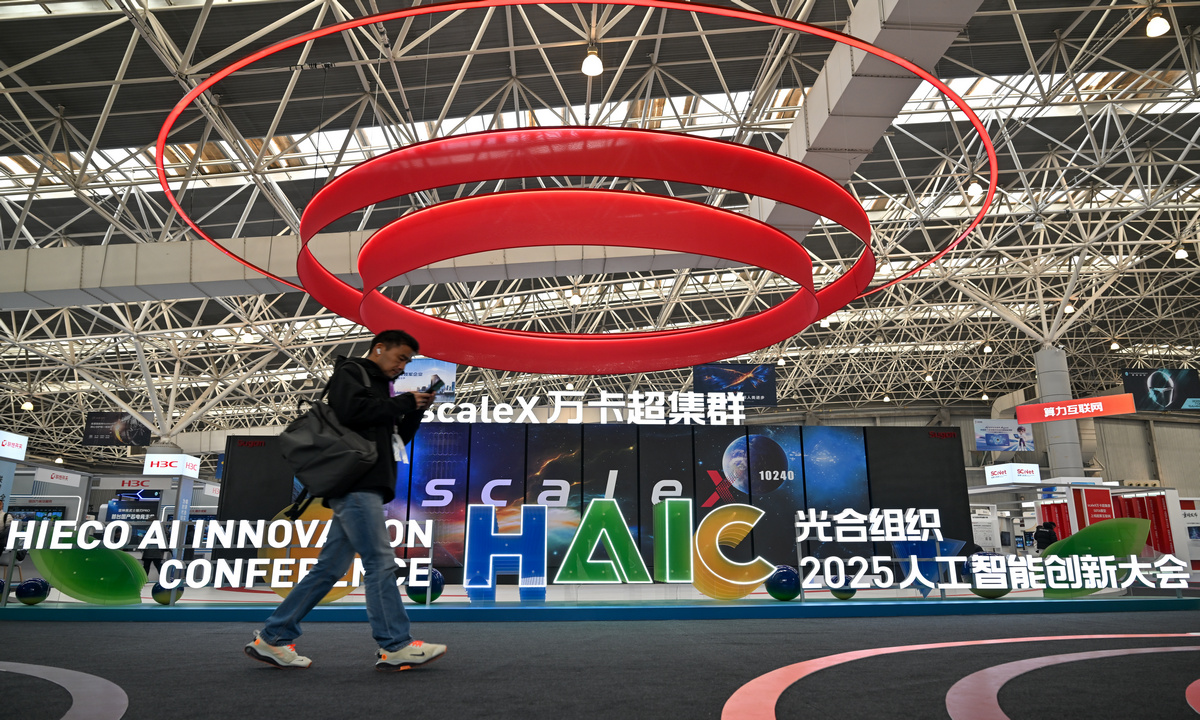
The HIECO AI Innovation Conference opens in Kunshan, East China's Jiangsu Province, on December 17, 2025. Drawing more than 4,000 guests from 2,500 companies, the event spotlights a wide range of achievements in artificial intelligence technologies, products, applications and ecosystems. Photo: VCG
Several Chinese government departments on Monday unveiled a guideline outlining 20 measures across six areas to accelerate the establishment of a sci-tech insurance system aligned with technological innovation, in a bid to bolster high-level self-reliance and strength in science and technology.
The guideline was jointly issued by the Ministry of Science and Technology (MOST), the National Financial Regulatory Administration (NFRA), the Ministry of Industry and Information Technology and the China National Intellectual Property Administration, according to a statement published on the MOST's official website.
The guideline covers insurance support for major national sci-tech missions, technology-based small and medium-sized enterprises (SMEs), and key sectors, as well as improvements in sci-tech insurance products and services, the investment of insurance funds, and regulatory safeguards.
The ministry said that the rollout of the guideline will better position sci-tech insurance as a "shock absorber" and "stabilizer" for innovation, address mismatches between insurance services and the practical needs of innovation, and enhance the capacity of insurance to serve high-level self-reliance in science and technology and the building of a strong sci-tech nation.
In serving major national sci-tech tasks, the document calls for establishing a national coordination mechanism to advance insurance support for key technological breakthroughs. It also pledges to strengthen insurance services for strategic sci-tech forces and key regions, including the Beijing-Tianjin-Hebei region, the Yangtze River Delta and the Guangdong-Hong Kong-Macao Greater Bay Area, which host international innovation centers.
China will promote more accessible and convenient sci-tech insurance products for technology-based SMEs, expand coverage, and provide flexible insurance solutions for new models such as "use first, pay later" commercialization of technological achievements, according to the guideline.
Notably, the guideline places a strong focus on innovation in sci-tech insurance products and services, targeting frontier sectors such as artificial intelligence, integrated circuits, quantum technology and brain-computer interfaces, while optimizing product development, underwriting and claims services, specialized operations and the broader development ecosystem.
The new guideline clarifies key institutional questions such as what to insure, how to insure and who to insure, providing a clearer top-level framework for sci-tech insurance, Dong Shaopeng, senior research fellow at the Chongyang Institute for Financial Studies at Renmin University of China, told the Global Times on Monday.
"Insurance should serve as a risk-sharing and loss-compensation mechanism in the innovation process, particularly for technology firms facing high upfront investment and significant uncertainty," Dong said.
As of September 2025, China's insurance sector had provided more than 10 trillion yuan ($1.39 trillion) in risk coverage for technology research, development and commercialization, the Economic Information Daily reported on Monday, citing data from the NFRA.
In the first three quarters of 2025, sci-tech insurance premium income rose 30 percent year-on-year, significantly outpacing the industry average, according to the report. At the same time, insurance funds have been increasingly channeled into technological innovation, fostering a supportive ecosystem for venture investment and injecting fresh capital into the innovation pipeline.
Sustainable funding sources, sound actuarial models and long-term viability remain real tests. Insurers must be able to mitigate risks for tech firms while maintaining prudent operations and preserving and growing capital, according to Dong.
RELATED ARTICLES