World stands to gain from affordable Chinese AI by looking beyond geopolitical bias
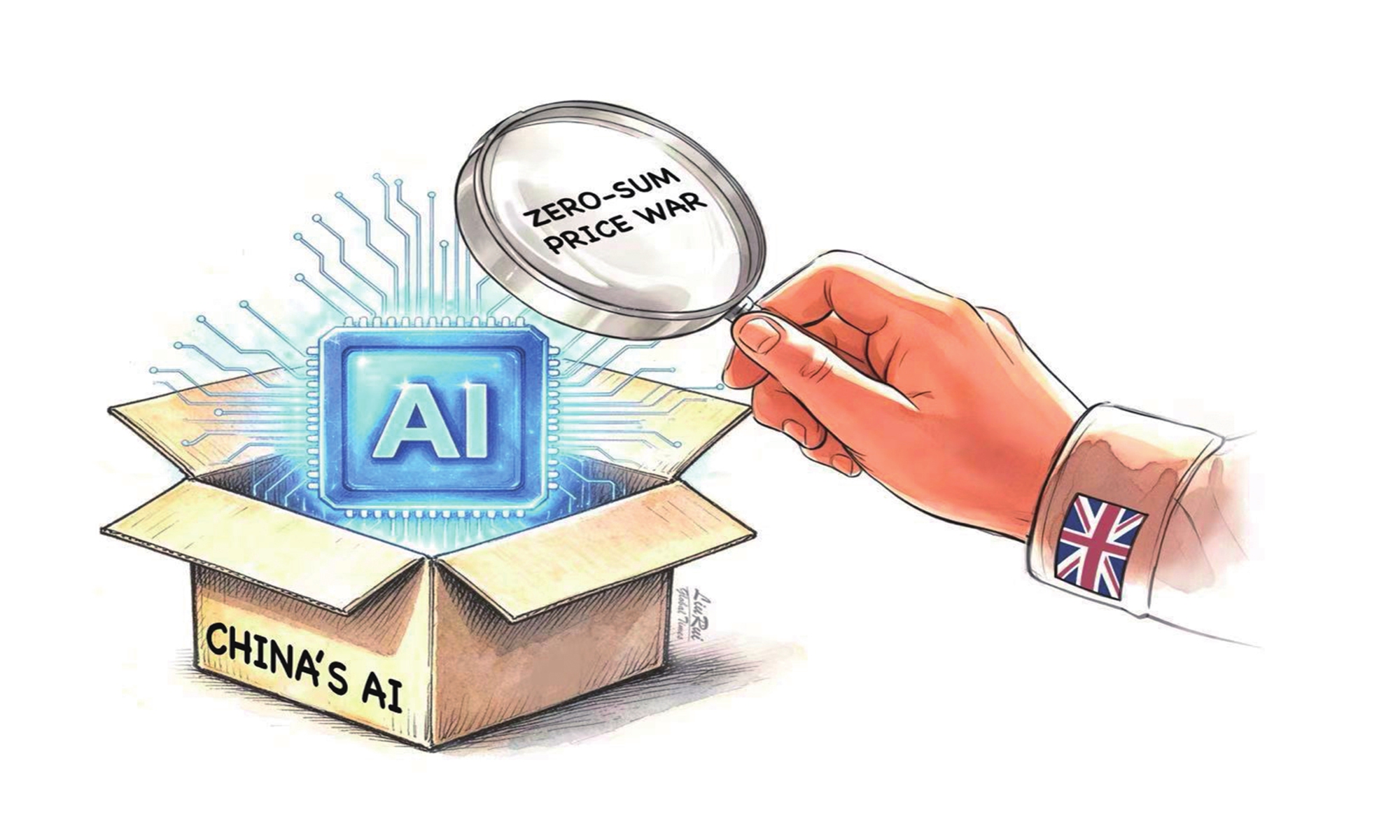
China's AI, zero-sum price war Illustration: Liu Rui/GT
Should Britain reject the lure of "cheap" Chinese artificial intelligence (AI)? In a column published in The Guardian on October 17, Phillip Inman makes the case for doing so. Yet the experience of businesses using AI tells a different story.
As AI advances, more businesses are putting it to work. But adoption depends on more than what a model can do. Cost matters, too. For many companies, especially smaller ones, AI is useful only if they can afford to use it at scale. Models that deliver good results at a lower cost can bring AI within reach of more businesses.
In China, AI is moving beyond the tech sector and into traditional industries, helping businesses work more efficiently and raise productivity. The broader the access to AI, the greater its potential economic benefits. Affordable AI is not just a cheaper option. It can help more businesses put the technology to work, turning advances in AI into gains across the wider economy.
In the real economy, AI's benefits are becoming tangible. At a company in Shanghai, designing a garment used to be a time-consuming process. Now, designers can upload a sketch and get a visual rendering in just 30 seconds. AI has dramatically sped up the design process. For businesses, adopting AI is a straightforward calculation: do the benefits outweigh the costs? The more affordable AI becomes, the more businesses stand to gain from it.
The same holds true for Britain and economies around the world, not just China.
Businesses are increasingly turning to AI to cut costs and improve productivity. What does this have to do with geopolitics? Nothing at all.
Yet some Western commentators insist on viewing technological progress through a geopolitical lens. The Guardian article claims that Western AI comes with "at least some effort to provide security and a benign intent" - "not so from China." Such arguments betray a deeper unease with China's AI progress.
As Chinese models deliver strong performance at lower cost, their economic appeal is becoming harder to deny. Geopolitical bias then becomes a convenient way of trying to cast doubt on Chinese AI without having to confront the facts.
However, it is still too early to claim that Western AI is inherently secure. In recent months, some cutting-edge AI products in the US have exposed security vulnerabilities. This does not mean that American AI is unsafe. Rather, it is a reminder that managing the risks that come with AI development is a shared challenge for the global technology industry.
China's AI industry is advancing rapidly, with wider access and stronger security measures developing alongside each other. As Chinese AI becomes more affordable and reaches a wider range of users, its benefits are spreading across businesses and society.
The economic appeal of Chinese AI is increasingly hard to deny. Advances in technology are making models more capable and affordable. Attempts to cast Chinese AI in a negative light will not stop its progress, nor can they obscure what users are discovering for themselves. In the end, businesses judge AI by its performance, its cost and the value it delivers, not by the geopolitical narratives surrounding it.
For traditional industries, the opportunities are real. AI is already helping businesses improve efficiency. In the AI era, competition is not just about who builds the most advanced models. It is also about who can put AI to work fastest across manufacturing and services, turning technological progress into productivity gains.
This is where China and other economies, including Britain, have room to cooperate. Making the most of that opportunity calls for a clear-eyed view of what Chinese AI can offer, free from the distortions of geopolitical bias and anxiety.
The author is a reporter with the Global Times. bizopinion@globaltimes.com.cn
RELATED ARTICLES