US Space Force eyes fivefold expansion in Middle East, fueling space arms race concerns: Chinese expert
By Published: Oct 20, 2026 08:18 PM

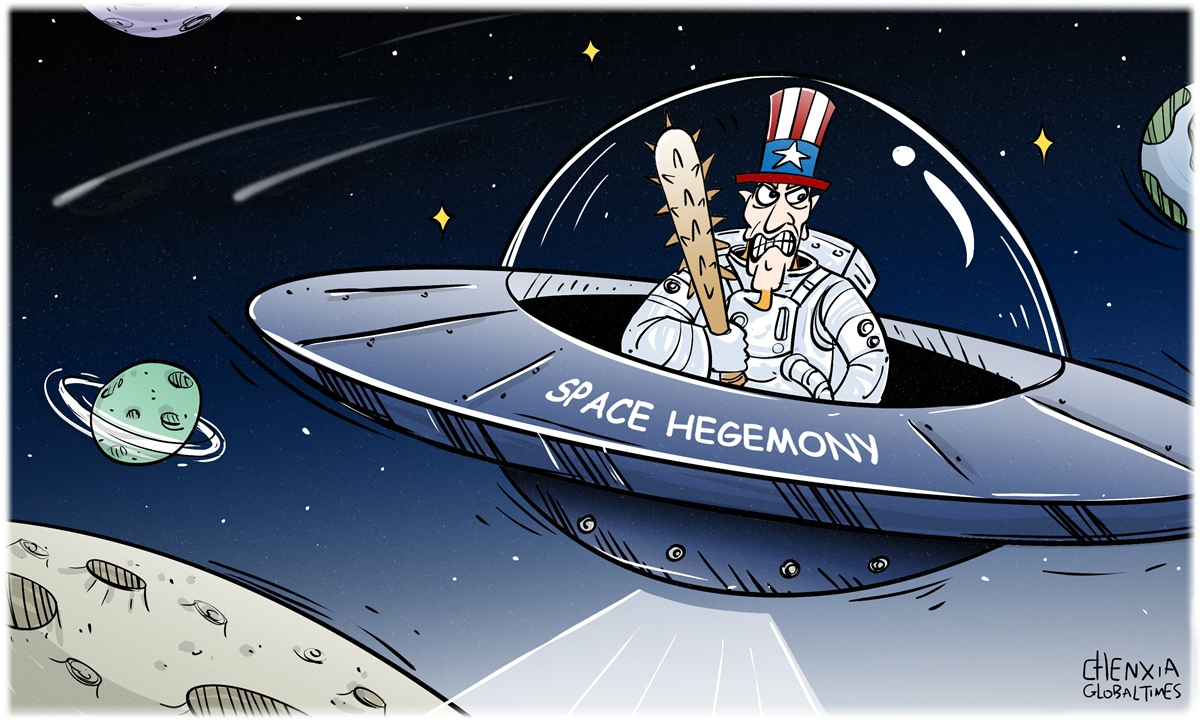
Militarizing space. Illustration: Chen Xia/GT
The commander of the US Space Force component supporting US Central Command said that he expects his force to grow to five times its current size in about three years, an expansion he described as necessary to meet the military's growing demand for space capabilities in operations across the Middle East, according to a report published Monday by the US military publication Air & Space Forces Magazine.The projected expansion reflects Washington's growing emphasis on offensive and defensive space capabilities, a Chinese military expert told the Global Times, warning that the continued buildup of US military power in space could fuel a new arms race and turn outer space into another arena of military confrontation.
According to the report, the US Space Forces Central (SPACECENT) was activated in December 2022 with a small staff of about 30 personnel split between Shaw Air Force Base, South Carolina, and Al Udeid Air Base, Qatar. Speaking during an event at the Mitchell Institute for Aerospace Studies, Todd Benson, SPACECENT commander, said his team had played an outsized role in operations against Iran but needed to grow.
Benson said operations over the past year had demonstrated the need for additional personnel and space systems, including ground-based jammers and systems operating in orbit. He added that deploying Space Force personnel closer to operational areas, while maintaining support from their home stations, had reinforced the importance of space capabilities in joint military operations.
"Space will forever be a part of every military operation going forward," Benson said. "There is no going backwards on that."
Song Zhongping, a Chinese military affairs expert, told the Global Times on Tuesday that the planned expansion reflects an evolution in the US Space Force's operational doctrine, as Washington increasingly emphasizes both offensive and defensive capabilities in space.
"The US Space Force is not only tasked with protecting its own space assets but also seeks to develop capabilities to disrupt or neutralize those of potential adversaries," Song said, noting that space capabilities are becoming increasingly integrated into military operations across different domains.
According to the report, the Space Force today has components within every geographic combatant command and just this month added its newest component, US Space Forces Special Operations, or SPACEFOR-SOC. Each component is charged with presenting space expertise to commanders in the field, and that includes deploying to the front line to generate space effects like electronic warfare, satellite communications, navigation and timing, and missile warning.
Song explained that ground-based jamming systems could interfere with other countries' satellite communications and related military capabilities, while orbital systems could serve defensive, offensive and operational support functions.
The expert warned that the increasing emphasis on offensive space capabilities could accelerate an arms race, as other countries may feel compelled to develop corresponding capabilities to safeguard their own security.
China has repeatedly voiced opposition to the weaponization of outer space and warned against efforts to turn it into a battlefield.
On September 15, Chinese Foreign Ministry spokesperson Guo Jiakun responded to reports that the US Space Force had announced the deployment of weapons in space, urging Washington to halt its military buildup.
"China stands for peaceful use of outer space and keeping it safe, and opposes any arms race in outer space or any attempt to weaponize it and turn it into a warzone," Guo said.
"We urge the US to stop expanding military build-up in outer space, and uphold global strategic stability with concrete actions," the spokesperson added.
More recently, Sun Xiaobo, director-general of the Department of Arms Control of China's Foreign Ministry, warned at the UN General Assembly's First Committee on October 9 that US announcements concerning weapons deployment in outer space had triggered widespread international concerns.
Sun called for advancing negotiations on a legally binding international instrument to prevent an arms race in outer space, stressing the urgency of preventing outer space from becoming a new battlefield.
RELATED ARTICLES