ARTS / CULTURE & LEISURE
China unveils first 5-year plan for cultural heritage protection, expanding safeguards beyond individual relics: experts
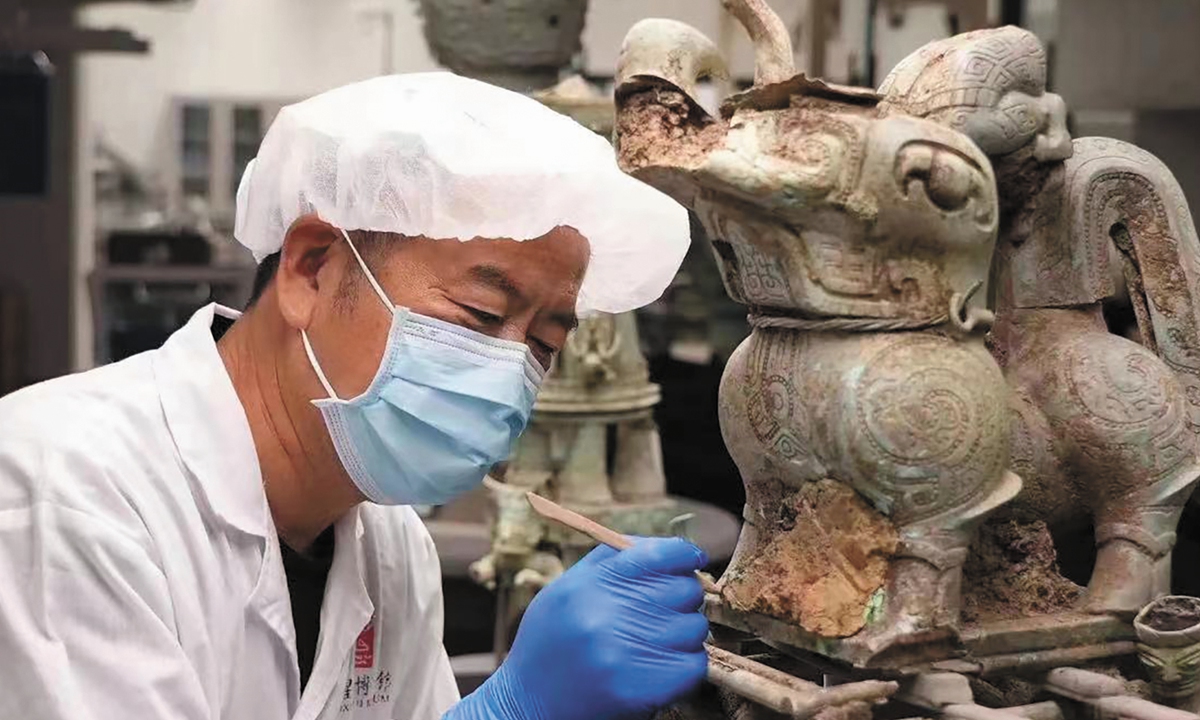
Cultural relic restorer Guo Hanzhong Photo: Courtesy of the Sanxingdui Museum
China will formulate a law on cultural heritage protection to strengthen legal safeguards for various types of cultural heritage, including historic and cultural districts, according to a press conference held by the State Council Information Office in Beijing on Tuesday.The law is one of the new measures to strengthen cultural heritage protection outlined in a national five-year plan, marking the first time China has formulated a five-year plan specifically dedicated to cultural heritage protection.
China will also establish an oversight system for cultural heritage protection and coordinate the use of measures such as education and training, audit-based supervision and public interest litigation to hold those responsible for damaging cultural heritage strictly accountable.
These efforts aim to make cultural heritage protection an unshakable national commitment, Hu Kaihong, deputy director of the General Office of the Central Commission for Guiding Cultural and Ethical Progress, said at the press conference.
With systematic cultural heritage protection as its core, the five-year plan aims to establish a comprehensive protection framework, improve cultural governance capacity and standards, and strengthen supporting measures and safeguards, Hu said.
The move marks a major upgrade to China's legal framework for cultural heritage protection, Yu Jinlong, a Beijing-based cultural scholar, told the Global Times on Tuesday
While the existing Law on the Protection of Cultural Relics focuses primarily on individual cultural relics, the new law will address gaps in the legal protection of living heritage, including historic and cultural districts and traditional villages. It will shift the focus from safeguarding individual relics to preserving entire cultural landscapes and their historical continuity, Yu noted.
Taking the Qinghefang Historic and Culture Feature Street in Hangzhou, East China's Zhejiang Province, as an example, Yu said that many residential buildings in these areas are not officially designated as protected cultural relics, yet the traditional street layouts and the cultural heritage embedded in everyday life are invaluable.
Qinghefang is one of Hangzhou's eight historic streets. In June, local authorities approved a conservation plan for the historic and cultural city covering the period from 2021 to 2035, prioritizing the preservation of historic buildings, traditional street layouts and the continuity of local life in historic and cultural districts, according to the local government.
In the past, inadequate legal safeguards at the higher legislative level left these areas vulnerable to large-scale demolition, redevelopment, or closure. The new law will clarify requirements for preserving historic character, protecting the rights and interests of original residents, limiting commercial development, helping curb destructive construction carried out in the name of development and excessive commercialization, Yu said.
To date, China has 146 nationally designated historic and cultural cities, 312 historic and cultural towns, 487 historic and cultural villages, 8,155 traditional Chinese villages, more than 1,300 historic and cultural districts, and 72,000 historic buildings nationwide, Qin Haixiang, vice minister of China's Ministry of Housing and Urban-Rural Development, said at the press conference.
The new plan calls for stronger surveys and protection efforts for old urban neighborhoods, villages and towns that have not yet been included on official protection lists. It emphasizes the holistic preservation of traditional layouts, spatial designs, historic character, street networks, architectural remains, cultural ecology and surrounding landscapes. It also advocates a micro-renewal approach, using small-scale, gradual restoration projects to support the living transmission of cultural heritage.
The law also emphasizes the integrated protection of cultural relics, intangible cultural heritage, natural heritage and historical remains in urban and rural areas, Hu told reporters at the press conference.
For example, Longquan celadon in Zhejiang can be protected through a holistic approach encompassing kiln sites, ancient villages and traditional firing techniques, Yu explained.
Longquan celadon firing techniques were listed as a national intangible cultural heritage in 2006 and were later inscribed on UNESCO's Representative List of the Intangible Cultural Heritage of Humanity in 2009.
Longquan city boasts abundant ceramic clay, dense forests, and the Longquan River, providing ideal conditions for its celadon industry. The city currently has over 3,000 celadon-related businesses with more than 23,000 workers, the Xinhua News Agency reported earlier in October.
At the same time, the law will clarify the respective rights and responsibilities of those involved in heritage protection, strengthen accountability for violations and create opportunities for the creative use and revitalization of intangible cultural heritage through exhibitions, art events and other activities, Yu said.
The law will lay a solid institutional foundation for the living transmission of Chinese civilization by balancing heritage protection, improvements to people's livelihoods and cultural communication, while supporting the sustainable preservation of China's cultural legacy and international cultural exchanges, he added.
RELATED ARTICLES