Implementation plan unveiled to boost technology-finance synergy in China’s Beijing-Tianjin-Hebei region
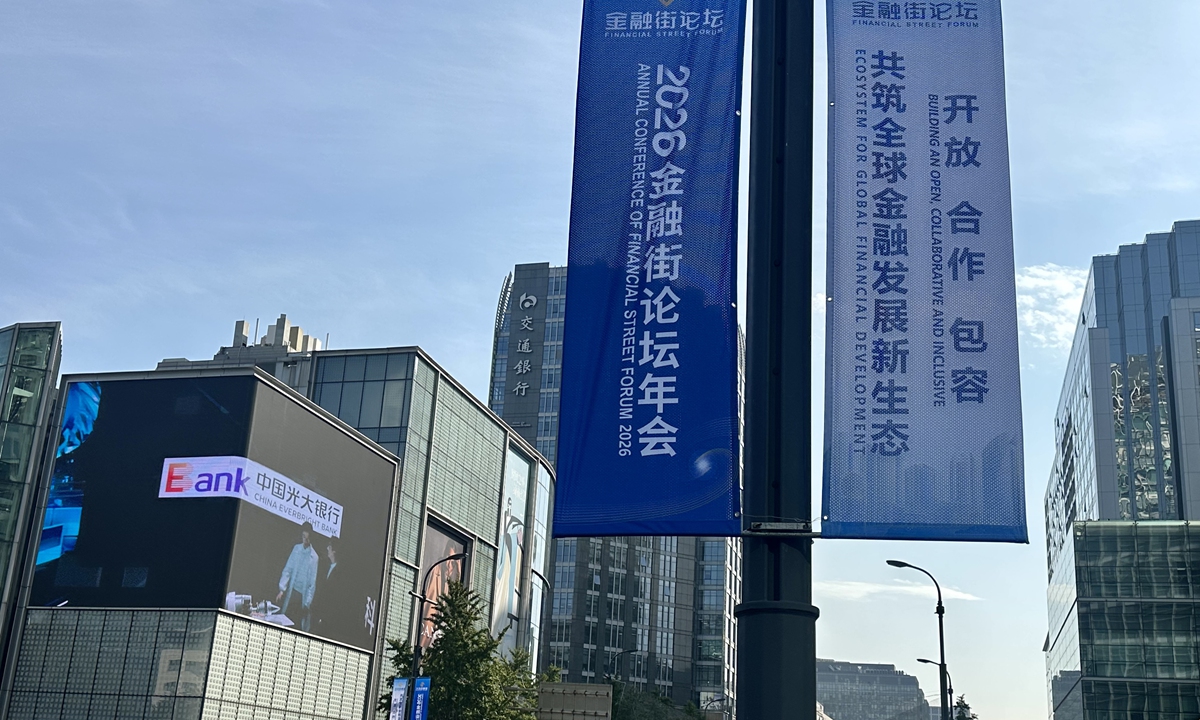
Annual Conference of Financial Street Forum (FSF) 2026 in Beijing on October 19, 2026 Photo: Ma Jingjing/GT
The Implementation Plan for Financial Support for the Construction of Beijing (Beijing-Tianjin-Hebei) International Science and Technology Innovation Center was released at the ongoing Annual Conference of the Financial Street Forum (FSF) 2026 in Beijing on Tuesday. The plan involves a series of measures in promoting the financial support for tech innovation in the region.
Li Wei, director-general of the Science and Technology Department of the People's Bank of China (PBC), the country's central bank, said the plan follows the newly issued national guideline on boosting financial support for building international science and technology centers in three main city clusters. He noted that it is a concrete step to implement the central leadership's instructions and align policy tools with the real needs of hard-tech enterprises across the Beijing-Tianjin-Hebei (Jingjinji) region.
The plan contains six parts and sets clear development targets for 2030 and 2035. It aims to build a multi-tier, multi-channel technology-finance support system. The framework focuses on strategic sci-tech forces, major national projects and cross-region coordination. It also stresses financial opening-up, regulatory innovation and risk control as core pillars of the regional innovation strategy.
Li explained that the plan supports national labs, top universities and major tech projects through ultra-long special treasury bonds and national funds. Structural monetary policy tools and faster government-fund investment will provide patient capital. The scheme also widens medium- and long-term funding from insurance and other institutional investors to match the long cycle of breakthrough innovation.
A cross-region tech-finance service system will be built under the plan. A Jingjinji tech-finance alliance will be formed. A comprehensive service platform will improve data sharing and platform connectivity. Technology-transfer financing and technology trading markets will be strengthened. These steps aim to close the gap between scientific research and industrial application across the three regions.
Peng Lifeng, Director-General of the PBC Credit Market Department, said the central bank has built the core framework of tech finance in recent years. This includes innovation and transformation relending, a bond-market tech board and data-use policies. He said these tools form the backbone of the country's technology-finance system.
The PBC continue implementing the innovation and transformation relending policy well. It will also improve the growth-enterprise market mechanism. More financial resources will flow into basic research, breakthrough technologies and industrial chains. Peng said the central bank will work with local governments and financial institutions to turn the new guidance and plan into real support for innovators.
Hou Junshu, Vice Chairman of the Beijing Municipal People's Congress, said Beijing has unique dual strengths. It is both an international sci-tech innovation center and a national financial hub. In 2025, Beijing had over 30,000 national high-tech enterprises and 1,214 specialized-and-new "little giant" firms. Around 100 companies were listed on the Beijing Stock Exchange.
Looking ahead, risk-sharing and incentive mechanisms will be strengthened. Government guidance funds, financing guarantees and risk compensation will be used. Appropriate tolerance for non-performing loans in the tech sector will be allowed. Reforms to facilitate insurance fund long-term investment and financial asset investment company equity investment will be advanced. This builds an environment that encourages innovation and tolerates failure, according to Hou.
China on Monday issued a guideline to boost financial support for building international science and technology centers in Beijing (Beijing-Tianjin-Hebei region), Shanghai (the Yangtze River Delta), and the Guangdong-Hong Kong-Macao Greater Bay Area (GBA).
The guideline, released by the PBC along with 10 other departments, aims to build a financial service system that better matches the core functions and international positioning of the three innovation hubs.
Speaking at the Annual Conference of Financial Street Forum 2026 in Beijing on Monday, PBC Governor Pan Gongsheng said that building the three international sci-tech innovation hubs is a major strategy of the Chinese authorities. Pan highlighted that the central bank will push for greater efforts in the three regions in areas such as relending, the bond market's "sci-tech board" and cross-border investment and financing.
Global Times
RELATED ARTICLES