China's financial regulators roll out targeted policies at key financial forum, reaffirm opening-up
Annual Conference of Financial Street Forum (FSF) 2026 in Beijing on October 19, 2026 Photo: Ma Jingjing/GT
The Annual Conference of Financial Street Forum (FSF) 2026 kicked off in Beijing on Monday, convening a heavyweight roster of top financial regulators who rolled out targeted policies, including a pilot initiative to allow overseas financial institutions to participate in yuan trading in China's interbank foreign exchange market as part of overall efforts to expand financial opening-up.
Remarks by officials at the key forum reiterated China's opening-up commitments and addressed the further upgrading of opening-up toward the institutional level, experts said, adding that China's development of new quality productive forces, earnest opening-up moves, and digital and green economy will provide fresh opportunities for international investors.
The People's Bank of China (PBC), the country's central bank, will roll out policies and measures, including setting up a liquidity backstop for large redemptions by non-bank financial institutions, expanding the scope of institutions eligible for the Standing Lending Facility, and rolling out a pilot initiative to allow overseas financial institutions to participate in yuan trading in China's interbank foreign exchange market, PBC Governor Pan Gongsheng said in a speech delivered at the opening ceremony of the FSF.
China is firmly implementing the strategic directions and key measures set out in the 15th Five-Year Plan (2026-30), continuing to transform its economic growth model, expand domestic demand and advance opening-up at a high level, contributing to a new round of dynamic rebalancing in the global economy, Pan said.
Zhu Hexin, deputy governor of the PBC and head of the State Administration of Foreign Exchange, said at the forum that a package of incremental measures will soon be rolled out to support enterprises in participating more effectively in international cooperation and competition, and in making better use of both domestic and international markets and resources.
Zhu said that policies will be introduced to facilitate current account transactions and optimize foreign exchange management under the capital account, and efforts will be made to promote the open development of the foreign exchange market.
China has always adhered to win-win cooperation and continues to promote high-level financial opening-up, with measures including actively expanding new areas for financial opening-up, supporting more foreign institutions and long-term capital to operate and invest in China, and promptly responding to the demands of foreign institutions, Ding Xiangqun, head of the National Financial Regulatory Administration, said at the opening ceremony.
"The most noteworthy signal from this year's FSF lies not in another reiteration of opening-up commitments, but in the further upgrading of opening-up toward the institutional level," Tian Lihui, dean of the Institute of Financial Development at Nankai University, told the Global Times on the sidelines of the FSF on Monday.
Initiatives such as strengthening financial infrastructure connectivity and supporting the offshore yuan market address not "whether foreign capital can enter," but "whether it can stay after entry." The joint appearance of major financial regulators and the parallel emphasis on opening-up and risk control also constitute a form of expectation management, and institutional opening-up is controllable and predictable, Tian said.
The new reform and opening-up measures came after China issued a plan in September to strengthen its financial sector during the 15th Five-Year Plan (2026-30) period. According to the plan, China aims to put in place the overall framework of a modern financial system with Chinese characteristics by 2030, while largely establishing a highly adaptive, competitive, and inclusive modern financial system with Chinese characteristics by 2035.
As China's macro policies gain traction and innovation momentum continues to build, the underlying conditions and fundamental trend of China's economy moving toward higher quality and long-term soundness remain strong, Wu Qing, chairperson of the China Securities Regulatory Commission, said at the ceremony. The underlying logic of the capital market's operation has undergone profound shifts, making the allocation value of Chinese assets even more compelling, he said.
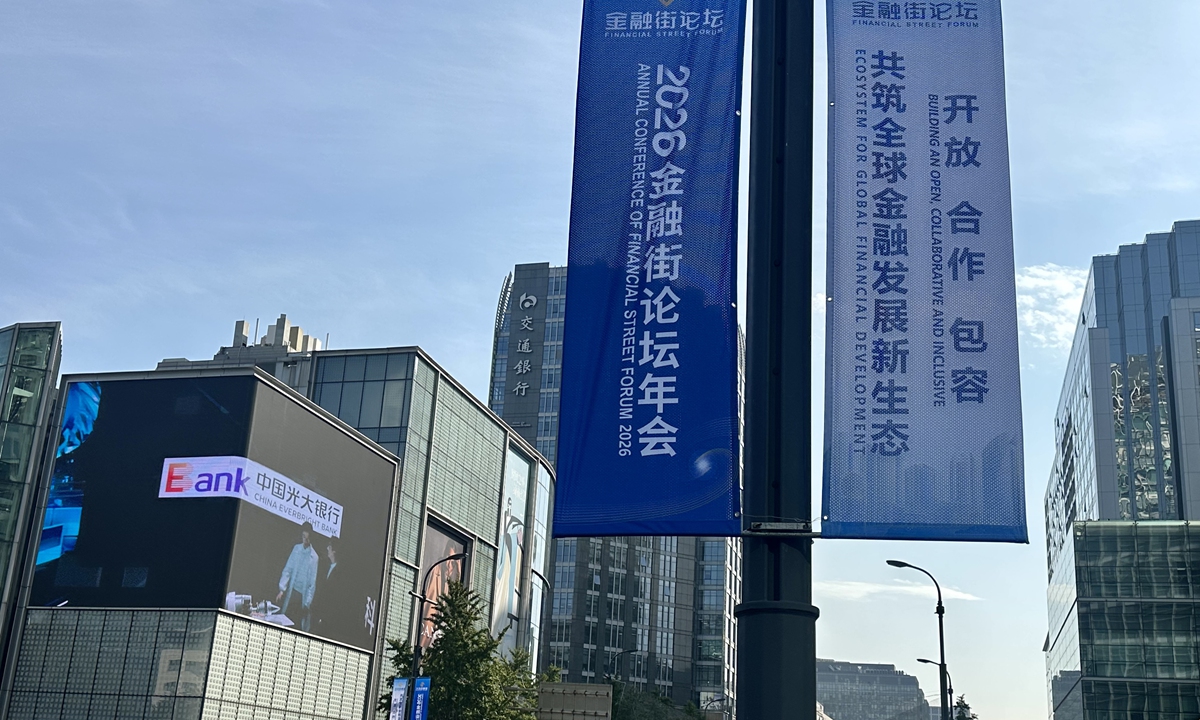
Under the theme of "Building an Open Collaborative and Inclusive Ecosystem for Global Financial Development," the Annual Conference of Financial Street Forum 2026 is taking place in Beijing from Monday to Thursday. This year, the event attracted the participation of more than 400 prominent guests from more than 40 countries and regions.
This year's event features discussions on economic governance, financial innovation, artificial intelligence (AI), capital market development, cross-border financial cooperation and global financial governance, according to the official agenda. It also includes a China-EU Financial Investment Forum, and sessions focusing on financial support for the real economy, technological innovation and private sector development.
A stroll through Beijing's Xicheng district reveals Financial Street in full forum mode. Blooming floral displays line the boulevard from end to end, while FSF logos and banners punctuate everything from street corners to lamp posts. Launched in 2012 to mark two decades of the area's development, the FSF has since grown into a flagship platform that not only raises the district's international profile but also cements its place on the global financial map.
The FSF has become an important window for the international community to observe China's financial reform and opening-up. A key message from this year's forum is that China remains committed to financial opening-up, with a growing focus on aligning its rules and institutions with international standards, Hu Qimu, professor at the Maritime Silk Road Institute of Huaqiao University, told the Global Times on Monday.
"China is shifting from an emphasis on market access toward institutional opening-up, including improving regulation, enhancing transparency and facilitating cross-border investment," said Hu, noting that amid global economic uncertainty, these efforts will help stabilize market expectations and strengthen international investors' confidence in China's long-term prospects.
Moreover, China's appeal to international capital lies in its vast market, comprehensive industrial system and ongoing economic transformation, said Hu. The expert added that emerging sectors such as AI, new energy, advanced manufacturing and the digital economy offer substantial investment opportunities, supported by the country's strong industrial supply chains and innovation capabilities.
RELATED ARTICLES