China allows qualified foreign investors to participate in treasury futures trading: CSRC
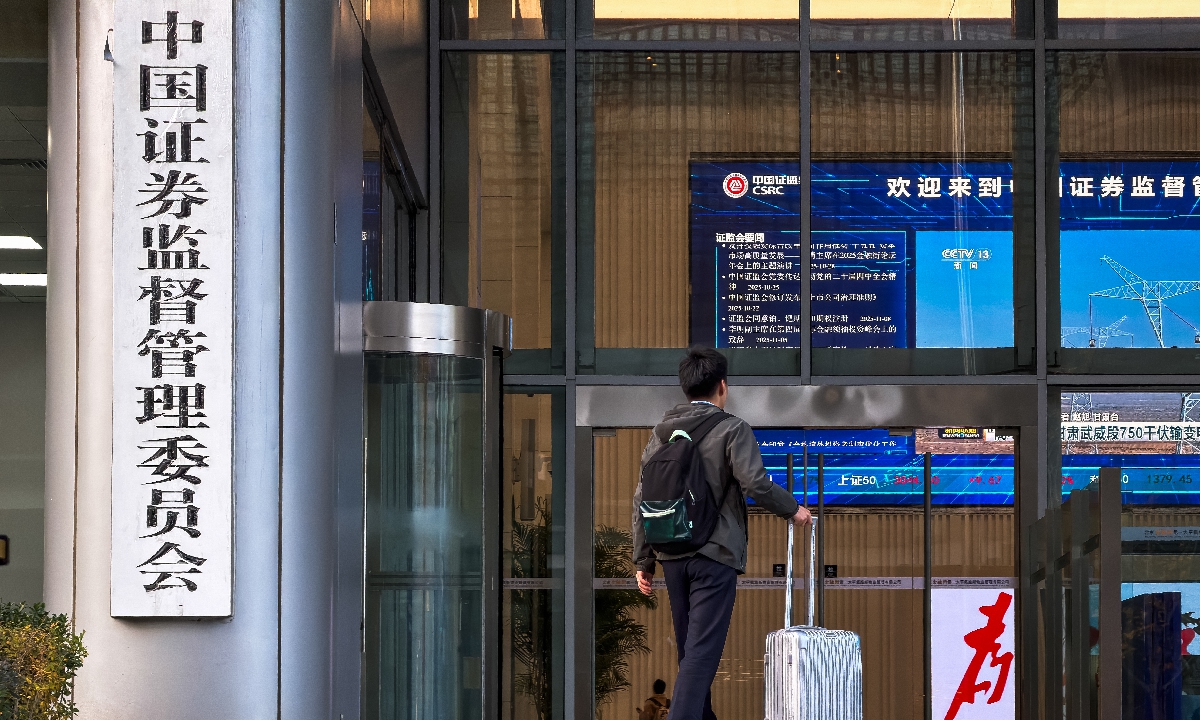
A man with a suitcase walks into the building of the China Securities Regulatory Commission in Beijing on November 12, 2025. Photo: VCG
China has allowed qualified foreign investors to participate in treasury futures trading for hedging purposes starting Friday, in a move that analysts say marks the steady opening-up of the country's financial sector and will boost the expansion of the yuan-denominated bond market.
According to a statement from the China Securities Regulatory Commission (CSRC) on Friday, this move is part of the country's overall efforts to expand high-level opening-up.
"The move is designed to continuously expand the investment scope for qualified foreign investors, enrich the interest rate risk management instruments for foreign institutional investors, strengthen the attractiveness of the yuan-denominated bond market, stabilize the investment behavior of overseas institutional investors, and promote the high-quality development of the bond spot and futures markets," it said.
Looking ahead, the CSRC said that it will introduce further measures to reform and develop the futures market and will continue to advance the high-level, institutional opening of China's capital market.
Allowing foreign investors into China's treasury futures market is an important step in the opening-up of the country's financial sector, which will not only boost the yuan's internationalization but also further expand the yuan-denominated bond market, Li Changan, a professor at the Academy of China Open Economy Studies at the University of International Business and Economics, told the Global Times on Friday.
The CSRC's move came amid the growing attractiveness of yuan bonds, thanks to steady growth in the Chinese economy.
According to Shanghai-based financial data provider Wind Information, overseas institutions had issued 52 panda bonds as of April 14, with a total value of 102.24 billion yuan ($14.99 billion), up 91.81 percent year-on-year. The outstanding balance of panda bonds rose 37.64 percent year-on-year to 499.73 billion yuan, the Securities Daily reported on April 15. Panda bonds are yuan-denominated debt securities issued by overseas entities in China and are a vital financing channel for international institutions.
China has evolved from a mere trading powerhouse into a premier destination for multinational investment, Hu Qimu, a deputy secretary-general of the Forum 50 for Digital-Real Economies Integration, told the Global Times on Friday. Against this backdrop, the functions of the yuan extend beyond payment and settlement to financing and investment, Hu said, noting that the latest opening-up move will further promote the yuan's internationalization.
China's economic fundamentals remain sound, its market ecosystem continues to improve, and the value of high-quality assets is becoming increasingly evident - solidifying the bedrock for the steady advancement of high-level institutional opening in the country's financial markets in the future, according to Hu.
Wu Qing, chairman of the CSRC, said at a press conference on Tuesday that efforts will be made to support more capital market service institutions to expand their presence in Beijing, while promoting the city as a pilot zone for implementing more capital market opening-up policies.
Li anticipates that China's financial sector opening-up will evolve into a pattern characterized by a higher level, deeper integration, and broader scope. Institutional opening-up is expected to intensify during the 15th Five-Year Plan period (2026-30), which will align domestic systems with high-standard international economic and trade rules, the expert said.
RELATED ARTICLES