IN-DEPTH / IN-DEPTH
Young engineers’ choice captures the essence of ‘Xiong’an speed’ in building a city where industries thrive together
30 Hours to Assemble
Editor's note:
What can the speed of satellite manufacturing reveal about how a city develops? Xiong'an New Area is emerging as a testing ground for China's push to turn technological innovation into new industrial capacity and new forms of urban development. Through a young engineer's decision to build his career there, and the new forces emerging across different links of Xiong'an's satellite-making chain, this report explores the planning and services behind "Xiong'an speed." It examines how bringing complementary businesses together, providing facilities suited to their needs and supporting the people who work there can offer lessons for other cities seeking to develop emerging industries.
Standing in Xiong'an New Area's growing satellite industry hub in North China's Hebei Province, young engineer Chen Yuepeng had plenty of stories to tell. But one satellite stood out: Xiong'an-1, the first satellite manufactured in the new area.
Even as he recalled the moment months later, Chen could not hide the pride and excitement on his face.
The story takes us back to the morning of August 19, 2026.
At 7:35 am, a Zhuque-3 Y2 rocket roared into the sky from the Dongfeng commercial space innovation pilot zone in northwest China, carrying Honghu-03, also known as Xiong'an-1. Flames lit up the launch pad as the rocket climbed into the sky. About two minutes later, the two stages separated, and the first stage began its journey back to Earth.
At around 7:41 am, the booster touched down at its designated landing site in Gansu Province, marking a breakthrough in China's reusable rocket technology.
Hundreds of kilometers away, at Hongqing Technology's satellite operations center in Xiong'an, another moment of anticipation was unfolding. Zhang Zilong, the head of the satellite operations and management platform, and his colleagues kept their eyes fixed on satellite operation screens.
At 7:45 am, confirmation finally came: Xiong'an-1 had entered its designated orbit, with its systems operating normally.
At that moment, the tension inside the satellite operations center gave way to cheers of excitement and relief. Chen recalled eagerly sharing the news with his family and friends, telling them a "star" built in Xiong'an had successfully made it into space.
Building speed on factory floor
For Xiong'an, the more surprising story was unfolding on the ground.
Just over a year earlier, in spring 2025, the factory that produced Xiong'an-1 had yet to be built.
Within months, Hongqing had completed construction, installed production equipment and rolled out its first satellite.
"The speed and pace honestly exceeded what we had imagined," Chen told the Global Times, recalling how quickly everything had come together.
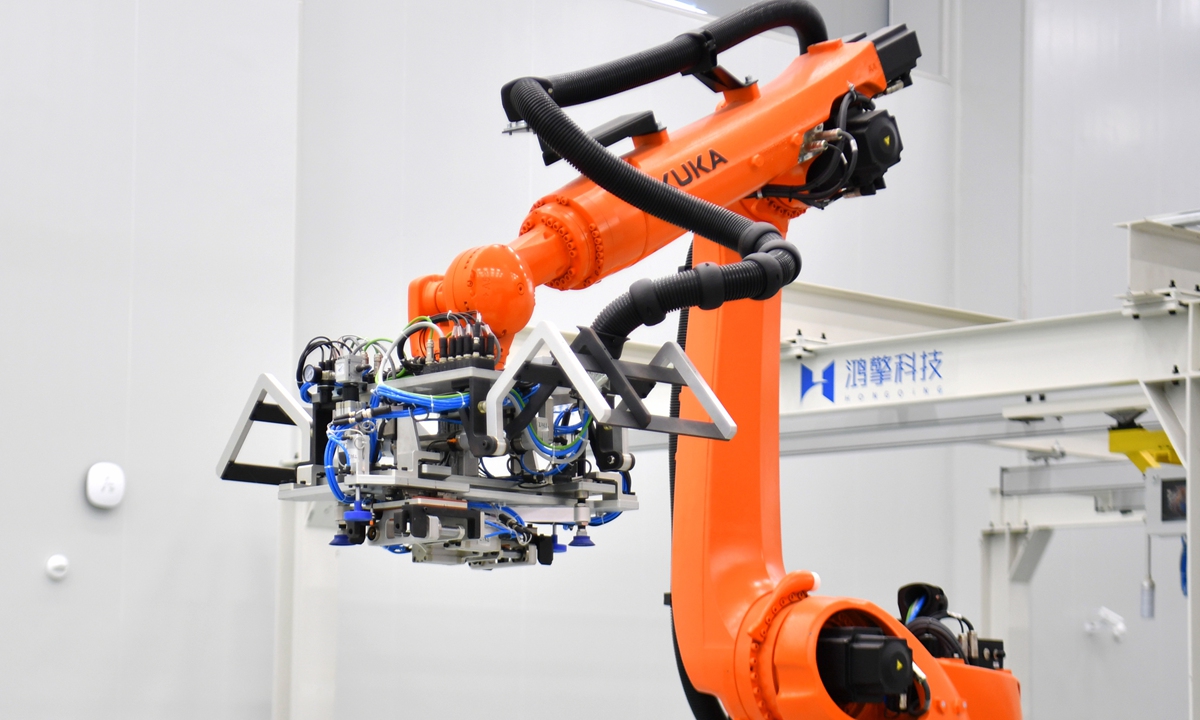
Today, Hongqing's automated production line can complete the assembly of a satellite in roughly 30 hours, a process that traditionally could take around half a month.
For Chen, who previously worked in Beijing, the change has been striking. What he witnessed was not just a factory rising from the ground, but an entire industry taking shape around it.
This is what people here call "Xiong'an speed." And behind that speed lies a bigger story about how a new city is bringing together companies, technology and talent to build an emerging industry.
Hongqing was registered, built its facility, began production and rolled out its first satellite all in 2025, achieving what the company calls "four milestones in one year," a vivid example of "Xiong'an speed," Sun Dezhi, deputy general manager of Hongqing's Manufacturing Center, told the Global Times.
At the company's 12,000-square-meter Xiong'an facility, the assembly line has demonstrated capacity for more than 100 flat-panel satellites annually, according to Sun.
Compared with traditional methods, the company reports production cycles more than 80 percent shorter.
For Chen, the quicker rhythm also brings an exacting responsibility.
"A satellite only gets one chance when it goes into space," he told the Global Times, explaining why possible faults must be addressed on the ground.
The challenge extends beyond one factory: manufacturing many satellites also requires enough components, testing capacity and deployment equipment to keep them moving.
Chen has watched that ecosystem take shape around him. In Xiong'an, companies are no longer building in isolation: manufacturers, suppliers, and shared testing platforms are being brought into the same industrial cluster, allowing the different links of the satellite-making process to connect more closely.
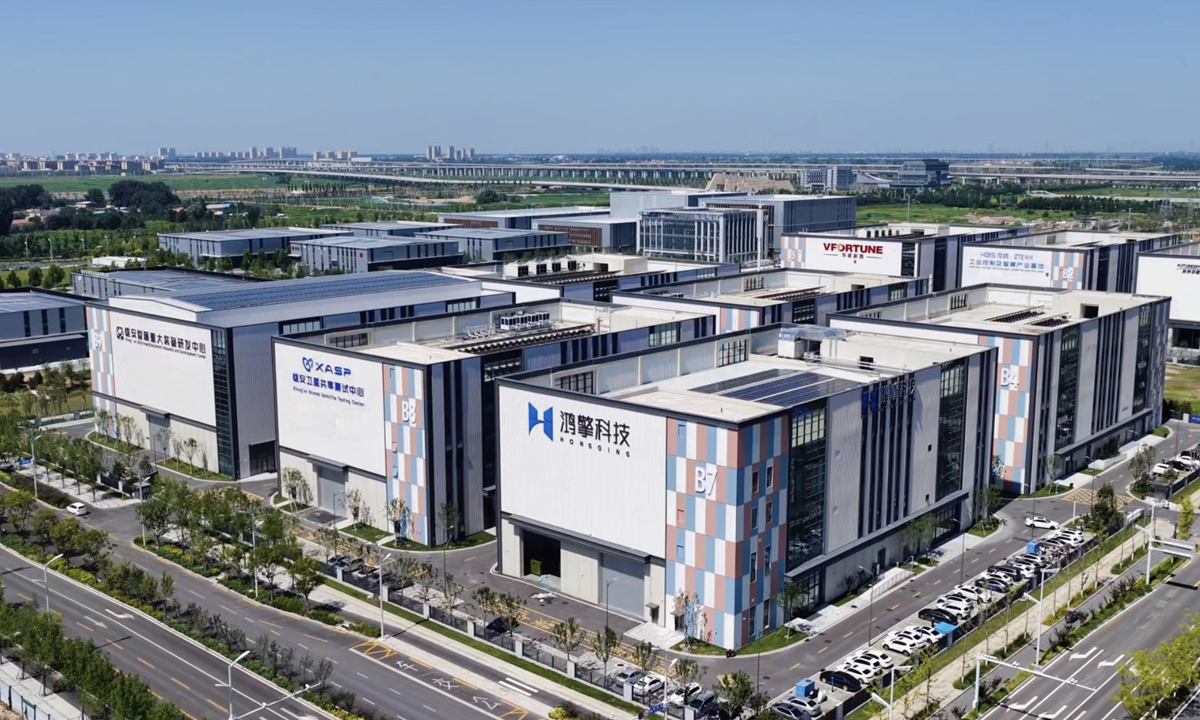
That clustering is becoming a defining feature of Xiong'an's push to build a commercial space industry. The new industrial base already hosts nearly 70 aerospace information companies, while shared manufacturing and testing facilities are being built to support the wider ecosystem.
Connecting companies across supply chain
Scaling up production requires suppliers and testing facilities to keep pace with the assembly line. Xiong'an's approach to industrial planning brings these links closer together, giving companies easier access to production partners and shared facilities as they expand.
As the satellite industry takes shape, a range of leading companies making launch-support equipment are emerging alongside it. Hebei Xiong'an FutureSpace Technology Co is preparing booster equipment to help propel satellites into orbit.
Born from the rise of commercial spaceflight, the company is China's first spacecraft manufacturer dedicated to this emerging sector. The first vehicle in its FX Series Space Vehicles family, FX-1, has rolled out of the assembly workshop and entered the engineering preparation stage ahead of its maiden flight.
The FX Series Space Vehicles platform is an orbital transfer vehicle that takes over orbital transportation after a rocket launch, carrying satellites from their initial orbits to their intended orbital positions while reducing consumption of the satellites' own propellant, Bai Junbiao, deputy general manager of Hebei Xiong'an FutureSpace Technology Co, told the Global Times.
Bai said the vehicle uses chemical propulsion to carry satellites to their target orbits more quickly, and can deploy multiple satellites at different altitudes during a single mission.
After signing its factory lease in May, it spent roughly four months on renovation and preparations for production, Bai said. The planned annual capacity is 60 FX Series Space Vehicles.
At Final Frontier (Xiong'an) Technology Co, another company in the pilot-scale production base, the pace of development has also been rapid. The company moved into Xiong'an in May, began renovating its production site in mid-June, and expected to complete commissioning of the line by the end of September. Once fully operational, the line is designed to produce up to 1,500 units a month, Yi Yalin, a mechanical structural design engineer at the company, told the Global Times.
During the Global Times visit, trial production was already under way. Thermal components and circuit boards are assembled onto a baseplate before automated equipment dispenses adhesive, tightens screws and uses machine vision to inspect the work. Commercial production is expected to ramp up once commissioning is completed.
As satellite constellations expand, manufacturers face growing pressure to produce components more quickly and efficiently. Final Frontier is developing new products alongside the processes needed to manufacture them at scale. Its flexible production line can switch between products by changing the fixtures that hold components in place, while detailed production records help workers trace defects to specific parts and manufacturing steps.
"At first it may be pressure, but it quickly turns into motivation," Yi said. "It is quite exciting. It feels like starting a business."
The concentration of satellite manufacturers and suppliers in Xiong'an also speeds up product testing and problem-solving.
A Final Frontier representative said an antenna can be sent to a nearby satellite maker for integration testing and returned for adjustments on the same day if problems arise.
Wang Yanan, editor-in-chief of Aerospace Knowledge magazine, told the Global Times the close proximity of companies helps them coordinate production capacity and technical requirements as the industry expands. Satellite makers can communicate their needs more directly, while suppliers can adjust their products and production plans accordingly, shortening the cycle from development and testing to feedback and improvement.
A city that helps innovation take root
Xiong'an is creating the infrastructure, services and urban conditions needed for emerging industries to take root and grow. But "Xiong'an speed" required support well beyond these.
"On the surface, it looks like speed," Sun told the Global Times, "but behind it are the new area's service capabilities, its understanding of the industry and its ability to organize resources."
Local governmental departments helped with registration, bank accounts, factory selection, staff relocation and recruitment, he said. Workshops were configured for satellite assembly and transport. An 80-million-yuan investment from a local science and technology innovation fund gave the company greater certainty in funding development and operations.
For a young satellite company, such support can make a practical difference: less time spent navigating administrative procedures and securing facilities, and more time devoted to getting production up and running.
The visit by the Global Times reporters to Xiong'an shows how this approach is taking shape on the ground. At FutureSpace's new manufacturing base, assembly, integration and testing capabilities are being brought together under one roof to support more standardized, higher-volume production. At Xiong'an's pilot-scale production base, Final Frontier has already set up operations in ready-built facilities, allowing it to move into production without first acquiring land and building a factory from scratch.
Support continues after companies move in. A representative from Final Frontier said science park staff help with administrative procedures, applications for technology projects, and introductions to potential investors and customers, allowing engineers to focus more of their time on product development.
The aim is not simply to attract companies to Xiong'an, but to help them turn research and technical expertise into products. Companies in Beijing, Shanghai and other cities can connect their existing research strengths with engineering, production and testing capabilities in the new area, creating opportunities to bring technologies closer to commercialization, experts said.
As demand for commercial space capabilities grows, Xiong'an is seeking to turn those broader ambitions into practical industrial capacity. The model being developed in Xiong'an is helping lay a solid foundation for achieving these national goals.
By bringing satellite manufacturers, component suppliers, testing facilities and orbital-transfer services into closer proximity, the new area is building a more connected commercial space supply chain, Wang said. Its industrial space, infrastructure and growing concentration of research institutions and technology companies provide a foundation for closer coordination across the sector, he added.
Notably, what makes this growth meaningful is not only the scientific achievements it makes possible, but also the everyday needs and aspirations of the thousands of researchers building their careers here.
For engineers working in Xiong'an, these ambitions translate into everyday tasks: refining a design, improving a test, delivering a component and ensuring a satellite continues to operate as intended.
Chen Yuepeng, the young researcher at Hongqing, also sees the appeal of Xiong'an in the conditions that make it possible to build a career and settle down. He cited support for housing, children's schooling and healthcare, alongside opportunities to develop professionally in a growing industry.
He and his younger colleagues have a phrase for the experience: growing alongside the city, like bamboo putting out new joints.
For Chen, the pace of development also conveys a sense of "being trusted" - the opportunity to take on demanding work and contribute to an industry of national importance.
"This place is growing rapidly," he said. "We are becoming more professional and more confident along with it."
What can the speed of satellite manufacturing reveal about how a city develops? Xiong'an New Area is emerging as a testing ground for China's push to turn technological innovation into new industrial capacity and new forms of urban development. Through a young engineer's decision to build his career there, and the new forces emerging across different links of Xiong'an's satellite-making chain, this report explores the planning and services behind "Xiong'an speed." It examines how bringing complementary businesses together, providing facilities suited to their needs and supporting the people who work there can offer lessons for other cities seeking to develop emerging industries.
Aerial view of an industrial park, home to a host of satellite-sector firms, in Xiong'an New Area Photo: Courtesy of the Xiong'an government
Standing in Xiong'an New Area's growing satellite industry hub in North China's Hebei Province, young engineer Chen Yuepeng had plenty of stories to tell. But one satellite stood out: Xiong'an-1, the first satellite manufactured in the new area.
Even as he recalled the moment months later, Chen could not hide the pride and excitement on his face.
The story takes us back to the morning of August 19, 2026.
At 7:35 am, a Zhuque-3 Y2 rocket roared into the sky from the Dongfeng commercial space innovation pilot zone in northwest China, carrying Honghu-03, also known as Xiong'an-1. Flames lit up the launch pad as the rocket climbed into the sky. About two minutes later, the two stages separated, and the first stage began its journey back to Earth.
At around 7:41 am, the booster touched down at its designated landing site in Gansu Province, marking a breakthrough in China's reusable rocket technology.
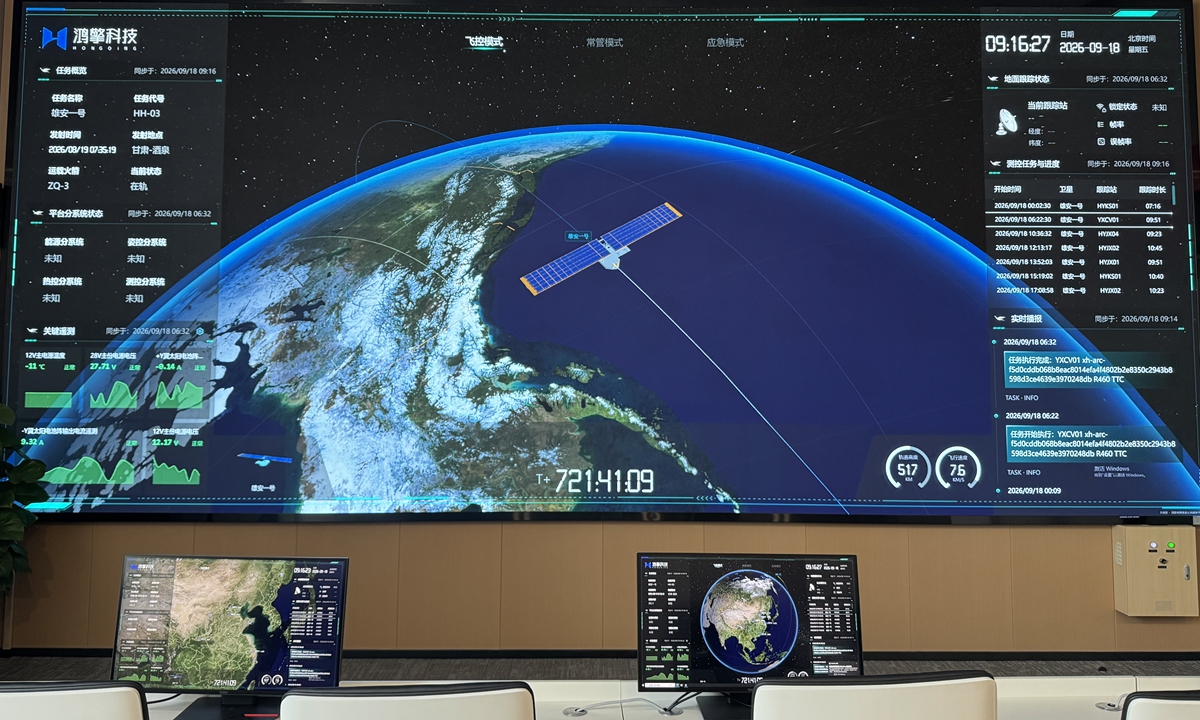
Hundreds of kilometers away, at Hongqing Technology's satellite operations center in Xiong'an, another moment of anticipation was unfolding. Zhang Zilong, the head of the satellite operations and management platform, and his colleagues kept their eyes fixed on satellite operation screens.
At 7:45 am, confirmation finally came: Xiong'an-1 had entered its designated orbit, with its systems operating normally.
At that moment, the tension inside the satellite operations center gave way to cheers of excitement and relief. Chen recalled eagerly sharing the news with his family and friends, telling them a "star" built in Xiong'an had successfully made it into space.
Production line at the satellite intelligent manufacturing pilot base of Hongqing Technology Photo: IC
Building speed on factory floor
For Xiong'an, the more surprising story was unfolding on the ground.
Just over a year earlier, in spring 2025, the factory that produced Xiong'an-1 had yet to be built.
Within months, Hongqing had completed construction, installed production equipment and rolled out its first satellite.
"The speed and pace honestly exceeded what we had imagined," Chen told the Global Times, recalling how quickly everything had come together.
Today, Hongqing's automated production line can complete the assembly of a satellite in roughly 30 hours, a process that traditionally could take around half a month.
For Chen, who previously worked in Beijing, the change has been striking. What he witnessed was not just a factory rising from the ground, but an entire industry taking shape around it.
This is what people here call "Xiong'an speed." And behind that speed lies a bigger story about how a new city is bringing together companies, technology and talent to build an emerging industry.
Hongqing was registered, built its facility, began production and rolled out its first satellite all in 2025, achieving what the company calls "four milestones in one year," a vivid example of "Xiong'an speed," Sun Dezhi, deputy general manager of Hongqing's Manufacturing Center, told the Global Times.
At the company's 12,000-square-meter Xiong'an facility, the assembly line has demonstrated capacity for more than 100 flat-panel satellites annually, according to Sun.
Compared with traditional methods, the company reports production cycles more than 80 percent shorter.
For Chen, the quicker rhythm also brings an exacting responsibility.
"A satellite only gets one chance when it goes into space," he told the Global Times, explaining why possible faults must be addressed on the ground.
The challenge extends beyond one factory: manufacturing many satellites also requires enough components, testing capacity and deployment equipment to keep them moving.
Chen has watched that ecosystem take shape around him. In Xiong'an, companies are no longer building in isolation: manufacturers, suppliers, and shared testing platforms are being brought into the same industrial cluster, allowing the different links of the satellite-making process to connect more closely.
That clustering is becoming a defining feature of Xiong'an's push to build a commercial space industry. The new industrial base already hosts nearly 70 aerospace information companies, while shared manufacturing and testing facilities are being built to support the wider ecosystem.
Real-time operating parameters of the Honghu-03 satellite, also known as Xiong'an-1, are monitored on a large screen at Hongqing Technology in Xiong'an New Area, Hebei Province, on September 18, 2026. Photo: Chen Qingrui/GT
Connecting companies across supply chain
Scaling up production requires suppliers and testing facilities to keep pace with the assembly line. Xiong'an's approach to industrial planning brings these links closer together, giving companies easier access to production partners and shared facilities as they expand.
As the satellite industry takes shape, a range of leading companies making launch-support equipment are emerging alongside it. Hebei Xiong'an FutureSpace Technology Co is preparing booster equipment to help propel satellites into orbit.
Born from the rise of commercial spaceflight, the company is China's first spacecraft manufacturer dedicated to this emerging sector. The first vehicle in its FX Series Space Vehicles family, FX-1, has rolled out of the assembly workshop and entered the engineering preparation stage ahead of its maiden flight.
The FX Series Space Vehicles platform is an orbital transfer vehicle that takes over orbital transportation after a rocket launch, carrying satellites from their initial orbits to their intended orbital positions while reducing consumption of the satellites' own propellant, Bai Junbiao, deputy general manager of Hebei Xiong'an FutureSpace Technology Co, told the Global Times.
Bai said the vehicle uses chemical propulsion to carry satellites to their target orbits more quickly, and can deploy multiple satellites at different altitudes during a single mission.
After signing its factory lease in May, it spent roughly four months on renovation and preparations for production, Bai said. The planned annual capacity is 60 FX Series Space Vehicles.
At Final Frontier (Xiong'an) Technology Co, another company in the pilot-scale production base, the pace of development has also been rapid. The company moved into Xiong'an in May, began renovating its production site in mid-June, and expected to complete commissioning of the line by the end of September. Once fully operational, the line is designed to produce up to 1,500 units a month, Yi Yalin, a mechanical structural design engineer at the company, told the Global Times.
During the Global Times visit, trial production was already under way. Thermal components and circuit boards are assembled onto a baseplate before automated equipment dispenses adhesive, tightens screws and uses machine vision to inspect the work. Commercial production is expected to ramp up once commissioning is completed.
As satellite constellations expand, manufacturers face growing pressure to produce components more quickly and efficiently. Final Frontier is developing new products alongside the processes needed to manufacture them at scale. Its flexible production line can switch between products by changing the fixtures that hold components in place, while detailed production records help workers trace defects to specific parts and manufacturing steps.
"At first it may be pressure, but it quickly turns into motivation," Yi said. "It is quite exciting. It feels like starting a business."
The concentration of satellite manufacturers and suppliers in Xiong'an also speeds up product testing and problem-solving.
A Final Frontier representative said an antenna can be sent to a nearby satellite maker for integration testing and returned for adjustments on the same day if problems arise.
Wang Yanan, editor-in-chief of Aerospace Knowledge magazine, told the Global Times the close proximity of companies helps them coordinate production capacity and technical requirements as the industry expands. Satellite makers can communicate their needs more directly, while suppliers can adjust their products and production plans accordingly, shortening the cycle from development and testing to feedback and improvement.
A city that helps innovation take root
Xiong'an is creating the infrastructure, services and urban conditions needed for emerging industries to take root and grow. But "Xiong'an speed" required support well beyond these.
"On the surface, it looks like speed," Sun told the Global Times, "but behind it are the new area's service capabilities, its understanding of the industry and its ability to organize resources."
Local governmental departments helped with registration, bank accounts, factory selection, staff relocation and recruitment, he said. Workshops were configured for satellite assembly and transport. An 80-million-yuan investment from a local science and technology innovation fund gave the company greater certainty in funding development and operations.
For a young satellite company, such support can make a practical difference: less time spent navigating administrative procedures and securing facilities, and more time devoted to getting production up and running.
The visit by the Global Times reporters to Xiong'an shows how this approach is taking shape on the ground. At FutureSpace's new manufacturing base, assembly, integration and testing capabilities are being brought together under one roof to support more standardized, higher-volume production. At Xiong'an's pilot-scale production base, Final Frontier has already set up operations in ready-built facilities, allowing it to move into production without first acquiring land and building a factory from scratch.
Support continues after companies move in. A representative from Final Frontier said science park staff help with administrative procedures, applications for technology projects, and introductions to potential investors and customers, allowing engineers to focus more of their time on product development.
The aim is not simply to attract companies to Xiong'an, but to help them turn research and technical expertise into products. Companies in Beijing, Shanghai and other cities can connect their existing research strengths with engineering, production and testing capabilities in the new area, creating opportunities to bring technologies closer to commercialization, experts said.
As demand for commercial space capabilities grows, Xiong'an is seeking to turn those broader ambitions into practical industrial capacity. The model being developed in Xiong'an is helping lay a solid foundation for achieving these national goals.
By bringing satellite manufacturers, component suppliers, testing facilities and orbital-transfer services into closer proximity, the new area is building a more connected commercial space supply chain, Wang said. Its industrial space, infrastructure and growing concentration of research institutions and technology companies provide a foundation for closer coordination across the sector, he added.
Notably, what makes this growth meaningful is not only the scientific achievements it makes possible, but also the everyday needs and aspirations of the thousands of researchers building their careers here.
For engineers working in Xiong'an, these ambitions translate into everyday tasks: refining a design, improving a test, delivering a component and ensuring a satellite continues to operate as intended.
Chen Yuepeng, the young researcher at Hongqing, also sees the appeal of Xiong'an in the conditions that make it possible to build a career and settle down. He cited support for housing, children's schooling and healthcare, alongside opportunities to develop professionally in a growing industry.
He and his younger colleagues have a phrase for the experience: growing alongside the city, like bamboo putting out new joints.
For Chen, the pace of development also conveys a sense of "being trusted" - the opportunity to take on demanding work and contribute to an industry of national importance.
"This place is growing rapidly," he said. "We are becoming more professional and more confident along with it."
RELATED ARTICLES

