How China’s drone export control adjustments help balance development and security
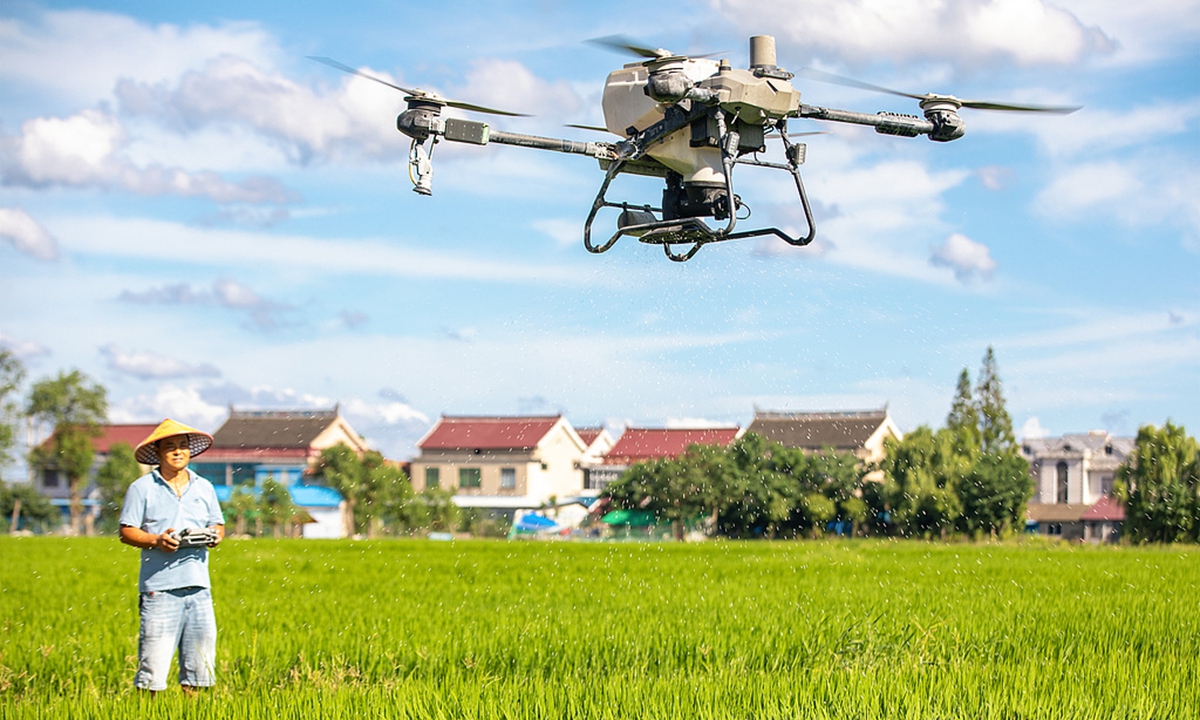
A farmer uses a crop-protection drone to apply fertilizer to rice in Nantong, East China's Jiangsu Province, on August 24, 2026. Photo: VCG
China on Monday announced a decision to optimize and adjust its export controls on certain drone-related items, with the new measures set to take effect on November 18, 2026. This marks a new step following China's adjustments to export controls on drone-related items in both 2023 and 2024.
The adjustments will help better balance development and security. Three aspects are worth noting.
First, the adjustments improve export controls on complete drones, key components, and related software and technologies. This marks the first broad adjustment to drone-related items since November 2024, reflecting the internationally established practice of regularly revising and improving control lists in response to advances in industrial technology.
The adjustments cover multiple categories of items. Overall, they ease controls on complete drones while strengthening controls on certain key components and technologies. The adjustments will help maintain the international competitiveness of China's advantaged industries in line with industrial and technological developments, while upholding the country's firm and consistent opposition to the use of drones for non-peaceful purposes. This approach helps balance development and security while promoting the sound and orderly development of the industry.
Second, the adjustments spell out for the first time the procedure for obtaining export credentials through information registration and filing, providing greater convenience for exporters. They specify the circumstances in which general licenses and this procedure apply, clarifying the licensing facilitation measures available to compliant businesses.
Previous regulations provided for three methods: individual licenses, general licenses, and obtaining export credentials through information registration and filing. The latest adjustments specify, for the first time, two circumstances in which the third method applies.
One applies to drones with a maximum endurance of at least 30 minutes but less than three hours, as well as drones capable of taking off and maintaining stable, controllable flight in gusts of at least 46.3 km/h (25 knots). Before each export, businesses can obtain export credentials through registration and information filing, after which they can export the drones themselves, facilitating customs clearance for manufacturers of complete drones.
The other applies to drones exhibited at trade shows and exhibitions in China or abroad. The adjustments clarify that both domestic and foreign manufacturers of complete drones can export the drones themselves after obtaining export credentials through registration and information filing. This provision does not apply to defense or police exhibitions.
Third, a Q&A was released alongside the adjustments to address businesses' questions about export procedures and provide guidance on export compliance.
China's Ministry of Commerce released a Q&A on dual-use items, with 17 detailed answers addressing questions about drone-related items that businesses may encounter when complying with export controls. The definitions of endurance and wind resistance conditions refer to relevant national standards, helping businesses determine whether their products fall within the scope of export controls.
In addition, the Q&A clarifies for the first time that holders of general licenses for the export of dual-use items and technologies should report on their use. Reports should be submitted every six months and within the 30 days preceding the expiry of a general license. The information to be reported includes the export date, item category, model, quantity, mode of trade, country or region of export, importer, end user, end use, transport route and customs declaration port. This will help government authorities better understand exports of controlled items and provide effective guidance to the industry.
In sum, at a time of frequent geopolitical conflicts and growing threats to world peace, dynamically adjusting drone export controls serves not only China's own security and interests but also global peace, security and stability. The adjustments reflect the rapid pace of technological advances in drones and the expanding range of their applications, while addressing the security risks of civilian drones being used for non-peaceful purposes. They demonstrate China's sense of responsibility as a major country and its approach to balancing development and security in export controls, helping promote the orderly, healthy, safe and sustainable development of China's drone industry.
The author is a senior engineer at the China Machinery Industry Information Research Institute. bizopinion@globaltimes.com.cn
RELATED ARTICLES