MIIT to outline standards for auto designing, R&D verification to accelerate high-quality industrial growth
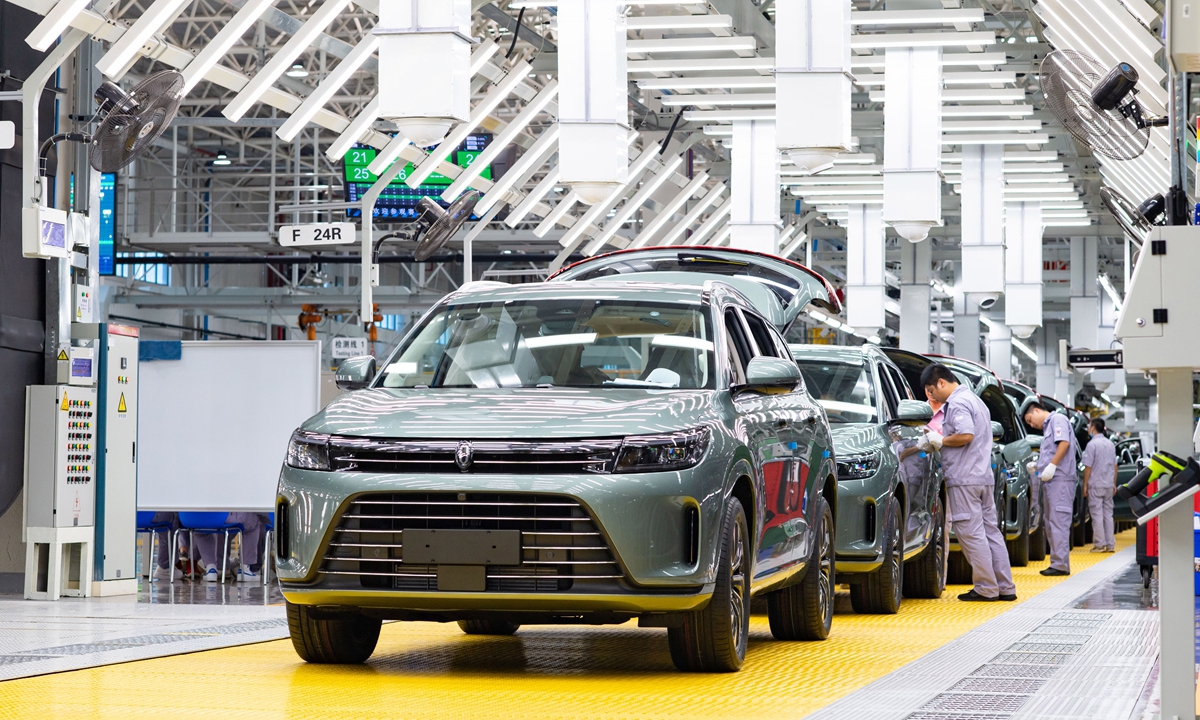
An NEV manufacturing line in Southwest China's Chongqing Municipality Photo: VCG
China’s Ministry of Industry and Information Technology (MIIT) will outline a series of standards to guide auto innovation design and R&D verification in an effort to steer China’s intelligent connected vehicle sector toward high-quality development.
Addressing the 2026 World Intelligent Connected Vehicles Conference (WICV 2026) in Beijing on Wednesday, Vice-Minister Xin Guobin of MIIT said that China will back top automakers to form innovation consortia focusing on energy powertrains, intelligent chassis and intelligent connectivity.
Authorities will push the implementation of mandatory standards for autonomous driving, automated parking and data security, Xin said.
China will actively participate in the formulation of international trade rules, align domestic standards with international norms, and support deeper R&D, investment and industrial cooperation between Chinese and foreign enterprises to jointly develop competitive products and explore global markets, he added.
The remarks come as China’s smart connected vehicles are moving faster into real-world applications, which places stricter requirements on driving safety, reliability, and alignment with international rules.
The MIIT will focus on technological breakthroughs, scenario rollout and industrial governance, and work with global industry players to jointly advance the sound and sustainable development of the intelligent connected vehicle sector, Xin said.
A day earlier, Wang Weiming, MIIT’s chief engineer, said that safety is the lifeline and core competitiveness of automakers. All R&D activities must take safety as the top priority and should never be pursued at the expense of safety. Products with unreasonable design or insufficient test validation will be kept off the market.
The remarks from MIIT officials showed regulators are moving to standard-based oversight with safety built into the R&D phase, and the coordinated framework will streamline joint research across the supply chain while aligning domestic rules with international norms to facilitate industry development, Cui Dongshu, secretary-general of the China Passenger Car Association, told the Global Times on Wednesday.
The policy package balances risk prevention and industrial upgrading. It helps correct cutthroat domestic competition in the sector in order to form long-term competitiveness based on a set of safety architecture, rigorous verification regime and core component capabilities, Cui said.
The smart new-energy vehicle (NEV) industry is anticipated to contribute greatly to the upgrading of China's automobile industry, along with continuous breakthroughs in core technologies in this sector including AI innovation.
The MIIT and eight other departments in early September jointly released a plan for the development of the intelligent connected NEV industry during the 15th Five-Year Plan period (2026-2030).
The plan proposes that, by 2030, China will further consolidate its advantages across the entire intelligent connected NEV industrial chain and join the ranks of the world's auto powerhouses. Intelligent connected NEVs are the direction for transforming and upgrading the country's automobile industry, the plan said.
In the first three quarters of 2025, 64 percent of new passenger vehicles in China were equipped with Level 2 (L2) combined driver-assistance functions. In 2026, this rate has climbed to 70 percent, and more than 30 percent of automobile models provide navigation-assisted driving functions. Level 3 (L3) conditional autonomous driving has run beyond closed-road testing into commercial application.
RELATED ARTICLES