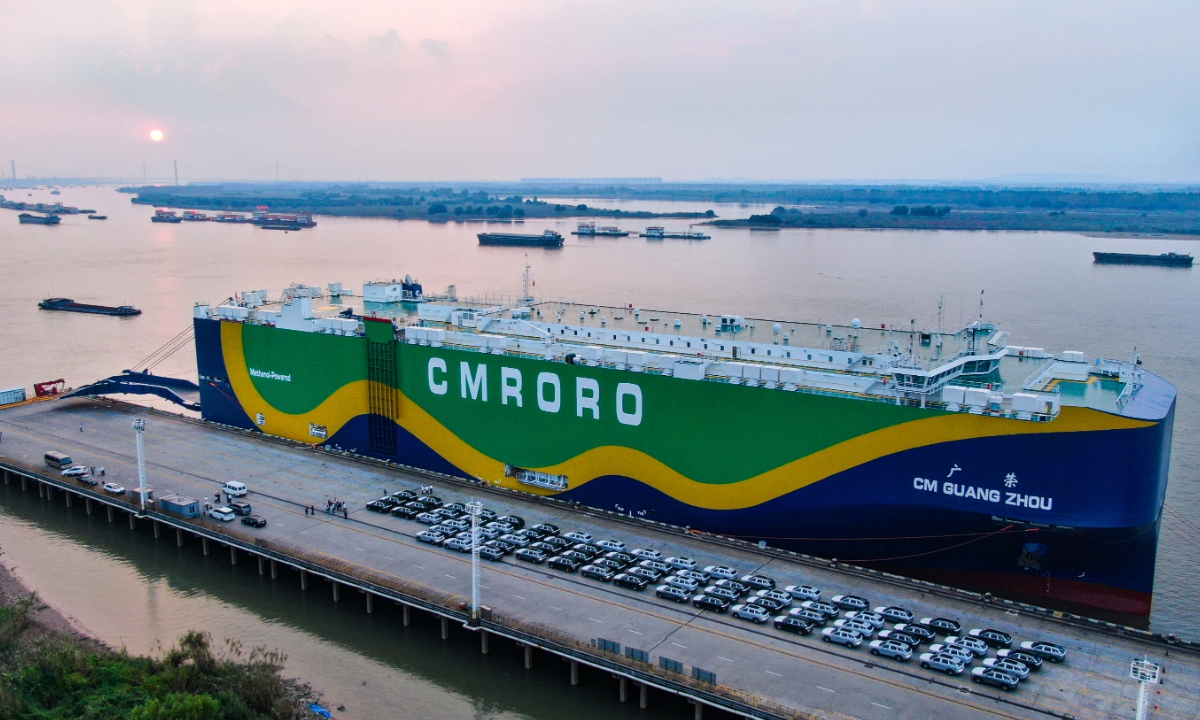
New-energy vehicles await shipment to Europe at Nanjing Port in East China's Jiangsu Province on October 10, 2026. Photo: VCG
China will lower the value added tax (VAT) export rebate rate for new-energy vehicles (NEVs) from 13 percent to 9 percent starting April 1, 2027, according to a joint announcement issued by the Ministry of Finance (MOF) and the State Taxation Administration (STA) on Monday, the Xinhua News Agency reported.
The announcement clarified that export consumption tax policies for the affected products subject to consumption tax will remain unchanged, with existing consumption tax refund and exemption policies continuing to apply.
The adjustment comes amid the rapid expansion of China's NEV industry in overseas markets. China's NEV output and sales both recorded double-digit growth in the first nine months of 2026, with NEVs accounting for 53.6 percent of total vehicle sales and exports surging 130 percent year-on-year, official data released on Monday showed.
The latest policy adjustment is intended to curb low-price export competition, encourage the survival of more competitive enterprises, phase out price-driven competition and promote industrial upgrading, Cui Dongshu, secretary-general of the China Passenger Car Association, told the Global Times on Monday.
"The adjustment is also expected to accelerate the transition toward overseas production capacity expansion, benefiting leading automakers with established overseas manufacturing operations and strong brand competitiveness," Cui said.
The policy will help encourage Chinese NEV manufacturers to shift from competing on prices and sales volumes toward competing on technology, branding and added value, according to Cui.
The latest move follows earlier adjustments to China's export tax rebate policies. In January, the MOF and the STA announced that VAT export rebates for photovoltaic products would be abolished starting April 1, 2026, while rebates for battery products would be reduced from 9 percent to 6 percent for the remainder of 2026 before being eliminated on January 1, 2027.
Cui noted that the latest adjustment announced on Monday should not be viewed simply as a measure to restrict NEV exports. Rather, by moderately adjusting policy incentives, it seeks to guide the industry from advantages in production scale toward greater strengths in product quality, technology and global value chain positioning, thereby promoting more sustainable international development of China's NEV industry, the expert said.
Global Times
RELATED ARTICLES