Japan's H1 dysprosium raw mineral imports plunge 82%, underscoring reliance on China for rare-earth supplies: Chinese experts
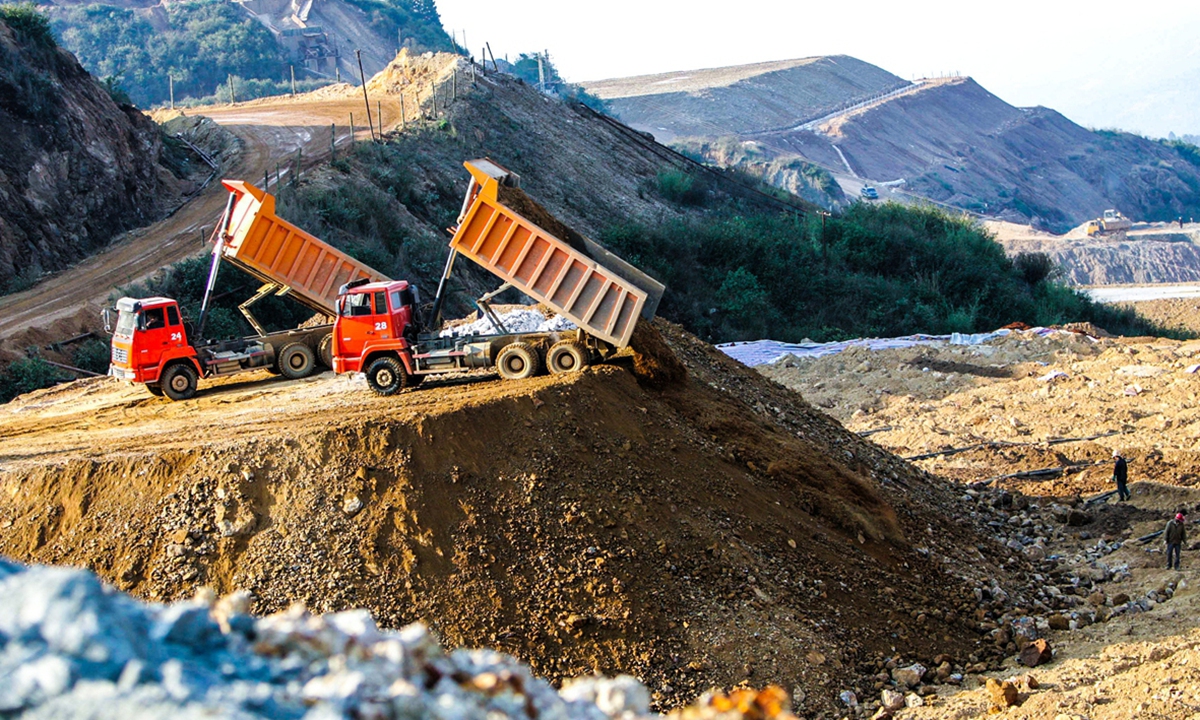
Rare earth File photo:VCG
Japan's rare-earth imports in the first half of 2026 plunged more than 80 percent. According to Chinese experts, the figure underscores Japan's continuing difficulty in reducing dependence on China for certain key strategic minerals, despite efforts by the Japanese government and companies to diversify supplies.
Japan's dysprosium raw material imports in the first half of this year plummeted to 13 tons, down 82 percent year-on-year, "before China's export restrictions," reported Nikkei Chinese on Wednesday, citing Japanese Ministry of Finance statistics.
The data shows that Japan received no dysprosium imports from China in January, February, May and June. Yttrium imports in the first half totaled 204 tons, falling 74 percent.
This change has already had a direct impact on Japanese companies. According to Nikkei, Japan has sought alternative sources from the US, Australia, Vietnam and other countries, but has yet to build a sufficiently stable supply system.
Dysprosium is a critical raw material used not only in semiconductor processes but also in high-performance magnets for electric and hybrid vehicle motors.
Chinese industry experts said that Japan's current supply shortages are not merely the result of external shocks, but rather the consequence of Japan's long-term reliance on Chinese rare earths, while it is also attempting to artificially sever existing supply chains. The current pressure on Japanese companies not only reflects their inadequate preparation in key strategic mineral sectors, but once again shows that China's position in the global rare-earth supply chain is difficult to replace in the short term.
Japan's participation in diversifying rare-earth supplies is driven by political motives and, from the outset, has been an attempt to disrupt the existing supply chain. However, it is very difficult to completely break away from dependence on China, Wu Chenhui, an independent analyst who closely follows the critical minerals industry, told the Global Times on Wednesday.
Although Japan has made every effort to diversify its sources, it still relies heavily on China for key heavy rare earths, Wu said, citing data from Japanese authorities and industry institutions showing that Japan has only addressed about half of its supply needs overall, while more than 80 percent of its heavy rare-earth demand remains dependent on China.
A recent survey by Tokyo-based supply chain risk management platform Resilire found that Japanese companies saw neodymium as the hardest rare earth to procure, with 74 percent of respondents citing difficulties. That was followed by samarium at 71 percent, gadolinium at 69 percent, yttrium at 68 percent, and dysprosium and terbium at 62 percent each.
Argus, a foreign market intelligence firm, said that some new expansion projects involving Japan are moving ahead and could ease supply tightness by 2027 or 2028.
But Wu cautioned that progress is unlikely to be smooth, citing the scarcity of heavy rare-earth resources and the technical challenge of producing ultra-high-purity materials needed for advanced applications.
China's competitive edge in the rare-earth industry lies not only in mining, but more importantly in its separation and refining capabilities, said Xiang Ligang, director-general of the Zhongguancun Modern Information Consumer Application Industry Technology Alliance.
Xiang said that building rare-earth separation and purification capabilities requires resolving issues related to energy, environmental protection, technology and market access. China enjoys relatively low-cost energy, a vast domestic market and a complete industrial ecosystem, giving it a strong overall advantage, he said.
"Even if other countries build processing facilities, they would face high costs and struggle to compete with China's mature industrial chain," Xiang added.
In April, China's Ministry of Commerce (MOFCOM) announced the establishment of a new licensing system for the export of some medium and heavy rare-earth related items, including dysprosium and terbium, tightening oversight of shipments of these dual-use materials.
In January, the MOFCOM announced bans on the export of all dual-use items to Japanese military users, for Japan's military use, and for any other end-users and end-use purposes that could help enhance Japan's military capabilities, according to the Xinhua News Agency.
A separate analysis by Nikkei found that China's exports to Japan of seven controlled rare-earth minerals fell 51 percent year-on-year in the first half, while China's overall rare-earth exports to the world declined 16 percent.
Rare earths are important strategic resources widely used in high-tech and defense industries. China's export controls on these items are a legitimate measure to safeguard national security and interests, and they are implemented in accordance with the law, according to Chinese experts.
Chinese officials have repeatedly said that export licensing measures for rare-earth items are intended to comply with international nonproliferation obligations and safeguard national security, while still allowing lawful civilian trade through licensed applications.
Rare earth-related items have dual-use attributes for both military and civilian purposes, a MOFCOM spokesperson said on June 29, 2025, noting that imposing export controls on such items is in line with international practice, according to Xinhua.
The spokesperson emphasized that the controls aim to better safeguard national security and interests and fulfill international obligations of non-proliferation, which reflects China's commitment to world peace and regional stability.
China has approved a certain number of export license applications for rare-earth related items, considering rising global demand for medium and heavy rare-earth elements driven by industries such as robotics and new-energy vehicles. China will continue to strengthen the review of compliant applications and is ready to enhance communication and dialogue on export controls with relevant countries to facilitate compliant trade, the spokesperson said.
RELATED ARTICLES