
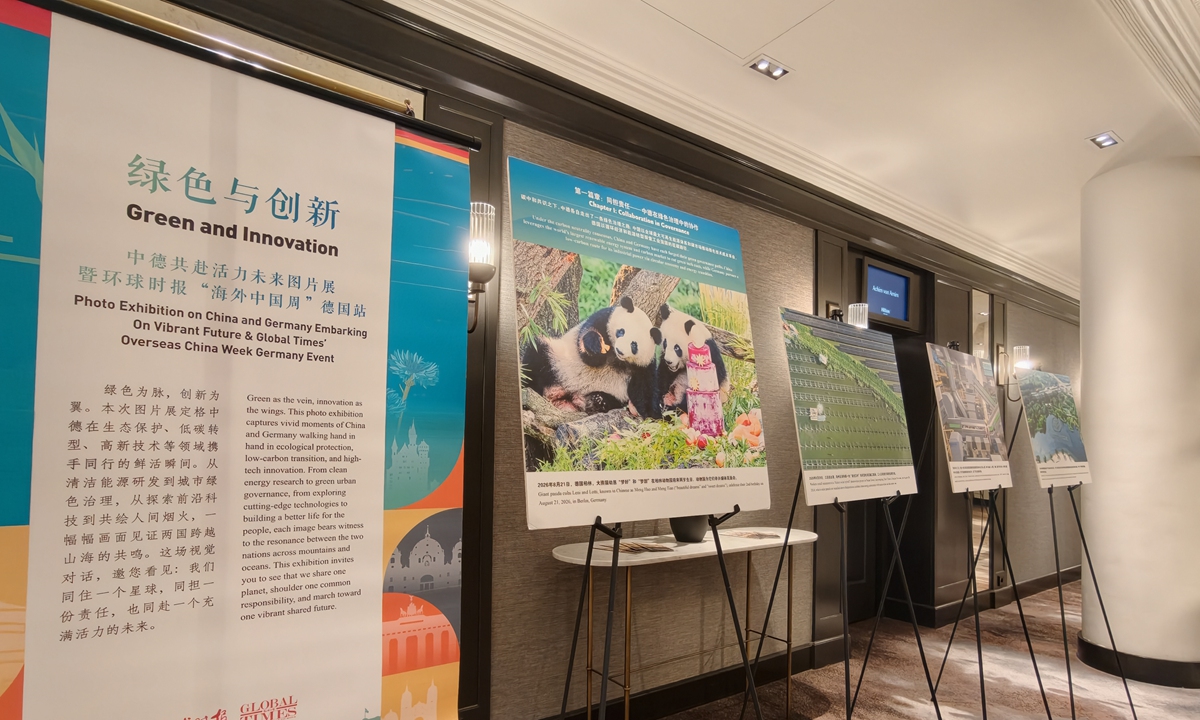
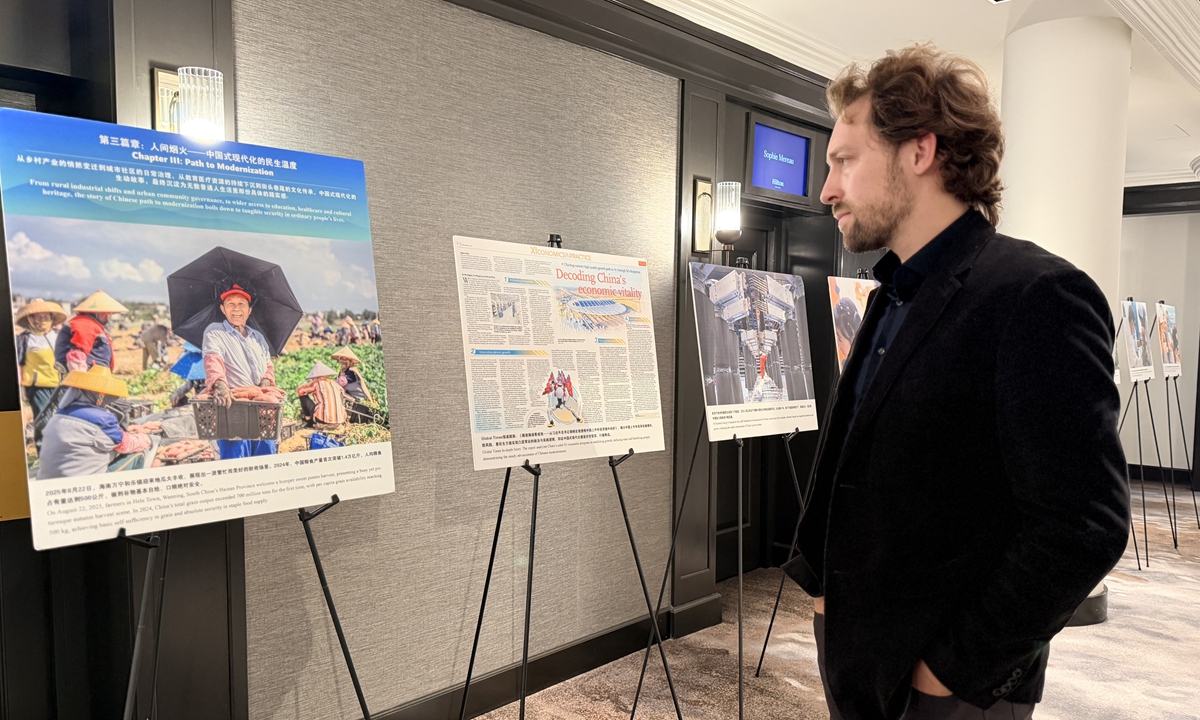
The Green and Innovation: China and Germany Embark on a Vibrant Future photo exhibition Photo: Hu Yuwei/GT
The photographs showed giant pandas from China, now settled in Germany, gathering around a birthday cake; solar panels stretching over fishponds in Lianyungang, East China's Jiangsu Province, where aquaculture and clean energy go hand in hand; and a robot from Shenzhen captivating crowds at a Berlin technology exhibition, with visitors eager to capture its every move.
These snapshots of China brought a series of compelling scenes to an exhibition hall in Heidelberg, Germany, inviting visitors to pause and take a closer look.
Held alongside the 17th Media Forum China-Germany from October 14 to 16, the photo exhibition, titled Green and Innovation: China and Germany Embark on a Vibrant Future, attracted visitors from both countries. From green development and technological innovation to urban construction and rural life, the photographs captured China's transformation through vivid, everyday scenes.
Some German visitors lingered in front of the display panels, leaning closer to examine the details. Others took out their phones to photograph the pictures that caught their eye. Some even returned to the exhibition after completing a first round, taking another look.
For visitors in Germany, the photographs offered both unfamiliar and familiar perspectives. What might seem unfamiliar was the speed of China's development and the scale at which certain technologies are being applied. What felt familiar were the questions behind the images: How can cities become more livable? How can energy consumption be reduced? How can technology genuinely improve people's lives? And how can countries find opportunities for cooperation in a changing world?
The exhibition sought to tell the story of a China that is not only accelerating the development of new technologies, but also exploring ways for people to live in greater harmony with nature, a country that is building modern cities while paying attention to the everyday lives of ordinary people.
Prior to the Heidelberg event, the Global Times' "Overseas China Week" had been held in Kyrgyzstan, South Africa, South Korea, Brazil, Argentina, Kazakhstan and other countries. Using photography as a medium, it shares China's development stories with the world, conveys China's openness, and builds a bridge for closer people-to-people ties between China and global communities.
This "Overseas China Week" event also displayed a series of Global Times feature reports on the Chinese President's important thoughts, including the special series "Decoding the Book Xi Jinping: The Governance of China," as well as multimedia coverage of practical cooperation between China and Germany and between China and Europe.
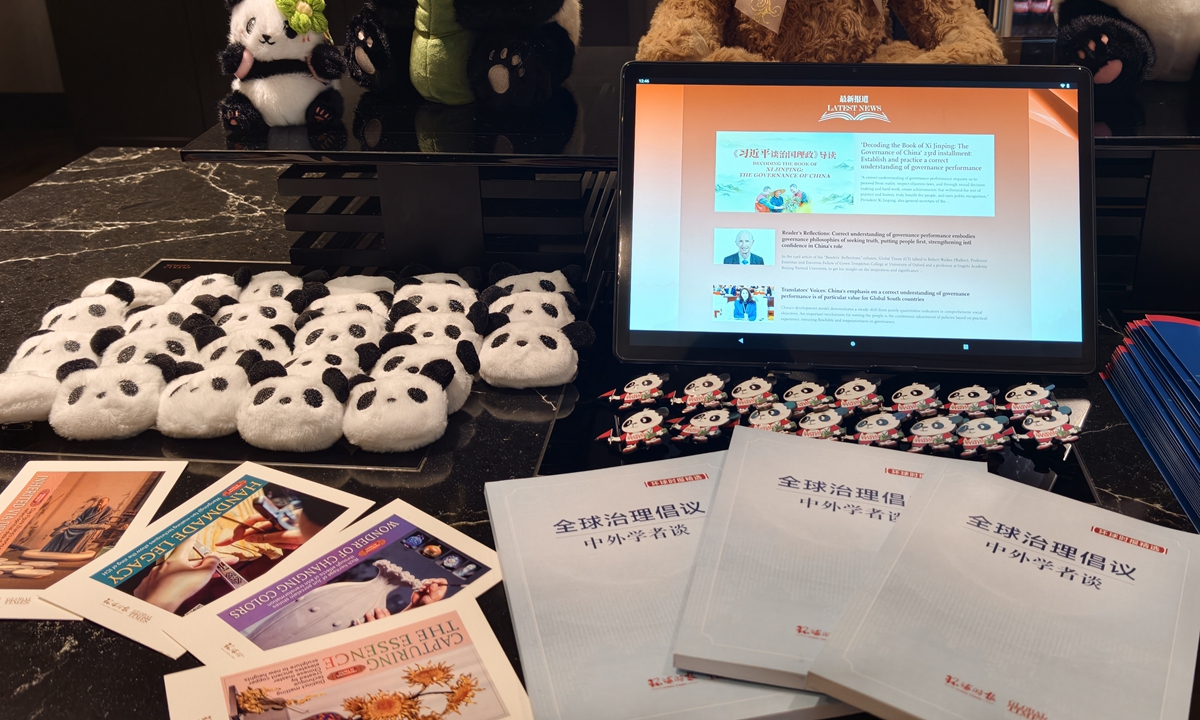
Creative cultural products and multimedia reports by the Global Times on display at the exhibition Photo: Hu Yuwei/GT
Addressing challenges in green transition
In the exhibition's chapter one "Collaboration in Governance," a fishery-solar hybrid project in Lianyungang stood out for its connection to everyday life.
Rows of solar panels were installed above fishponds, allowing aquaculture to continue below. In another photograph, a fish farmer smiled as he held up freshly harvested freshwater fish, with an expansive stretch of water behind him. The two images documented different stages of the project, from equipment installation to the fish harvest, bringing clean energy and traditional aquaculture into the same frame.
During his visit, Carsten Senz, vice president of corporate communications at Huawei Technologies (Germany), shared his observations of similar scenes when he visited China before. He noted that in some solar power projects, sheep can graze beneath the panels, which provide shade from the sun. Such arrangements create connections between land use, clean energy production and livestock farming.
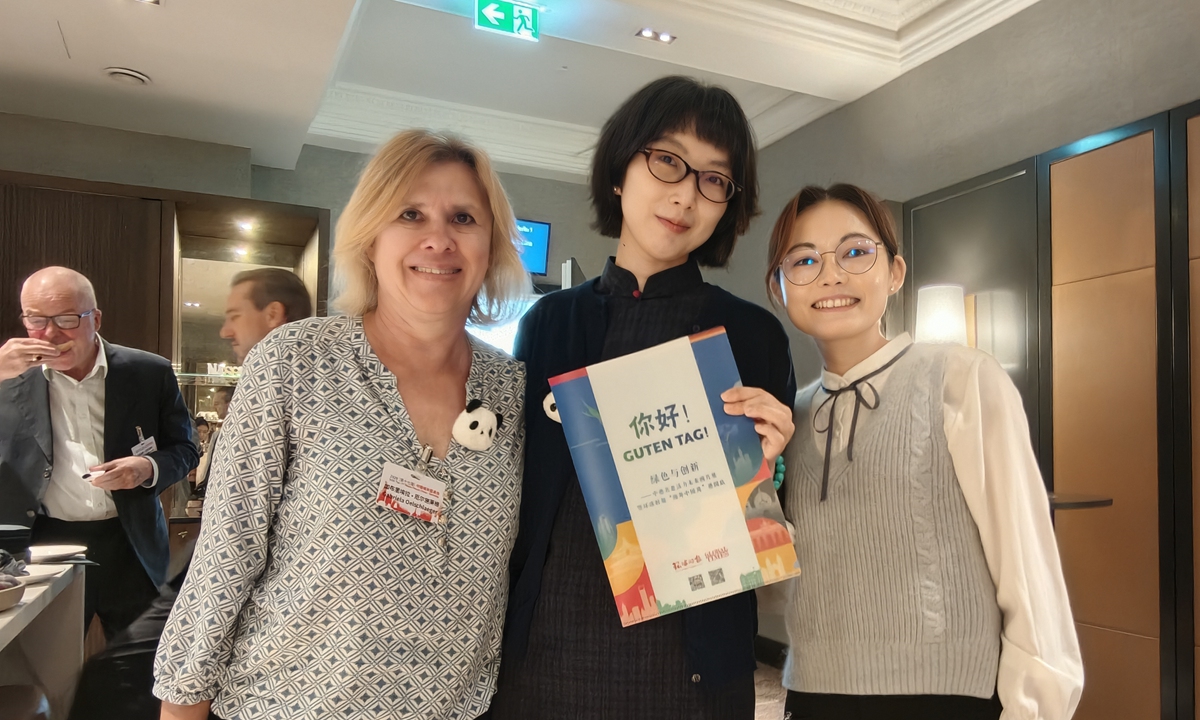
Guests show creative cultural products at the exhibition. Photo: Hu Yuwei/GT
For German visitors, these Chinese experiments offered a practical idea: with careful planning, solar power generation can coexist with fish farming and livestock raising, allowing energy production and traditional industries to share the same space.
Another photograph took visitors to a green, digitally enabled waste-sorting center in Hangzhou, East China's Zhejiang Province. Conveyor belts, sorting equipment and electronic screens formed a modern waste-recycling operation. The facility combines large AI models with fleets of robots and can sort recyclable materials with an accuracy rate of more than 99 percent before sending them to downstream companies for recycling and reuse.
The use of technology to transform resource recovery was also one of the aspects of the exhibition that left a strong impression on Heidelberg mayor Dr Eckart Würzner.
He cited Heidelberg's Bahnstadt district as an example of how passive house buildings can reduce energy consumption for heating and cooling through better insulation, improved airtightness in windows and doors, and architectural designs that minimize heat loss. Würzner told the Global Times that Heidelberg hoped to move toward climate neutrality through such urban development practices.
He also spoke about exchanges between China and Germany on technologies such as triple-glazed windows and gas-filled glazing. Chinese companies subsequently applied related technologies in production. In his view, the value of technological exchange lies not merely in introducing a product, but in translating the experience accumulated in different countries into practical applications. A guest visits the photo exhibition. Photo: Cao Siqi/GT
From technological innovation to everyday life
At IFA Berlin 2026, held in September, a robot developed by Shenzhen-based EngineAI interacted enthusiastically with visitors. The exhibition featured a photograph of people gathering around the robot: some were filming with their phones, while others leaned forward to observe it, creating a scene filled with curiosity about the interaction between humans and machines.
A veteran German business journalist told the Global Times that robots were no longer merely technological concepts confined to laboratories. They were becoming products that appeared at exhibitions and interacted directly with the public. The journalist said the photograph gave her a sense of the "warmth" and "hope" that emerge as machines become part of human life.
Similar discussions arose beside another photograph in the exhibition's second chapter "Driven by Innovation."
In September 2026, an electric bus made by Chinese automaker BYD served as an official shuttle at the 72nd IAA Transportation trade fair in Hanover, Germany. For German visitors, this was hardly an unfamiliar scene. As Chinese new energy vehicles enter more overseas markets, the German public is increasingly likely to encounter Chinese electric vehicles on the road.
The photograph naturally prompted discussion that extended beyond a single shuttle bus to electric mobility, the energy transition and the development of China's automotive industry.
Frank Sieren, a German columnist, author and veteran journalist who has covered China for major German media outlets, told the Global Times that the photographs might surprise many Germans because their existing perceptions of China did not necessarily encompass every aspect of the country's development.
He said the exhibition offered a broader perspective, allowing visitors to see what China was doing and better understand its development capabilities.
He stressed that understanding a country requires looking at its different facets rather than relying on a single, one-sided impression. A photo in the exhibition: A volunteer medical team from Shanghai, organized by the Red Cross Society of China, screens local children for congenital heart disease in Kashi, Northwest China's Xinjiang Uygur Autonomous Region, in May 2023.
Sieren's own impressions of Chinese cities echoed the exhibition's focus on modernization. He spoke particularly warmly of Xiong'an New Area, saying he liked the way it combined modern architecture with the natural environment, creating a good balance between the two.
In his view, Xiong'an's modernization was not simply about the size of the city or the height of its buildings. It addressed a question that ordinary people could readily understand: Can a city preserve natural spaces and provide a more comfortable living environment while developing rapidly?
The photographs of Xiong'an in the exhibition presented China's urban development from precisely this perspective. They showed waterways, green spaces and modern buildings interwoven in the urban landscape. Since China announced plans to establish the Xiong'an New Area in April 2017, the city has evolved from a blueprint into a vibrant city. This new area is designed to relieve functions that are non-essential to Beijing's role as the national capital and advance the coordinated development of the Beijing-Tianjin-Hebei region.
In the exhibition's third chapter "Path to Modernization," a photograph of a traditional culture class at a kindergarten in Lhasa, Southwest China's Xizang Autonomous Region, taken in 2023, turned visitors' attention to China's border regions.
The image came from an on-the-ground reporting trip by Global Times journalist Shan Jie. It captured the sincere, radiant smiles of Tibetan children, a scene that moved visitors at the exhibition.
Rather than relying on textual explanations, the photograph conveyed a picture of life in Xizang through an authentic everyday scene. It offered German audiences a glimpse of the region's development and the lives of its people, illustrating that modernization is not simply about the growth of macroeconomic indicators. It is also reflected in the smiles on people's faces and in the security, well-being and happiness that ordinary people can experience in their daily lives.

Understanding begins with seeing one another
For Chinese and German participants amid debates over geopolitics and international trade, the exhibition carried an additional significance.
Jörg Lau, an international affairs journalist at the German weekly newspaper Die Zeit, told the Global Times that amid disagreements over issues such as market access and trade practices, it was important to focus on areas where cooperation remained possible and explore new opportunities for collaboration.
The exhibition offered concrete examples that could help people "find a path toward a future characterized by greater cooperation," he said.
He also advised German media colleagues to "go to China and see for themselves," describing firsthand visits as one of the most direct and effective ways to understand a country.
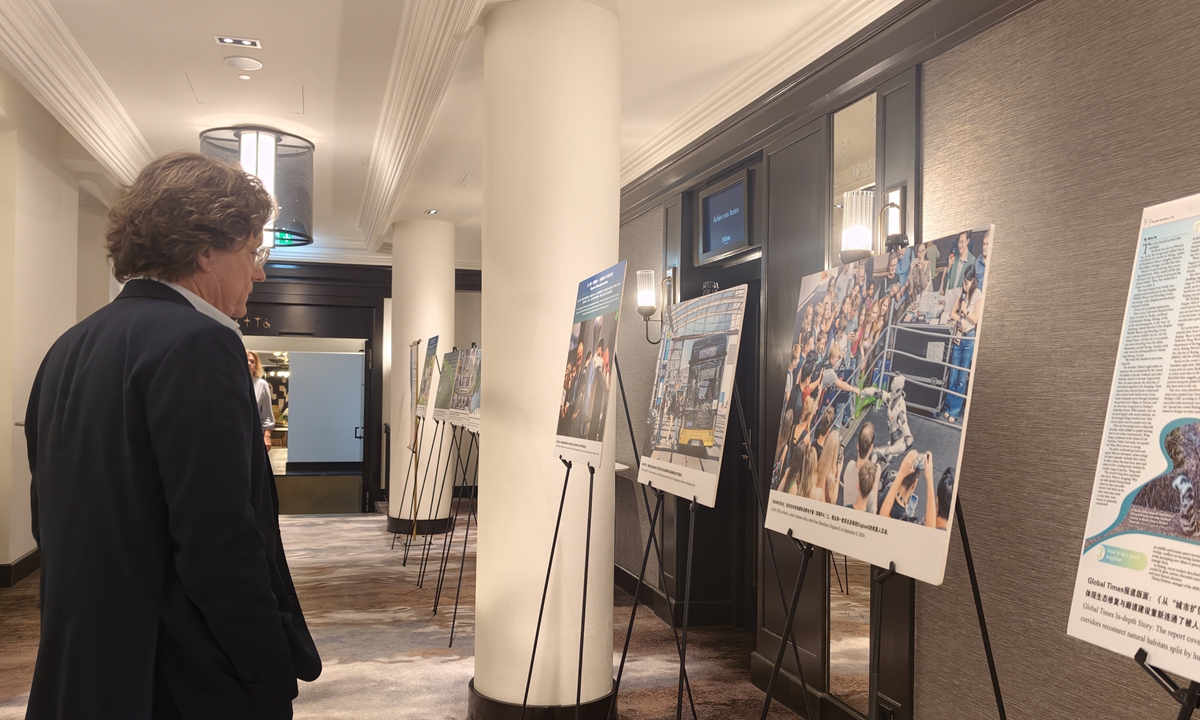
The Green and Innovation: China and Germany Embark on a Vibrant Future photo exhibition Photo: Hu Yuwei/GT
This helps explain why the exhibition began with concrete scenes. When visitors see industries continuing beneath solar panels, green spaces preserved in modern cities, children learning traditional culture and musicians performing together on stage, China becomes more than an abstract label associated with "great-power competition," a "technology race" or a "trade rival."
It becomes a place of cities, technologies and everyday jobs, inhabited by people with their own lives and genuine emotions.
The value of the photo exhibition in Heidelberg lies not in leading every visitor to exactly the same conclusions, but in offering concrete images that invite people to pause, observe, ask questions and exchange views.
When people from different countries recognize familiar challenges in these scenes while discovering the different ways others are addressing them, a starting point for mutual understanding begins to emerge.
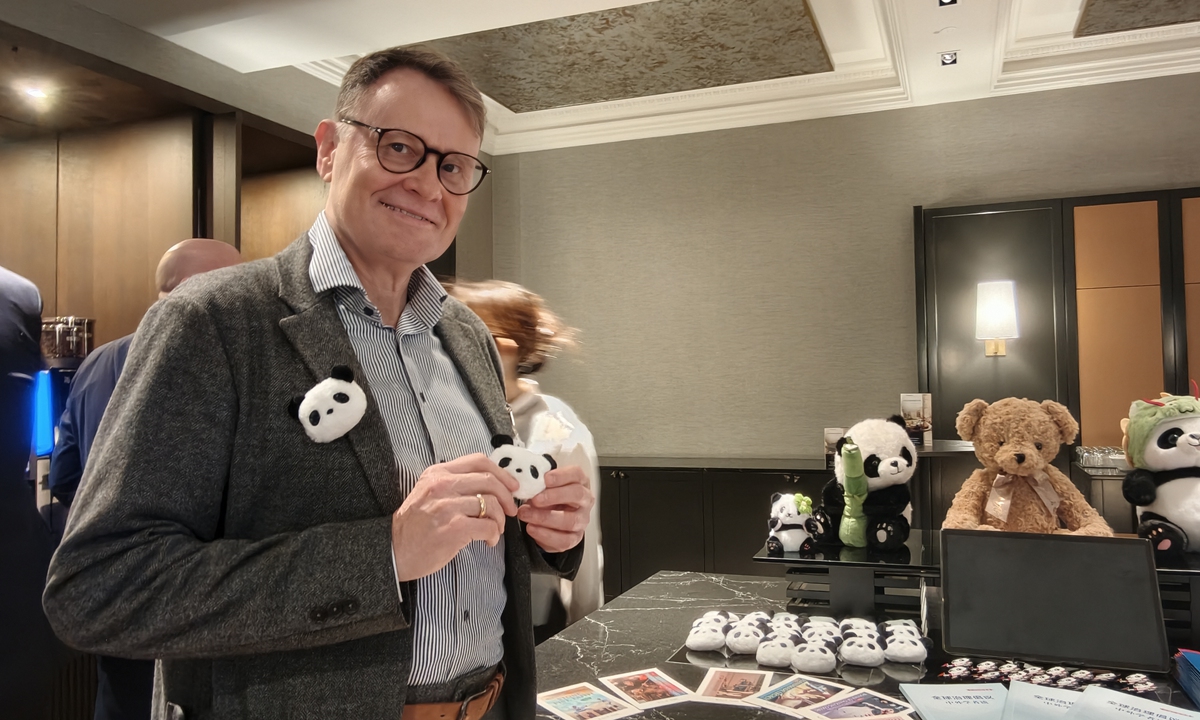
Jörg Lau, international correspondent for German media Die Zeit, visits the photo exhibition and tries the panda brooch. Photo: Hu Yuwei/GT