Financial Street Forum highlights openness, win-win cooperation to advance high-quality BRI development

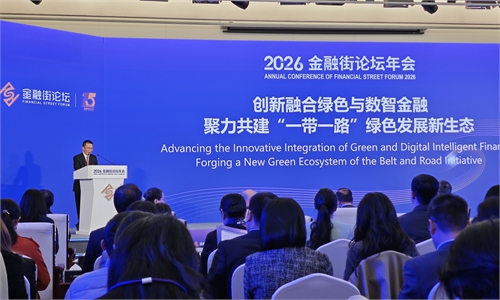
Annual Conference of Financial Street Forum (FSF) 2026 in Beijing on October 20, 2026 Photo: Yin Yeping/GT
Chinese and foreign government officials and industry representatives highlighted the importance of openness, win-win cooperation and financial innovation in advancing high-quality Belt and Road Initiative (BRI) development at a parallel forum of the Annual Conference of Financial Street Forum 2026 in Beijing on Wednesday, calling for stronger international cooperation to expand investment and financing opportunities.
Under the theme "Upholding Openness and Win-Win Cooperation to Foster New Dynamism for High Quality Belt and Road Cooperation," the forum, co-organized by the Export-Import Bank of China (CEXIM), brought together representatives from China and BRI partner countries to discuss infrastructure connectivity, sustainable financing and new opportunities for economic cooperation.
As a major financial institution supporting the BRI, CEXIM has extended more than 7 trillion yuan ($1.04 trillion) in loans to support the initiative over the past decade, with operations covering more than 130 partner countries, Chen Huaiyu, chairperson of the bank, said at the forum.
Chen said that the bank has continued to promote financial innovation and cooperation, including establishing a 30-billion-yuan special financing quota for China-Europe freight trains and creating the market's first basket of panda bonds involving BRI partner countries.
The bank has also explored diversified cooperation models with institutions including the New Development Bank and the World Bank to amplify the impact of financing, he said.
The growing economic ties between China and BRI partner countries have also been reflected in Beijing's expanding trade with these markets.
Vice Mayor of Beijing Tang Wenhong said that the Beijing has actively explored international markets under the initiative and launched its first freight train service to Central Asia.
In 2025, Beijing's total trade reached 3.19 trillion yuan, of which trade with BRI partner countries accounted for 1.93 trillion yuan, or 60.4 percent of the total, according to Tang.
While Chinese officials highlighted progress in financial support and trade connectivity, representatives from African countries emphasized the need for more diversified and sustainable financing to translate infrastructure investment into long-term economic development.
Kenya's Cabinet Secretary for the National Treasury and Economic Planning John Mbadi Ng'ongo said in remarks delivered from a satellite venue that the BRI has emerged as an important framework for strengthening connectivity, facilitating trade and investment, and expanding access to development finance.
For Kenya, infrastructure remains a key pillar of its national development agenda, with investment needed in the transport, energy, water, information and communication technology, and other critical sectors.
Achieving these objectives requires strong partnerships and access to adequate, affordable and sustainable financing, Mbadi said.
He welcomed growing collaboration among African countries, China, multilateral development institutions and the private sector in mobilizing resources for major development projects, noting that such partnerships also provide opportunities for knowledge sharing, technology transfer, capacity building and deeper economic integration.
Echoing the call for stronger financial cooperation, Lesotho's Minister of Finance and Development Planning Retselisitsoe Matlanyane highlighted China's experience in gradually opening its financial system while strengthening domestic institutions, saying that it offers lessons for African countries seeking to expand financial inclusion and access to capital.
On cooperation under the BRI, she said that the initiative has provided an important platform for strengthening connectivity, expanding economic cooperation and developing trade corridors. Such cooperation should be aligned with national development priorities and deliver tangible benefits to local communities, she added.
At Wednesday's forum, CEXIM signed cooperation agreements with international financial institutions and enterprises, covering financial cooperation, industrial development and overseas investment.
The growing emphasis on financial cooperation under the BRI reflects a shift toward more diversified and sustainable financing models, particularly as partner countries seek to address infrastructure gaps and support long-term economic growth, Hu Qimu, professor at the Maritime Silk Road Institute of Huaqiao University, told the Global Times on Wednesday.
The expert said that closer cooperation among Chinese financial institutions, multilateral development banks and local partners could help mobilize more capital, share investment risks and improve the efficiency of project financing. Such cooperation could also help translate infrastructure connectivity into tangible economic benefits by facilitating trade, attracting investment and creating local jobs, the expert noted.
RELATED ARTICLES