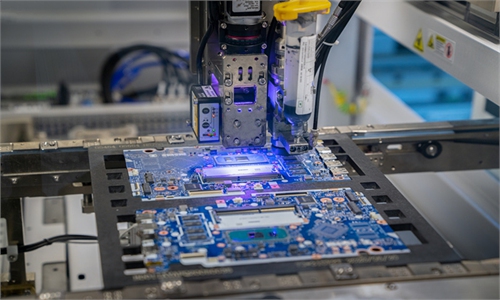
An AI-generated image of a chip Photo: VCG
While Japan is in the midst of a major push to revive its chip sector, it is being pressed to build America's, Reuters reported on Tuesday.
The report comes after news that Japan will invest up to $21 billion to build two chip factories in New York state that will be jointly owned by the US government and Japanese interests and operated by GlobalFoundries. It is part of a pledge to invest $550 billion in the US made with the Trump administration in return for lower tariffs.
While the investment appears to be a deepening of the US-Japan alliance, it is actually a costly drain on Japan's reboot of its semiconductor sector.
Some may believe that investment in the US and domestic investment can be compatible, and they will both benefit Japanese equipment manufacturers. But the bilateral agreement reached in 2025 already showed that the US is the side that could benefit significantly from Japan's investment. Japan's investment projects will be selected and managed by the US, and cash flows generated by the investments are to be split equally until Japan recoups its "deemed allocation amount," after which 90 percent of the cash flow will go to the US.
This arrangement means Japan is putting up its capital to build up America's domestic chip production capacity, only to end up with meager returns. Some have already pointed out that this kind of investment is essentially a "tax" in exchange for lower tariffs for Japanese exports to the US. This is the core reality that should not be overlooked: in Washington's calculation, the industrial capabilities of its allies are resources to be mobilized and made to bear the costs of America's own industrial priorities.
The so-called "Chip Alliance" - publicly framed as a collective effort to safeguard global supply chain security - is in essence a mechanism that pulls the fiscal resources of US allies directly into Washington's industrial policy toolbox. The allies pay the bills, the US builds the factories, and the production capacity and decision-making power remain in American hands. Japan has long imagined that it is deepening its alliance and guaranteeing its own security, but in reality it is subsidizing America's manufacturing reshoring campaign.
To be fair, the GlobalFoundries deal alone does not prove that Japan's semiconductor revival will fail. Japan has not abandoned its domestic semiconductor ambitions, with projects including its flagship chip-sector project Rapidus still moving forward. The Japanese government pledges to roll out subsidies to support local advanced process research and development. The crux of the problem, however, is whether Japan's fiscal situation can possibly bear the burden of both massive US-bound investment and its own domestic semiconductor revival at the same time. Japan's government debt-to-GDP ratio ranks the highest among all developed economies.
The Takaichi government has ambitions to pour public-private investment totaling some $2.3 trillion through fiscal 2040 across 17 strategic Japanese sectors, including artificial intelligence and chips. The $550 billion investment commitment in the US is no small sum either. As more resources are funneled into American investment, how much is left for domestic plans becomes a real constraint. Investing in the US and reviving capabilities at home are not mutually exclusive, but whether Japan's finances can sustain both is an open question.
Japan once sought to leverage the US-Japan alliance and draw on American supply chain resources to nurture its own domestic semiconductor capacity, with the ultimate aim of reviving its chip industry. But the GlobalFoundries project has laid bare the flaw in that thinking. The more Japan pours into the US, the more fragile its domestic semiconductor industry becomes, and the more its place in the global chip chain is locked into that of a supporting supplier to American industry. If Japan cannot wake up from the illusion that clinging to the US can revive its industry, the only outcome waiting for it is the wholesale hollowing out of its domestic semiconductor industry.
RELATED ARTICLES